



Association of Census Tract-Level Socioeconomic Status with Disparities in Prostate Cancer-Specific Survival
Supporting Files

-
10 2011 ; 10-2011
-
Available in CDC Stacks on October 01, 2012, 12:00 AM
File Language:
English
Details
-
Alternative Title:Cancer Epidemiol Biomarkers Prev
-
Personal Author:
-
Description:Background
Social determinants of prostate cancer survival and their relation to racial/ethnic disparities thereof are poorly understood. We analyzed whether census tract-level socioeconomic status (SES) at diagnosis is a prognostic factor in men with prostate cancer and helps explain racial/ethnic disparities in survival.
Methods
We used a retrospective cohort of 833 African-American and white, non-Hispanic men diagnosed with prostate cancer at four Chicago-area medical centers between 1986 and 1990. Tract-level concentrated disadvantage (CD), a multi-dimensional area-based measure of SES, was calculated for each case using 1990 U.S. census data. Its association with prostate cancer-specific survival was measured using Cox proportional hazard models adjusted for case and tumor characteristics, treatment, and healthcare system (private sector vs. Veterans Administration VA).
Results
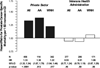
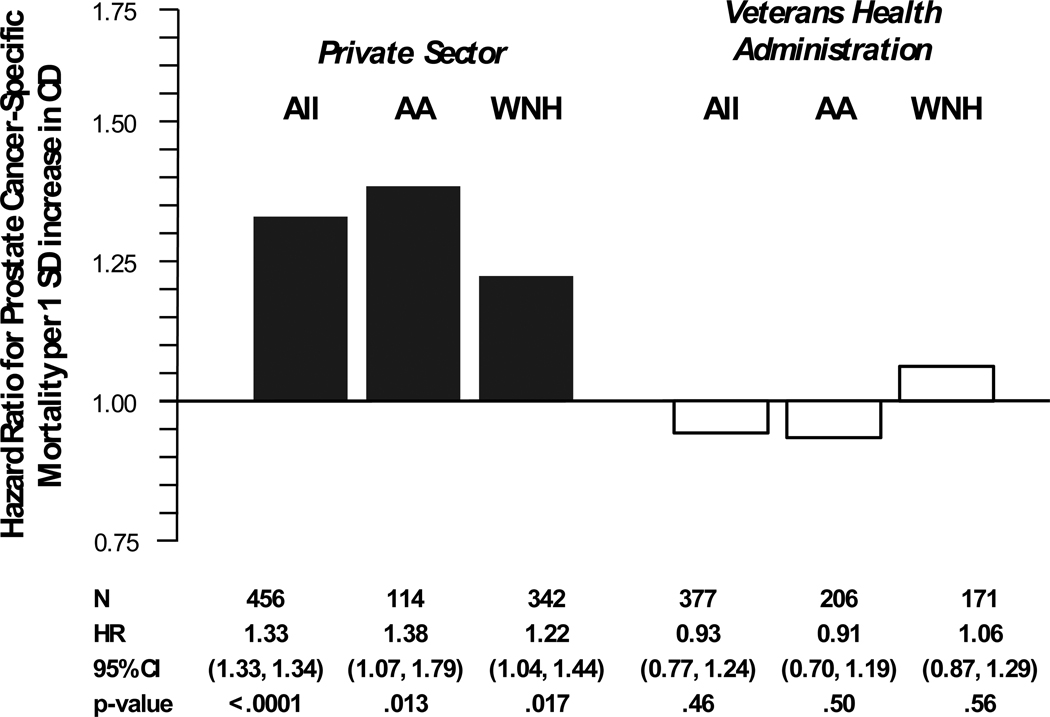
Tract-level CD associated with an increased risk of death from prostate cancer (highest vs. lowest quartile, hazard ratio HR = 2.37, p < .0001). However, the association was observed in the private sector and not in the VA (per 1 standard deviation SD increase, HR = 1.33, p < .0001 and HR = 0.93, p = .46, respectively). The multivariate HR for African Americans before and after accounting for tract-level CD was 1.30 (p = .0036) and 0.96 (p = .82), respectively.
Conclusion
Census tract-level SES is a social determinant of prostate-specific mortality and helps account for racial/ethnic disparities in survival. An equal-access healthcare system may moderate this association.
Impact
This study identifies a potential pathway for minimizing disparities in prostate cancer control. The findings need confirmation in a population-based study. -
Keywords:
-
Source:Cancer Epidemiol Biomarkers Prev. 20(10):2150-2159
-
Pubmed ID:21784953
-
Pubmed Central ID:PMC3189295
-
Document Type:
-
Funding:P60 MD003424/MD/NIMHD NIH HHSUnited States/ ; P50CA106743/CA/NCI NIH HHSUnited States/ ; R18 DP001140/DP/NCCDPHP CDC HHSUnited States/ ; R01 CA116750/CA/NCI NIH HHSUnited States/ ; R01CA129140/CA/NCI NIH HHSUnited States/ ; P20 MD001816/MD/NIMHD NIH HHSUnited States/ ; R18DP001140/DP/NCCDPHP CDC HHSUnited States/ ; R01 CA129140/CA/NCI NIH HHSUnited States/ ; R01 AG023424/AG/NIA NIH HHSUnited States/ ; P50 CA106743/CA/NCI NIH HHSUnited States/ ; P60MD003424/MD/NIMHD NIH HHSUnited States/ ; P50 CA106743-02S1/CA/NCI NIH HHSUnited States/ ; AG023424/AG/NIA NIH HHSUnited States/
-
Volume:20
-
Issue:10
-
Download URL:
-
File Type:
 [PDF - 360.07 KB]
 -
Collection(s):
-
Main Document Checksum:urn:sha256:d4977bf13b8fee1940e9f58754c9013832e5921b2fd200fb8d2b1abcc1c082f1
Supporting Files


File Language:
English
 Was this page helpful?
 Found an issue?


CDC STACKS serves as an archival repository of CDC-published products including
scientific findings, journal articles, guidelines, recommendations, or other public health information authored or
co-authored by CDC or funded partners.
As a repository, CDC STACKS retains documents in their original published format to ensure public access to scientific information.
As a repository, CDC STACKS retains documents in their original published format to ensure public access to scientific information.
You May Also Like
COLLECTION
CDC Public Access