


Capsule Typing of Haemophilus influenzae by Matrix-Assisted Laser Desorption/Ionization Time-of-Flight Mass Spectrometry1
Supporting Files
Public Domain

-
Mar 2018
-
File Language:
English
Details
-
Alternative Title:Emerg Infect Dis
-
Personal Author:
-
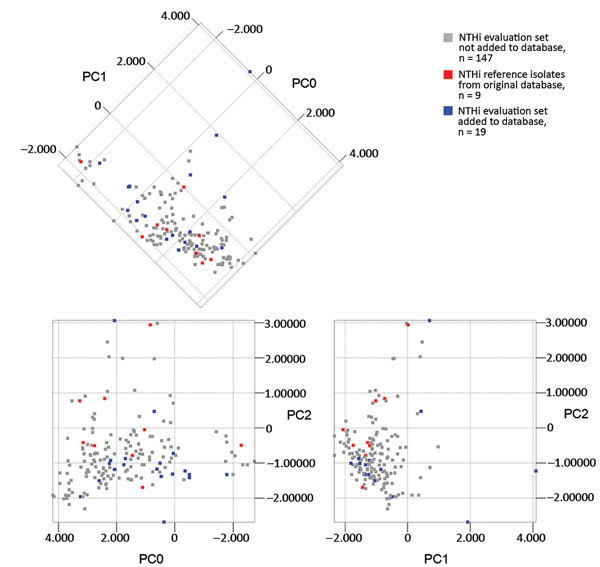
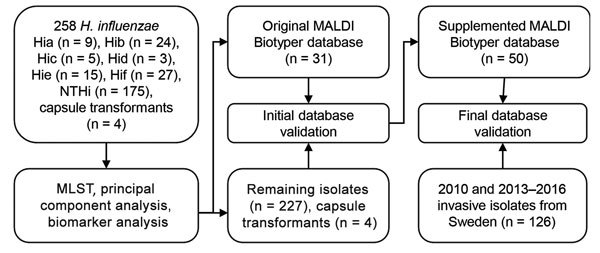
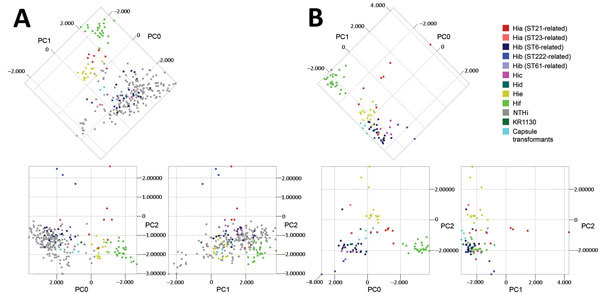
Description:Encapsulated Haemophilus influenzae strains belong to type-specific genetic lineages. Reliable capsule typing requires PCR, but a more efficient method would be useful. We evaluated capsule typing by using matrix-assisted laser desorption/ionization time-of-flight (MALDI-TOF) mass spectrometry. Isolates of all capsule types (a-f and nontypeable; n = 258) and isogenic capsule transformants (types a-d) were investigated. Principal component and biomarker analyses of mass spectra showed clustering, and mass peaks correlated with capsule type-specific genetic lineages. We used 31 selected isolates to construct a capsule typing database. Validation with the remaining isolates (n = 227) showed 100% sensitivity and 92.2% specificity for encapsulated strains (a-f; n = 61). Blinded validation of a supplemented database (n = 50) using clinical isolates (n = 126) showed 100% sensitivity and 100% specificity for encapsulated strains (b, e, and f; n = 28). MALDI-TOF mass spectrometry is an accurate method for capsule typing of H. influenzae.
-
Subjects:
-
Source:Emerg Infect Dis. 24(3):443-452.
-
Pubmed ID:29460728
-
Pubmed Central ID:PMC5823330
-
Document Type:
-
Volume:24
-
Issue:3
-
Collection(s):
-
Main Document Checksum:urn:sha256:770c30cd3e5ac0aa77bca0cc05aecd7664a1b179d14d4f618b3abdb3bd7da769
-
Download URL:
-
File Type:
 [PDF
- 2.06 MB
]
[PDF
- 2.06 MB
]
Supporting Files


File Language:
English
ON THIS PAGE





CDC STACKS serves as an archival repository of CDC-published products including
scientific findings,
journal articles, guidelines, recommendations, or other public health information authored or
co-authored by CDC or funded partners.
As a repository, CDC STACKS retains documents in their original published format to ensure public access to scientific information.
As a repository, CDC STACKS retains documents in their original published format to ensure public access to scientific information.
You May Also Like
COLLECTION
Emerging Infectious Diseases