



Use of Pristinamycin for Macrolide-Resistant Mycoplasma genitalium Infection
Supporting Files
Public Domain

-
2018/02/01
File Language:
English
Details
-
Alternative Title:Emerg Infect Dis
-
Personal Author:Read, Tim R.H. ; Jensen, Jørgen S. ; Fairley, Christopher K. ; Grant, Mieken ; Danielewski, Jennifer A. ; Su, Jenny ; Murray, Gerald L. ; Chow, Eric P.F. ; Worthington, Karen ; Garland, Suzanne M. ; Tabrizi, Sepehr N. ; Bradshaw, Catriona S.
-
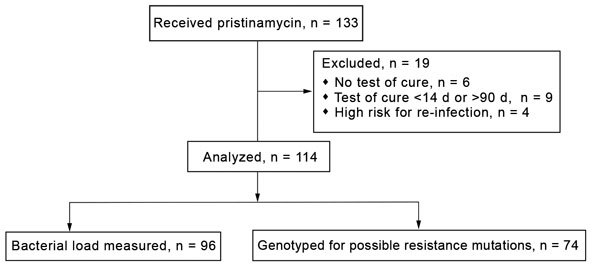
Description:High levels of macrolide resistance and increasing fluoroquinolone resistance are found in Mycoplasma genitalium in many countries. We evaluated pristinamycin for macrolide-resistant M. genitalium in a sexual health center in Australia. Microbiologic cure was determined by M. genitalium-specific 16S PCR 14-90 days after treatment began. Of 114 persons treated with pristinamycin, infection was cured in 85 (75%). This percentage did not change when pristinamycin was given at daily doses of 2 g or 4 g or at 3 g combined with 200 mg doxycycline. In infections with higher pretreatment bacterial load, treatment was twice as likely to fail for each 1 log10 increase in bacterial load. Gastrointestinal side effects occurred in 7% of patients. Pristinamycin at maximum oral dose, or combined with doxycycline, cured 75% of macrolide-resistant M. genitalium infections. Pristinamycin is well-tolerated and remains an option where fluoroquinolones have failed or cannot be used.
-
Subjects:
- Adult
- Anti-Bacterial Agents
- Anti-Bacterial Agents / pharmacology
- Drug Resistance, Multiple, Bacterial
- Female
- Humans
- Macrolides
- Macrolides / pharmacology
- Male
- Mycoplasma genitalium
- Mycoplasma genitalium / drug effects
- Mycoplasma genitalium / genetics
- Mycoplasma Infections
- Mycoplasma Infections / drug therapy
- Mycoplasma Infections / microbiology
- Pristinamycin
- Pristinamycin / therapeutic use
-
Source:Emerg Infect Dis. 24(2):328-335.
-
Pubmed ID:29350154
-
Pubmed Central ID:PMC5782881
-
Document Type:
-
Genre:
-
Volume:24
-
Issue:2
-
Download URL:
-
File Type:
 [PDF - 623.04 KB]
 -
Collection(s):
-
Main Document Checksum:urn:sha-512:14b9a2b7f0393d547bca3fa4bfb7e65eb532a4a002d0400cd46f3efdfcc211a297d971b1bbcfae7a4daa3a047fa665ad2021be1efdde13b121c2b9db6f7697fe
Supporting Files


File Language:
English
 Was this page helpful?
 Found an issue?



CDC STACKS serves as an archival repository of CDC-published products including
scientific findings, journal articles, guidelines, recommendations, or other public health information authored or
co-authored by CDC or funded partners.
As a repository, CDC STACKS retains documents in their original published format to ensure public access to scientific information.
As a repository, CDC STACKS retains documents in their original published format to ensure public access to scientific information.
You May Also Like
COLLECTION
Emerging Infectious Diseases