


Time to Second-line Treatment and Subsequent Relative Survival in Older Patients With Relapsed Chronic Lymphocytic Leukemia/Small Lymphocytic Lymphoma
Supporting Files

-
Jul 19 2017
-
File Language:
English
Details
-
Alternative Title:Clin Lymphoma Myeloma Leuk
-
Personal Author:
-
Description:Background
Novel targeted therapies offer excellent short-term outcomes in patients with chronic lymphocytic leukemia and small lymphocytic lymphoma (CLL/SLL). However, there is disagreement over how widely these therapies should be used in place of standard chemo-immunotherapy (CIT). We investigated whether stratification on the length of the interval between first-line (T1) and second-line (T2) treatments could identify a subgroup of older patients with relapsed CLL/SLL with an expectation of normal overall survival, and for whom CIT could be an acceptable treatment choice.
Patients and Methods
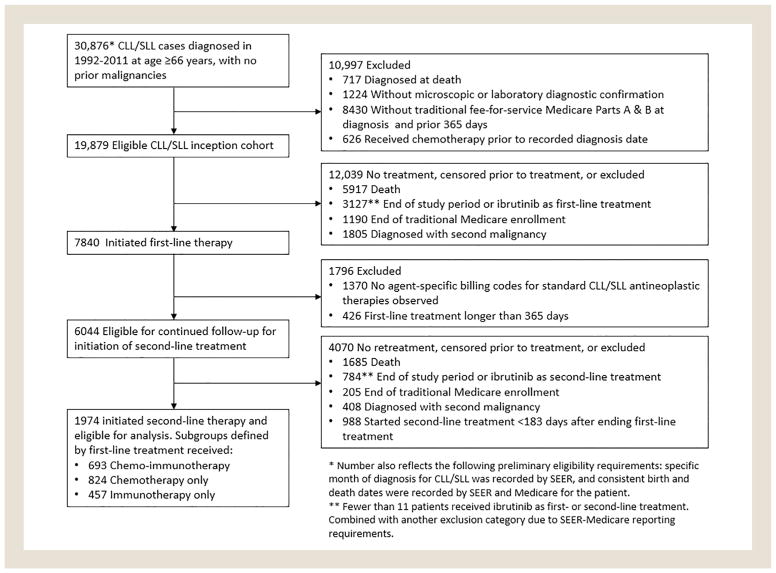
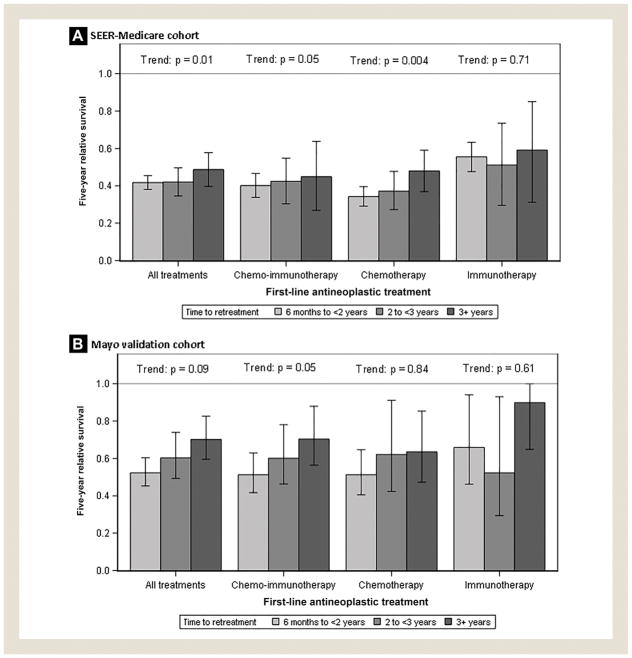
Patients with relapsed CLL/SLL who received T2 were identified from the SEER-Medicare Linked Database. Five-year relative survival (RS5; ie, the ratio of observed survival to expected survival based on population life tables) was assessed after stratifying patients on the interval between T1 and T2. We then validated our findings in the Mayo Clinic CLL Database.
Results
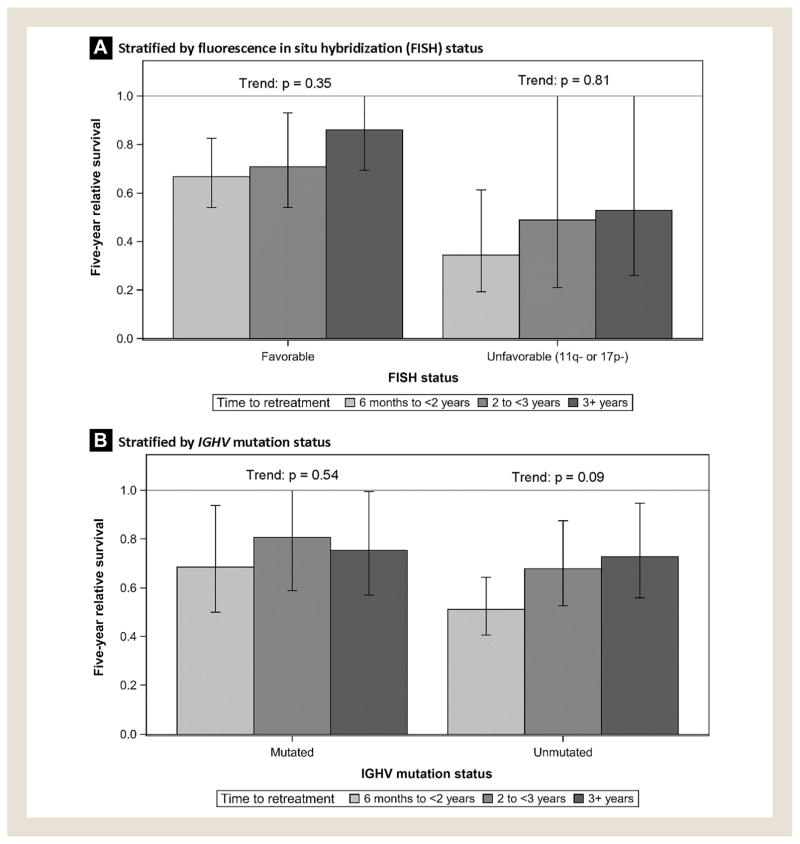
Among 1974 SEER-Medicare patients (median age = 77 years) who received T2 for relapsed CLL/SLL, longer time-to-retreatment was associated with a modestly improved prognosis (P = .01). However, even among those retreated ≥ 3 years after T1, survival was poor compared with the general population (RS5 = 0.50 or lower in SEER-Medicare). Similar patterns were observed in the younger Mayo validation cohort, although prognosis was better overall among the Mayo patients, and patients with favorable fluorescence in situ hybridization retreated ≥ 3 years after T1 had close to normal expected survival (RS5 = 0.87).
Conclusion
Further research is needed to quantify the degree to which targeted therapies provide meaningful improvements over CIT in long-term outcomes for older patients with relapsed CLL/SLL.
-
Subjects:
-
Source:Clin Lymphoma Myeloma Leuk. 17(12):e11-e25.
-
Pubmed ID:28802891
-
Pubmed Central ID:PMC5769450
-
Document Type:
-
Funding:HHSN261201000140C/CA/NCI NIH HHS/United States ; HHSN261201000035C/CA/NCI NIH HHS/United States ; P30 CA086862/CA/NCI NIH HHS/United States ; HHSN261201000035I/CA/NCI NIH HHS/United States ; HHSN261201000034C/CA/NCI NIH HHS/United States ; U58 DP003862/DP/NCCDPHP CDC HHS/United States ; P50 CA097274/CA/NCI NIH HHS/United States
-
Volume:17
-
Issue:12
-
Collection(s):
-
Main Document Checksum:urn:sha256:5e28685dcc004a9f30f275a20bd236113bc08422b797da5e94535c822f52bb5f
-
Download URL:
-
File Type:
 [PDF
- 697.42 KB
]
[PDF
- 697.42 KB
]
Supporting Files


File Language:
English
ON THIS PAGE


CDC STACKS serves as an archival repository of CDC-published products including
scientific findings,
journal articles, guidelines, recommendations, or other public health information authored or
co-authored by CDC or funded partners.
As a repository, CDC STACKS retains documents in their original published format to ensure public access to scientific information.
As a repository, CDC STACKS retains documents in their original published format to ensure public access to scientific information.
You May Also Like
COLLECTION
CDC Public Access