



Impact of Preexisting Mental Illness on Breast Cancer Endocrine Therapy Adherence
Supporting Files

-
2019/02/01
-
Available in CDC Stacks on February 01, 2020, 12:00 AM
File Language:
English
Details
-
Alternative Title:Breast Cancer Res Treat
-
Personal Author:
-
Description:Purpose:
Patients with estrogen receptor positive (ER+) breast cancer are often non-adherent to endocrine therapies, despite clear survival benefits. We utilized a nationally representative cancer cohort to examine the role of specific mental illnesses on endocrine therapy adherence.
Methods:
Using the SEER-Medicare database, we included 21,894 women aged 68+ at their first surgically treated stage I-IV ER+ breast cancer during 2007-2013. All had continuous fee-for-service Medicare Parts A and B for 36+ months before, 18+ months after diagnosis, and continuous Part D for 4+ months before, 18+ after diagnosis. Mental illness was defined as occurring in the 36 months prior to cancer onset. We analyzed endocrine therapy adherence, initiation, and discontinuation using longitudinal linear and Cox regression models.
Results:
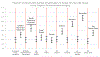
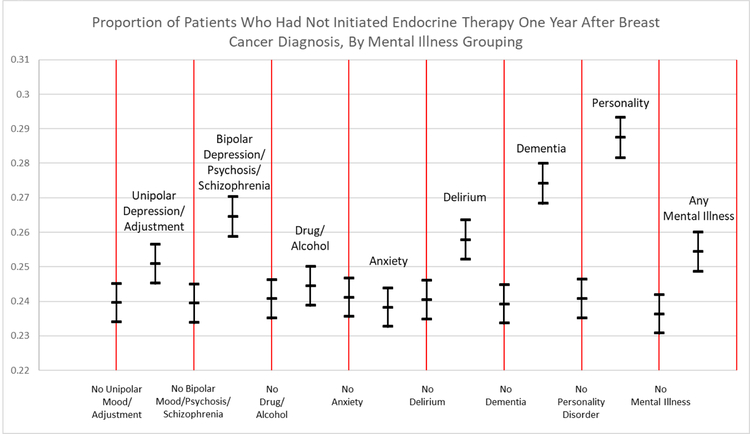
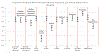
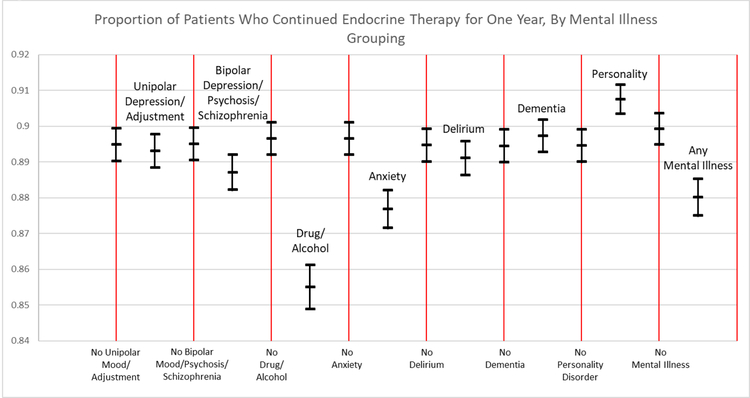
Unipolar depression (11.0%), anxiety (9.5%), non-schizophrenia psychosis (4.6%), and dementias (4.6%) were the most prevalent diagnoses. Endocrine therapies were initiated by 80.0% of women. Among those with at least one year of use, 28.0% were non-adherent (<0.80 adherence, mean=0.84) and 25.7% discontinued. Patients with dementia or bipolar depression/psychotic/schizophrenia disorders had lower adjusted initiation probabilities by year one of follow-up, versus those without these diagnoses 0.74 95% CI (0.73-0.74) and 0.73 (0.72-0.73), respectively, reference 0.76 (0.76-0.77). Patients with substance use or anxiety disorders less frequently continued endocrine therapy for at least one year, after adjustment, 0.85 95% CI (0.85-0.86) and 0.88 (0.87-0.88), respectively, reference 0.90 (0.89-0.90). Patients with substance use disorders had 2.3% lower adherence rates (p<0.001).
Conclusions:
Nearly one-quarter of female Medicare beneficiaries have diagnosed mental illness preceding invasive breast cancer. Those with certain mental illnesses have modestly reduced rates of initiation, adherence, and discontinuation and this may help define patients at higher risk of treatment abandonment. Overall, endocrine therapy adherence remains suboptimal, unnecessarily worsening recurrence and mortality risk. -
Keywords:
-
Source:Breast Cancer Res Treat. 174(1):197-208
-
Pubmed ID:30465157
-
Pubmed Central ID:PMC6426454
-
Document Type:
-
Funding:HHSN261201000140C/CA/NCI NIH HHSUnited States/ ; HHSN261201000035C/CA/NCI NIH HHSUnited States/ ; P30 CA086862/CA/NCI NIH HHSUnited States/ ; HHSN261201000035I/CA/NCI NIH HHSUnited States/ ; HHSN261201000034C/CA/NCI NIH HHSUnited States/ ; T32 GM007337/GM/NIGMS NIH HHSUnited States/ ; U58 DP003862/DP/NCCDPHP CDC HHSUnited States/
-
Genre:
-
Volume:174
-
Issue:1
-
Download URL:
-
File Type:
 [PDF - 393.77 KB]
 -
Collection(s):
-
Main Document Checksum:urn:sha-512:cca185e1e1ead3a8e581d623fe844d5b3536ff2c038ed2b25ef0f8b171e350a3130cea44d1954db3cec03b0a4233b145f53570e381f3d7d068ab326c0834d147
Supporting Files


File Language:
English
 Was this page helpful?
 Found an issue?

CDC STACKS serves as an archival repository of CDC-published products including
scientific findings, journal articles, guidelines, recommendations, or other public health information authored or
co-authored by CDC or funded partners.
As a repository, CDC STACKS retains documents in their original published format to ensure public access to scientific information.
As a repository, CDC STACKS retains documents in their original published format to ensure public access to scientific information.
You May Also Like
COLLECTION
CDC Public Access