



Profiling Cholinesterase Adduction: A High-Throughput Prioritization Method for Organophosphate Exposure Samples
Supporting Files

-
Aug 16 2013
-
Available in CDC Stacks on 2017-12-04T00:00:00Z
Details
-
Alternative Title:J Biomol Screen
-
Personal Author:
-
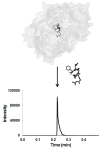
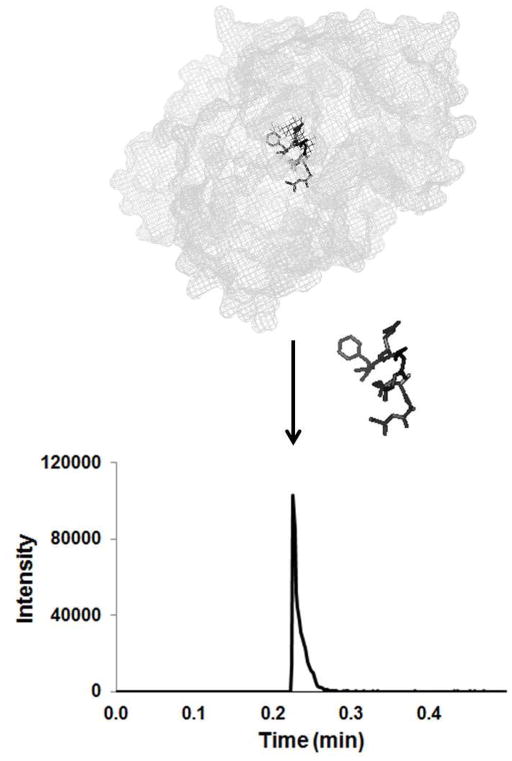
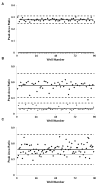
Description:A high-throughput prioritization method was developed for use with a validated confirmatory method detecting organophosphorus nerve agent exposure by immunomagnetic separation high-performance liquid chromatography tandem mass spectrometry. A ballistic gradient was incorporated into this analytical method to profile unadducted butyrylcholinesterase (BChE) in clinical samples. With Zhang et al.'s Z' factor of 0.88 ± 0.01 (SD) of control analytes and Z factor of 0.25 ± 0.06 (SD) of serum samples, the assay is rated an "excellent assay" for the synthetic peptide controls used and a "double assay" when used to prioritize clinical samples. Hits, defined as samples containing BChE Ser-198 adducts or no BChE present, were analyzed in a confirmatory method for identification and quantitation of the BChE adduct, if present. The ability to prioritize samples by highest exposure for confirmatory analysis is of particular importance in an exposure to cholinesterase inhibitors such as organophosphorus nerve agents, in which a large number of clinical samples may be collected. In an initial blind screen, 67 of 70 samples were accurately identified, giving an assay accuracy of 96%, and it yielded no false-negatives. The method is the first to provide a high-throughput prioritization assay for profiling adduction of Ser-198 BChE in clinical samples.
-
Subjects:
- Article
- butyrylcholinesterase
- high-throughput screening
- organophosphorus nerve agent
- cholinesterase inhibitors
- sample prioritization
- ballistic gradient
- Butyrylcholinesterase
- Cholinesterase Inhibitors
- Cholinesterases
- Chromatography, Liquid
- High-Throughput Screening Assays
- Humans
- Mass Spectrometry
- Organophosphorus Compounds
-
Source:J Biomol Screen. 19(2):325-330.
-
Pubmed ID:23954929
-
Pubmed Central ID:PMC5713889
-
Document Type:
-
Funding:
-
Volume:19
-
Issue:2
-
Download URL:
-
File Type:
 [PDF - 650.05 KB]
 -
Collection(s):
-
Main Document Checksum:urn:sha256:649dec78c73f1c9aa9e0d23587b506a9b55b1ca0c1895fe5c90f702c7fbc0ac9
Supporting Files


 Was this page helpful?
 Found an issue?



CDC STACKS serves as an archival repository of CDC-published products including
scientific findings, journal articles, guidelines, recommendations, or other public health information authored or
co-authored by CDC or funded partners.
As a repository, CDC STACKS retains documents in their original published format to ensure public access to scientific information.
As a repository, CDC STACKS retains documents in their original published format to ensure public access to scientific information.
You May Also Like
COLLECTION
CDC Public Access