


Acute Hepatitis B Outbreaks in Two Skilled Nursing Facilities and Possible Sources of Transmission — North Carolina, 2009–2010
Supporting Files

-
May 16 2013
-
Details
-
Alternative Title:Infect Control Hosp Epidemiol
-
Personal Author:
-
Description:Objectives
Acute hepatitis B virus (HBV) infections have been reported in long-term care facilities (LTCFs) primarily associated with infection control breaks during assisted blood glucose monitoring. We investigated HBV outbreaks that occurred in separate skilled nursing facilities (SNFs) to determine factors associated with transmission.
Design
Outbreak investigation with case-control studies.
Setting
Two SNFs (Facility A and B) in Durham, North Carolina during 2009–2010.
Patients
Residents with acute HBV infection and controls randomly selected from HBV-susceptible residents during the outbreak period.
Methods
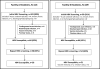
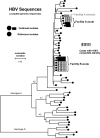
After initial cases were identified, screening was offered to all residents with repeat testing three months later for HBV-susceptible residents. Molecular testing was performed to assess viral relatedness. Infection control practices were observed. Case-control studies were conducted to evaluate associations between exposures and acute HBV infection in each facility.
Results
Six acute HBV cases were identified in each SNF. Viral phylogenetic analysis revealed a high degree of HBV relatedness within, but not between, facilities. No evaluated exposures were significantly associated with acute HBV infection in Facility A; those associated with infection in Facility B (all odds ratios>20) included injections, hospital or emergency room visits, and daily blood glucose monitoring. Observations revealed absence of trained infection control staff at Facility A, and suboptimal hand hygiene practices during blood glucose monitoring and insulin injections at Facility B.
Conclusions
These outbreaks underscore the vulnerability of LTCF residents to acute HBV infection, the importance of surveillance and prompt investigation of incident cases, and the need for improved infection control education to prevent transmission.
-
Subjects:
-
Source:Infect Control Hosp Epidemiol. 34(7):709-716.
-
Pubmed ID:23739075
-
Pubmed Central ID:PMC5675526
-
Document Type:
-
Funding:
-
Place as Subject:
-
Volume:34
-
Issue:7
-
Collection(s):
-
Main Document Checksum:urn:sha256:c0dde902b786ae8ee692f04654e068b2aa3e5459f25eda576dde0d4e5fb37cd9
-
Download URL:
-
File Type:
 [PDF
- 627.34 KB
]
[PDF
- 627.34 KB
]
Supporting Files


ON THIS PAGE



CDC STACKS serves as an archival repository of CDC-published products including
scientific findings,
journal articles, guidelines, recommendations, or other public health information authored or
co-authored by CDC or funded partners.
As a repository, CDC STACKS retains documents in their original published format to ensure public access to scientific information.
As a repository, CDC STACKS retains documents in their original published format to ensure public access to scientific information.
You May Also Like
COLLECTION
CDC Public Access