



Trends in Prevalence of Protective Levels of Hepatitis B Surface Antibody Among Adults Aged 18-49 Years With Risk Factors for Hepatitis B Virus Infection-United States, 2003-2014
Supporting Files

-
2020/04/15
-
Available in CDC Stacks on 2020-08-20T00:00:00Z
File Language:
English
Details
-
Journal Article:Clin Infect Dis
-
Personal Author:
-
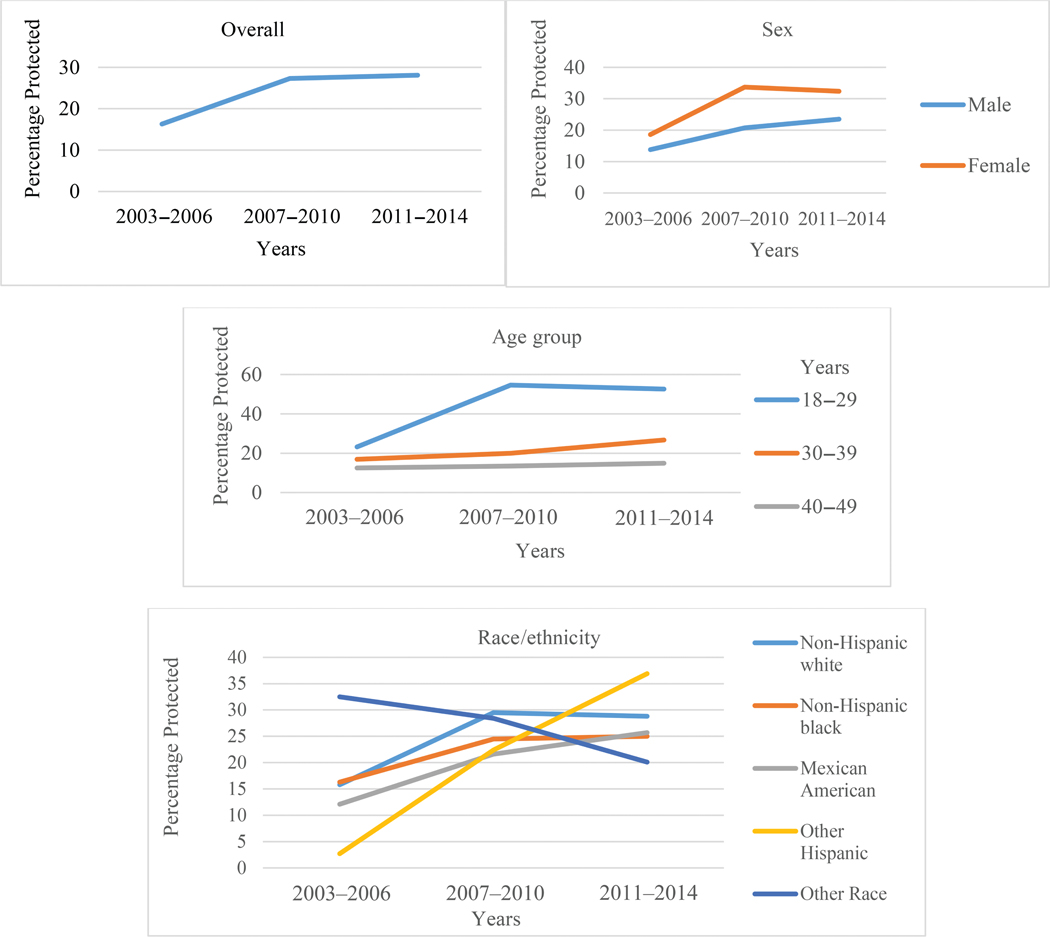
Description:Background. ; Hepatitis B virus (HBV) infection can be prevented through vaccination. However, previous data show that only about 24%-45% of US adults at high risk of HBV infection are protected. Our aims were to assess prevalence and trends in protective levels of hepatitis B surface antibody (anti-HBs) from 2003 to 2014 and explore factors associated with protection among adults at high risk. ; Methods. ; Data were taken from the 2003-2014 National Health and Nutrition Examination surveys. Our sample included adults aged 18-49 years who were tested for HBV and reported at least 1 of the following infection risks: history of sexually transmitted disease, sex with men (for men), infection with human immunodeficiency virus, and injection drug use. We calculated the prevalence of anti-HBs (≥10 mIU/mL), indicative of immunity from vaccination, among respondents for three 4-year time intervals (2003-2006, 2007-2010, and 2011-2014) and applied the Cochran-Mantel-Haenszel test to assess trends. Using multivariable logistic regression, we examined factors associated with positive anti-HBs serology. ; Results. ; The prevalence of positive anti-HBs serology was 23.4%. Prevalence increased from 2003-2006 (16.3%) to 2007-2010 (27.3%), but no change occurred from 2007-2010 (27.3%) to 2011-2014 (28.1%). Among factors predicting positive anti-HBs serology were young age and higher education. ; Conclusions. ; By 2014, less than one-third of adults aged 18-49 years at risk of infection exhibited protective antibodies ≥10 mIU/mL. Because these adults account for a majority of unprotected adults, targeted intervention strategies are essential to achieve the hepatitis B elimination goal.
-
Subjects:
-
Keywords:
-
Source:Clin Infect Dis. 70(9):1907-1915
-
DOI:
-
Pubmed ID:31228240
-
Pubmed Central ID:PMC7440671
-
Document Type:
-
Funding:
-
Genre:
-
Volume:70
-
Issue:9
-
Download URL:
-
File Type:
 [PDF - 624.00 KB]
 -
Collection(s):
-
Main Document Checksum:urn:sha-512:37b6c16e2497b627b6d71d25fd1de22050c90784f36f7182adfad405eaa0fdf466c2a515667bdbf3e438450bf12a235682552596f3e55a611c52bcb23cca90da
Supporting Files


File Language:
English
 Was this page helpful?
 Found an issue?


CDC STACKS serves as an archival repository of CDC-published products including
scientific findings, journal articles, guidelines, recommendations, or other public health information authored or
co-authored by CDC or funded partners.
As a repository, CDC STACKS retains documents in their original published format to ensure public access to scientific information.
As a repository, CDC STACKS retains documents in their original published format to ensure public access to scientific information.
You May Also Like
COLLECTION
CDC Public Access