


Molecular Antimicrobial Resistance Surveillance for Neisseria gonorrhoeae, Northern Territory, Australia
Supporting Files
Public Domain

-
Sep 2017
-
Details
-
Alternative Title:Emerg Infect Dis
-
Personal Author:Whiley, David M. ; Trembizki, Ella ; Buckley, Cameron ; Freeman, Kevin ; Baird, Robert W. ; Beaman, Miles ; Chen, Marcus ; Donovan, Basil ; Kundu, Ratan L. ; Fairley, Christopher K. ; Guy, Rebecca ; Hogan, Tiffany ; Kaldor, John M. ; Karimi, Mahdad ; Limnios, Athena ; Regan, David G. ; Ryder, Nathan ; Su, Jiunn-Yih ; Ward, James ; Lahra, Monica M.
-
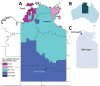
Description:Neisseria gonorrhoeae antimicrobial resistance (AMR) is a globally recognized health threat; new strategies are needed to enhance AMR surveillance. The Northern Territory of Australia is unique in that 2 different first-line therapies, based primarily on geographic location, are used for gonorrhea treatment. We tested 1,629 N. gonorrhoeae nucleic acid amplification test-positive clinical samples, collected from regions where ceftriaxone plus azithromycin or amoxicillin plus azithromycin are recommended first-line treatments, by using 8 N. gonorrhoeae AMR PCR assays. We compared results with those from routine culture-based surveillance data. PCR data confirmed an absence of ceftriaxone resistance and a low level of azithromycin resistance (0.2%), and that penicillin resistance was <5% in amoxicillin plus azithromycin regions. Rates of ciprofloxacin resistance and penicillinase-producing N. gonorrhoeae were lower when molecular methods were used. Molecular methods to detect N. gonorrhoeae AMR can increase the evidence base for treatment guidelines, particularly in settings where culture-based surveillance is limited.
-
Subjects:
-
Source:Emerg Infect Dis. 23(9):1478-1485.
-
Pubmed ID:28820128
-
Pubmed Central ID:PMC5572890
-
Document Type:
-
Volume:23
-
Issue:9
-
Collection(s):
-
Main Document Checksum:urn:sha256:e248707420c0b63f5fbf5ccc2368abba01e4e3967644d5784baa15e2d24a06c2
-
Download URL:
-
File Type:
 [PDF
- 1.56 MB
]
[PDF
- 1.56 MB
]
Supporting Files


ON THIS PAGE



CDC STACKS serves as an archival repository of CDC-published products including
scientific findings,
journal articles, guidelines, recommendations, or other public health information authored or
co-authored by CDC or funded partners.
As a repository, CDC STACKS retains documents in their original published format to ensure public access to scientific information.
As a repository, CDC STACKS retains documents in their original published format to ensure public access to scientific information.
You May Also Like
COLLECTION
Emerging Infectious Diseases