



Serum Cystatin C in Youth with Diabetes: the SEARCH for Diabetes in Youth Study
Supporting Files

-
8 2017 ; 8-2017
-
Available in CDC Stacks on 2018-08-01T00:00:00Z
File Language:
English
Details
-
Alternative Title:Diabetes Res Clin Pract
-
Personal Author:Shankar, Roopa Kanakatti ; Dolan, Lawrence M ; Isom, Scott ; Saydah, Sharon ; Maahs, David M ; Dabelea, Dana ; Reynolds, Kristi ; Hirsch, Irl B ; Rodriguez, Beatriz L ; Mayer-Davis, Elizabeth J ; Marcovina, Santica ; D’Agostino, Ralph ; Mauer, Michael ; Mottl, Amy K
-
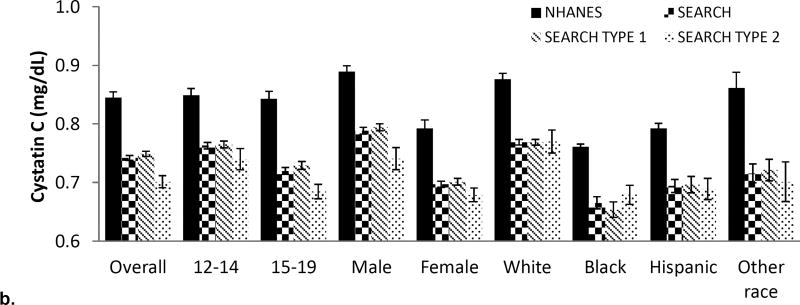
Description:AIMS ; We compared cystatin C in youth with versus without diabetes and determined factors associated with cystatin C in youth with type 1 diabetes (T1D) and type 2 diabetes (T2D). ; METHODS ; Youth (ages 12–19 years) without diabetes (N=544) were ascertained from the NHANES Study 2000- 2002 and those with T1D (N=977) and T2D (N=168) from the SEARCH for Diabetes in Youth Study. Adjusted means of cystatin C concentrations were compared amongst the 3 groups. Next, we performed multivariable analyses within the T1D and T2D SEARCH samples to determine the association between cystatin C and race, sex, age, diabetes duration, HbA1c, fasting glucose, and BMI. ; RESULTS ; Adjusted cystatin C concentrations were statistically higher in NHANES (0.85mg/L) than in either the T1D (0.75mg/L) or T2D (0.70mg/L) SEARCH groups (p<0.0001). Fasting glucose was inversely related to cystatin C only in T1D (p<0.001) and BMI positively associated only in T2D (p<0.01) while HbA1c was inversely associated in both groups. ; CONCLUSIONS ; Cystatin C concentrations are statistically higher in youth without diabetes compared to T1D or T2D, however the clinical relevance of this difference is quite small, especially in T1D. In youth with diabetes, cystatin C varies with BMI and acute and chronic glycemic control, however their effects may be different according to diabetes type.
-
Subjects:
-
Keywords:
-
Source:Diabetes Res Clin Pract. 130:258-265
-
Pubmed ID:28666182
-
Pubmed Central ID:PMC5575920
-
Document Type:
-
Funding:P30 DK057516/DK/NIDDK NIH HHSUnited States/ ; UC4 DK108173/DK/NIDDK NIH HHSUnited States/ ; U01 DP000247/DP/NCCDPHP CDC HHSUnited States/ ; U18 DP002710/DP/NCCDPHP CDC HHSUnited States/ ; UL1 TR000154/TR/NCATS NIH HHSUnited States/ ; U18 DP002714/DP/NCCDPHP CDC HHSUnited States/ ; U01 DP000248/DP/NCCDPHP CDC HHSUnited States/ ; U01 DP000244/DP/NCCDPHP CDC HHSUnited States/ ; K23 DK093804/DK/NIDDK NIH HHSUnited States/ ; UL1 RR029882/RR/NCRR NIH HHSUnited States/ ; U18 DP002709/DP/NCCDPHP CDC HHSUnited States/ ; UL1 TR000077/TR/NCATS NIH HHSUnited States/ ; UL1 TR000423/TR/NCATS NIH HHSUnited States/ ; U01 DP000250/DP/NCCDPHP CDC HHSUnited States/ ; U18 DP002708/DP/NCCDPHP CDC HHSUnited States/ ; HIR 10-001/HX/HSRD VAUnited States/ ; U01 DP000245/DP/NCCDPHP CDC HHSUnited States/ ; U18 DP006134/DP/NCCDPHP CDC HHSUnited States/ ; UL1 TR001425/TR/NCATS NIH HHSUnited States/ ; UL1 TR002319/TR/NCATS NIH HHSUnited States/ ; U01 DP000246/DP/NCCDPHP CDC HHSUnited States/ ; U01 DP000254/DP/NCCDPHP CDC HHSUnited States/
-
Volume:130
-
Download URL:
-
File Type:
 [PDF - 690.00 KB]
 -
Collection(s):
-
Main Document Checksum:urn:sha256:c5490af540b0154b1c4cb3a225f40eb421d9a57f465f5ed4979b3cfefd04f89b
Supporting Files


File Language:
English
 Was this page helpful?
 Found an issue?


CDC STACKS serves as an archival repository of CDC-published products including
scientific findings, journal articles, guidelines, recommendations, or other public health information authored or
co-authored by CDC or funded partners.
As a repository, CDC STACKS retains documents in their original published format to ensure public access to scientific information.
As a repository, CDC STACKS retains documents in their original published format to ensure public access to scientific information.
You May Also Like
COLLECTION
CDC Public Access