



Treatment regimens and glycosylated hemoglobin levels in youth with type 1 and type 2 diabetes: data from SEARCH (United States) and YDR (India) registries
Supporting Files

-
2 2021
-
Available in CDC Stacks on February 01, 2022, 12:00 AM
File Language:
English
Details
-
Journal Article:Pediatr Diabetes
-
Personal Author:Anandakumar, Amutha ; Praveen, Pradeep A ; Hockett, Christine W. ; Ong, Toan C ; Jensen, Elizabeth T ; Isom, Scott ; D'Agostino, Ralph ; Hamman, Richard F ; Mayer-Davis, Elizabeth ; Wadwa, R Paul ; Lawrence, Jean M ; Pihoker, Catherine ; Kahn, Michael ; Dabelea, Dana ; Tandon, Nikhil ; Mohan, Viswanathan
-
Description:Objective:
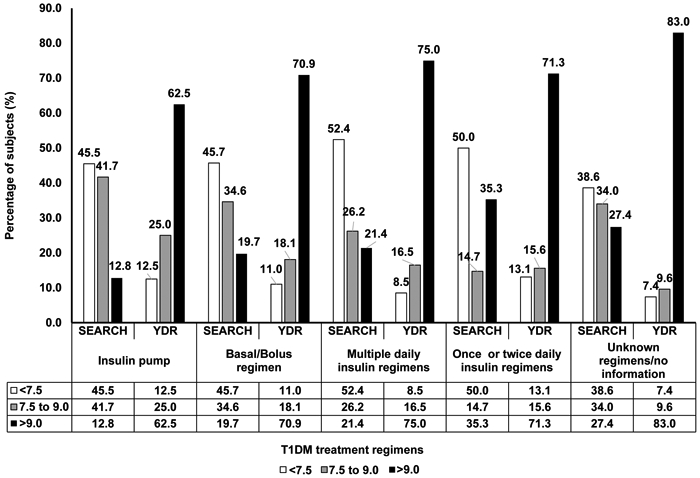
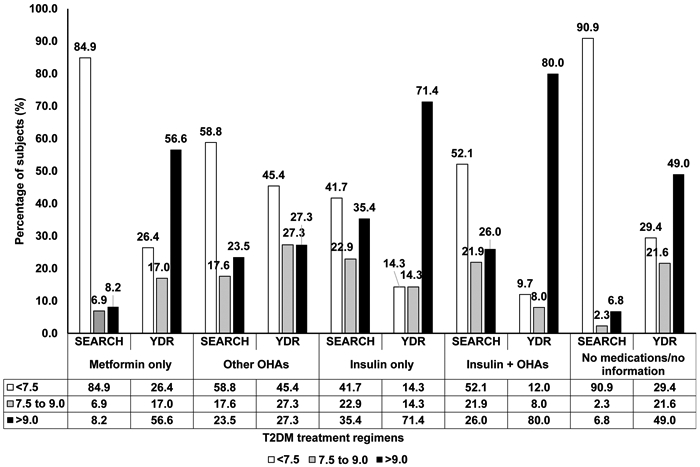
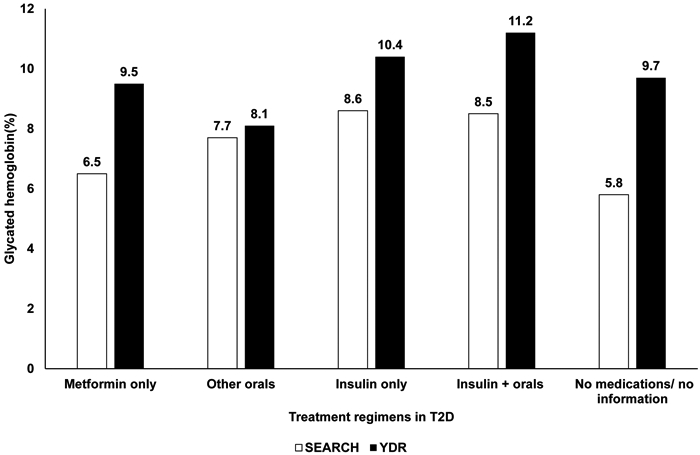
To compare treatment regimens and glycosylated haemoglobin (A1c) levels in type 1 (T1D) and type 2 diabetes (T2D) using diabetes registries from two countries – SEARCH for Diabetes in Youth (SEARCH) in the U.S. and the Registry of People with Diabetes with Youth Age at Onset (YDR) in India.
Methods:
The SEARCH and YDR data were harmonized to the structure and terminology in the Observational Medical Outcomes Partnership (OMOP) Common Data Model (v5). Data used in the analyses were from youth with physician-diagnosed T1D and T2D between 2006-2012 for YDR, and 2006, 2008 & 2012 for SEARCH and were <20 years at the time of diagnosis. We compared diabetes treatment regimens and A1c levels across the two registries.
Results:
We included 4,003 T1D (SEARCH=1,899; YDR=2,104) and 611 T2D (SEARCH =384; YDR=227) youth for this analysis. The mean A1c was higher in YDR compared to SEARCH (T1D: 11.0 ± 2.9 vs. 7.8 ± 1.7%, p<0.001; T2D: 9.9 ± 2.8 vs. 7.2 ± 2.1%, p<0.001). Among T1D youth in SEARCH, 65.1% were on a basal/bolus regimen, whereas in YDR, 52.8% were on once/twice daily insulin regimen. Insulin pumps were used by 16.2% of SEARCH and 1.5% of YDR youth with T1D. Among T2D youth, a majority were on metformin only, followed by insulin+any oral hypoglycemic agents and insulin only in both SEARCH and YDR.
Conclusion:
Efforts to achieve better glycemic control for both T1D and T2D youth are urgently needed in order to reduce the risk of long term complications. -
Subjects:
-
Keywords:
-
Source:Pediatr Diabetes. 22(1):31-39
-
DOI:
-
Pubmed ID:32134536
-
Pubmed Central ID:PMC7744104
-
Document Type:
-
Funding:U18 DP002710/DP/NCCDPHP CDC HHSUnited States/ ; U18 DP006134/DP/NCCDPHP CDC HHSUnited States/ ; U18 DP006138/DP/NCCDPHP CDC HHSUnited States/ ; UL1 TR000154/TR/NCATS NIH HHSUnited States/ ; U18 DP002714/DP/NCCDPHP CDC HHSUnited States/ ; U01 DP000248/DP/NCCDPHP CDC HHSUnited States/ ; U01 DP000244/DP/NCCDPHP CDC HHSUnited States/ ; UL1 TR000062/TR/NCATS NIH HHSUnited States/ ; UL1 TR000423/TR/NCATS NIH HHSUnited States/ ; P30 DK057516/DK/NIDDK NIH HHSUnited States/ ; HIR 10-001/HX/HSRD VAUnited States/ ; U01 DP000247/DP/NCCDPHP CDC HHSUnited States/ ; U18 DP006131/DP/NCCDPHP CDC HHSUnited States/ ; U18 DP006136/DP/NCCDPHP CDC HHSUnited States/ ; U18 DP002709/DP/NCCDPHP CDC HHSUnited States/ ; U18 DP006133/DP/NCCDPHP CDC HHSUnited States/ ; R21 DK105869/DK/NIDDK NIH HHSUnited States/ ; UL1 TR001425/TR/NCATS NIH HHSUnited States/ ; U18 DP006139/DP/NCCDPHP CDC HHSUnited States/ ; UL1 TR000077/TR/NCATS NIH HHSUnited States/ ; UL1 TR001450/TR/NCATS NIH HHSUnited States/ ; U01 DP000250/DP/NCCDPHP CDC HHSUnited States/ ; U01 DP000246/DP/NCCDPHP CDC HHSUnited States/ ; U01 DP000254/DP/NCCDPHP CDC HHSUnited States/ ; U18 DP002708/DP/NCCDPHP CDC HHSUnited States/ ; R21DK105869-02/DK/NIDDK NIH HHSUnited States/
-
Genre:
-
Volume:22
-
Issue:1
-
Download URL:
-
File Type:
 [PDF - 438.67 KB]
 -
Collection(s):
-
Main Document Checksum:urn:sha-512:d8452705684fba3c29f69ca20a1ee452c1c4ba5a7a8a79ddd4871991f6e2ca044133f7f0ae9a33c3be7a297cb4521f557357bb588c43895b3cc6f765b8b398bb
Supporting Files


File Language:
English
 Was this page helpful?
 Found an issue?





CDC STACKS serves as an archival repository of CDC-published products including
scientific findings, journal articles, guidelines, recommendations, or other public health information authored or
co-authored by CDC or funded partners.
As a repository, CDC STACKS retains documents in their original published format to ensure public access to scientific information.
As a repository, CDC STACKS retains documents in their original published format to ensure public access to scientific information.
You May Also Like
COLLECTION
CDC Public Access