



Characterization of Fitzroy River Virus and Serologic Evidence of Human and Animal Infection
Supporting Files
Public Domain

-
Aug 2017
File Language:
English
Details
-
Alternative Title:Emerg Infect Dis
-
Personal Author:Johansen, Cheryl A. ; Williams, Simon H. ; Melville, Lorna F. ; Nicholson, Jay ; Hall, Roy A. ; Bielefeldt-Ohmann, Helle ; Prow, Natalie A. ; Chidlow, Glenys R. ; Wong, Shani ; Sinha, Rohini ; Williams, David T. ; Lipkin, W. Ian ; Smith, David W.
-
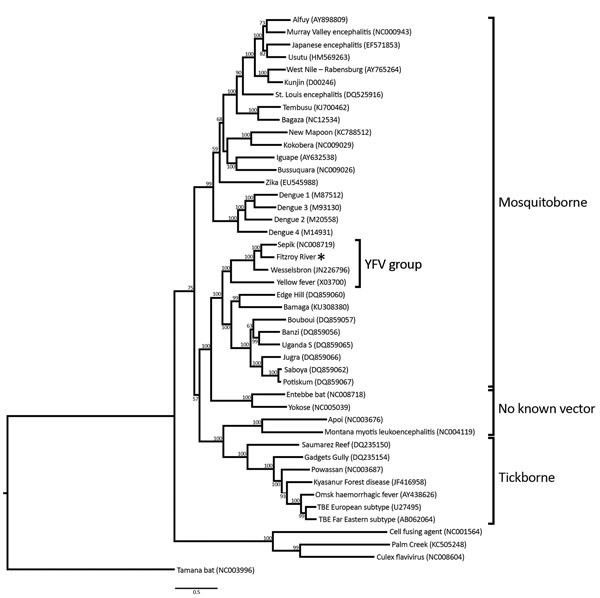
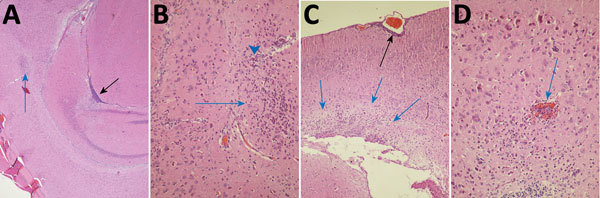
Description:In northern Western Australia in 2011 and 2012, surveillance detected a novel arbovirus in mosquitoes. Genetic and phenotypic analyses confirmed that the new flavivirus, named Fitzroy River virus, is related to Sepik virus and Wesselsbron virus, in the yellow fever virus group. Most (81%) isolates came from Aedes normanensis mosquitoes, providing circumstantial evidence of the probable vector. In cell culture, Fitzroy River virus replicated in mosquito (C6/36), mammalian (Vero, PSEK, and BSR), and avian (DF-1) cells. It also infected intraperitoneally inoculated weanling mice and caused mild clinical disease in 3 intracranially inoculated mice. Specific neutralizing antibodies were detected in sentinel horses (12.6%), cattle (6.6%), and chickens (0.5%) in the Northern Territory of Australia and in a subset of humans (0.8%) from northern Western Australia.
-
Subjects:
-
Source:Emerg Infect Dis. 23(8):1289-1299.
-
Pubmed ID:28726621
-
Pubmed Central ID:PMC5547785
-
Document Type:
-
Place as Subject:
-
Location:
-
Volume:23
-
Issue:8
-
Download URL:
-
File Type:
 [PDF - 2.15 MB]
 -
Collection(s):
-
Main Document Checksum:urn:sha256:920fd540392c2f643015f2d6c85a84ea6f5c97fadf0b78ba58d73248c1c991fa
Supporting Files


File Language:
English
 Was this page helpful?
 Found an issue?




CDC STACKS serves as an archival repository of CDC-published products including
scientific findings, journal articles, guidelines, recommendations, or other public health information authored or
co-authored by CDC or funded partners.
As a repository, CDC STACKS retains documents in their original published format to ensure public access to scientific information.
As a repository, CDC STACKS retains documents in their original published format to ensure public access to scientific information.
You May Also Like
COLLECTION
Emerging Infectious Diseases