



Hodgkin lymphoma, HIV, and Epstein–Barr virus in Malawi: Longitudinal results from the Kamuzu Central Hospital Lymphoma study
Supporting Files

-
5 2017 ; 5-2017
-
Available in CDC Stacks on May 01, 2018, 12:00 AM
File Language:
English
Details
-
Alternative Title:Pediatr Blood Cancer
-
Personal Author:Westmoreland, Katherine D. ; Stanley, Christopher C. ; Montgomery, Nathan D. ; Kaimila, Bongani ; Kasonkanji, Edwards ; El-Mallawany, Nader Kim ; Wasswa, Peter ; Mtete, Idah ; Butia, Mercy ; Itimu, Salama ; Chasela, Mary ; Mtunda, Mary ; Chikasema, Maria ; Makwakwa, Victor ; Kampani, Coxcilly ; Dhungel, Bal M. ; Sanders, Marcia K. ; Krysiak, Robert ; Tomoka, Tamiwe ; Liomba, N. George ; Dittmer, Dirk P. ; Fedoriw, Yuri ; Gopal, Satish
-
Description:Background
Contemporary descriptions of classical Hodgkin lymphoma (cHL) are lacking from sub-Saharan Africa where human immunodeficiency virus (HIV) and Epstein–Barr virus (EBV) are prevalent.
Methods
We describe a prospective cHL cohort in Malawi enrolled from 2013 to 2015. Patients received standardized treatment and evaluation, including HIV status and EBV testing of tumors and plasma.
Results
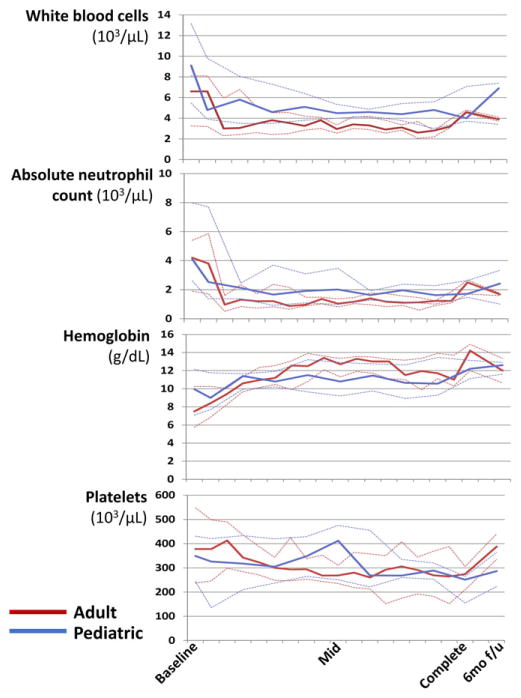
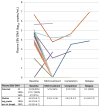
Among 31 patients with confirmed cHL, the median age was 19 years (range, 2–51 years) and 22 (71%) were male. Sixteen patients (52%) had stage III/IV, 25 (81%) B symptoms, and 16 (52%) performance status impairment. Twenty-three patients (74%) had symptoms >6 months, and 11 of 29 (38%) had received empiric antituberculosis treatment. Anemia was common with median hemoglobin 8.2 g/dL (range, 3.1–17.1 g/dL), which improved during treatment. No children and 5 of 15 adults (33%)were HIV+. All HIV+ patients were on antiretroviral therapy for a median 15 months (range, 2–137 months), with median CD4 count 138 cells/μL (range, 23–329 cells/μL) and four (80%) having undetectable HIV. EBV was present in 18 of 24 (75%) tumor specimens, including 14 of 20 (70%) HIV− and 4 of 4 (100%) HIV+. Baseline plasma EBV DNA was detected in 25 of 28 (89%) patients, with median viral load 4.7 (range, 2.0–6.7) log10copies/mL, and subsequently declined in most patients. At 12 months, overall survival was 75% (95% confidence interval CI, 55%–88%) and progression-free survival 65% (95% CI, 42%–81%). Baseline plasma EBV DNA and persistent viremia during treatment were associated with poorer outcomes.
Conclusion
cHL in Malawi is characterized by delayed diagnosis and advanced disease. Most cases were EBV associated and one-third of adults were HIV+. Despite resource limitations, 12-month outcomes were good. -
Subjects:
- Adolescent
- Adult
- CD4 Lymphocyte Count
- Child
- Child, Preschool
- DNA, Viral
- Disease-Free Survival
- Epstein-Barr Virus Infections
- Female
- HIV Infections
- HIV-1
- Herpesvirus 4, Human
- Hodgkin Disease
- Humans
- Longitudinal Studies
- Malawi
- Male
- Middle Aged
- Prospective Studies
- Risk Factors
- Treatment Outcome
- Viral Load
- Viremia
- Young Adult
-
Keywords:
-
Source:Pediatr Blood Cancer. 64(5)
-
Pubmed ID:27781380
-
Pubmed Central ID:PMC5529120
-
Document Type:
-
Funding:K01 TW009488/TW/FIC NIH HHSUnited States/ ; P20 CA210285/CA/NCI NIH HHSUnited States/ ; P30 CA016086/CA/NCI NIH HHSUnited States/ ; U2G PS001965/PS/NCHHSTP CDC HHSUnited States/ ; U01 CA121947/CA/NCI NIH HHSUnited States/ ; P01 CA019014/CA/NCI NIH HHSUnited States/ ; R21 CA180097/CA/NCI NIH HHSUnited States/ ; U54 CA190152/CA/NCI NIH HHSUnited States/ ; R25 TW009340/TW/FIC NIH HHSUnited States/ ; P30 AI050410/AI/NIAID NIH HHSUnited States/ ; R21 CA180815/CA/NCI NIH HHSUnited States/
-
Volume:64
-
Issue:5
-
Download URL:
-
File Type:
 [PDF - 590.29 KB]
 -
Collection(s):
-
Main Document Checksum:urn:sha256:d4e81e3412af6aa87b01785a967b0f46cb61d34727078ff98dbb60a7e9a525b0
Supporting Files


File Language:
English
 Was this page helpful?
 Found an issue?



CDC STACKS serves as an archival repository of CDC-published products including
scientific findings, journal articles, guidelines, recommendations, or other public health information authored or
co-authored by CDC or funded partners.
As a repository, CDC STACKS retains documents in their original published format to ensure public access to scientific information.
As a repository, CDC STACKS retains documents in their original published format to ensure public access to scientific information.
You May Also Like
COLLECTION
CDC Public Access