



Plasma Epstein-Barr virus DNA for pediatric Burkitt lymphoma diagnosis, prognosis, and response assessment in Malawi
Supporting Files

-
6 01 2017 ; 6-01-
-
Available in CDC Stacks on June 01, 2018, 12:00 AM
File Language:
English
Details
-
Alternative Title:Int J Cancer
-
Personal Author:Westmoreland, Katherine D. ; Montgomery, Nathan D. ; Stanley, Christopher C. ; El-Mallawany, Nader Kim ; Wasswa, Peter ; van der Gronde, Toon ; Mtete, Idah ; Butia, Mercy ; Itimu, Salama ; Chasela, Mary ; Mtunda, Mary ; Kampani, Coxcilly ; Liomba, N. George ; Tomoka, Tamiwe ; Dhungel, Bal M. ; Sanders, Marcia K. ; Krysiak, Robert ; Kazembe, Peter ; Dittmer, Dirk P. ; Fedoriw, Yuri ; Gopal, Satish
-
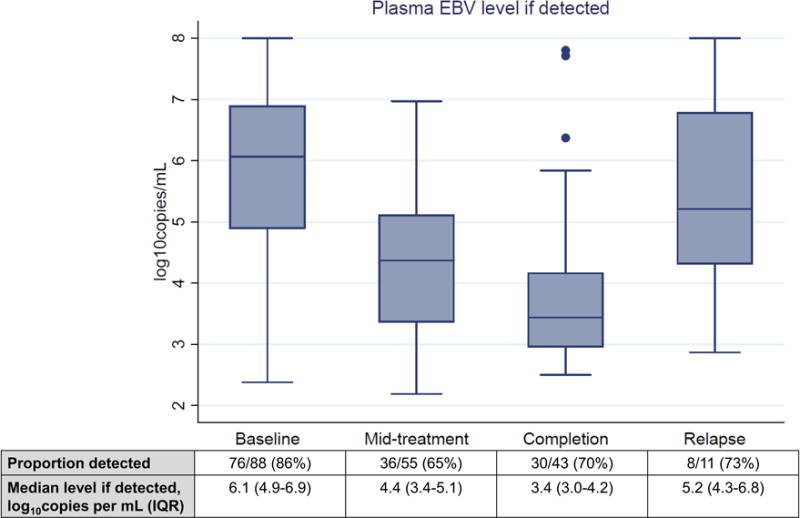
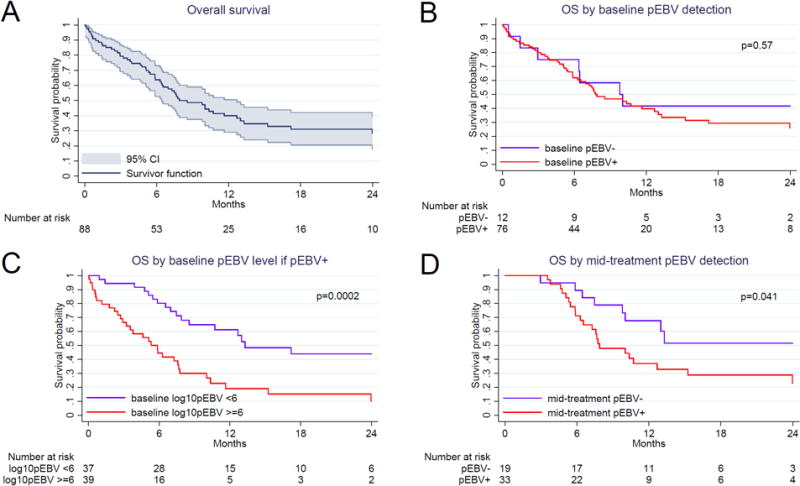
Description:Point-of-care tools are needed in sub-Saharan Africa (SSA) to improve pediatric Burkitt lymphoma (BL) diagnosis and treatment. We evaluated plasma Epstein-Barr virus (pEBV) DNA as a pediatric BL biomarker in Malawi. Prospectively enrolled children with BL were compared to classical Hodgkin lymphoma (cHL) and nonlymphoma diagnoses. Pediatric BL patients received standardized chemotherapy and supportive care. pEBV DNA was measured at baseline, mid-treatment, and treatment completion. Of 121 assessed children, pEBV DNA was detected in 76/88 (86%) with BL, 16/17 (94%) with cHL, and 2/16 (12%) with nonlymphoma, with proportions higher in BL versus nonlymphoma (p < 0.001) and similar in BL versus cHL (p = 0.69). If detected, median pEBV DNA was 6.1 log| copies/mL for BL, 4.8 log| copies/mL for cHL, and 3.4 log| copies/mL for nonlymphoma, with higher levels in BL versus cHL (p = 0.029), and a trend toward higher levels in BL versus nonlymphoma (p = 0.062). pEBV DNA declined during treatment in the cohort overall and increased in several children before clinical relapse. Twelve-month overall survival was 40% in the cohort overall, and for children with baseline pEBV detected, survival was worse if baseline pEBV DNA was ≥6 log| copies/mL versus <6 log| copies/mL (p = 0.0002), and also if pEBV DNA was persistently detectable at mid-treatment versus undetectable (p = 0.041). Among children with baseline pEBV DNA detected, viremia was the only significant risk factor for death by 12 months in multivariate analyses (adjusted hazard ratio 1.35 per log| copies/mL, 95% CI 1.04-1.75, p = 0.023). Quantitative pEBV DNA has potential utility for diagnosis, prognosis, and response assessment for pediatric BL in SSA.
-
Subjects:
-
Keywords:
-
Source:Int J Cancer. 140(11):2509-2516
-
Pubmed ID:28268254
-
Pubmed Central ID:PMC5386821
-
Document Type:
-
Funding:P01 CA019014/CA/NCI NIH HHSUnited States/ ; K01 TW009488/TW/FIC NIH HHSUnited States/ ; P30 CA016086/CA/NCI NIH HHSUnited States/ ; U2G PS001965/PS/NCHHSTP CDC HHSUnited States/ ; U54 CA190152/CA/NCI NIH HHSUnited States/ ; R25 TW009340/TW/FIC NIH HHSUnited States/ ; P30 AI050410/AI/NIAID NIH HHSUnited States/ ; R21 CA180815/CA/NCI NIH HHSUnited States/
-
Volume:140
-
Issue:11
-
Download URL:
-
File Type:
 [PDF - 492.94 KB]
 -
Collection(s):
-
Main Document Checksum:urn:sha256:f63bc6afaf3894f04dd0bb5ec300bb7deff81d1f9e745d6a05d2b6d52a175a9d
Supporting Files


File Language:
English
 Was this page helpful?
 Found an issue?


CDC STACKS serves as an archival repository of CDC-published products including
scientific findings, journal articles, guidelines, recommendations, or other public health information authored or
co-authored by CDC or funded partners.
As a repository, CDC STACKS retains documents in their original published format to ensure public access to scientific information.
As a repository, CDC STACKS retains documents in their original published format to ensure public access to scientific information.
You May Also Like
COLLECTION
CDC Public Access