



Uncontrolled Donation After Circulatory Determination of Death Donors (uDCDDs) as a Source of Lungs for Transplant
Supporting Files

-
Apr 14 2015
-
Available in CDC Stacks on 2017-06-29T00:00:00Z
File Language:
English
Details
-
Alternative Title:Am J Transplant
-
Personal Author:
-
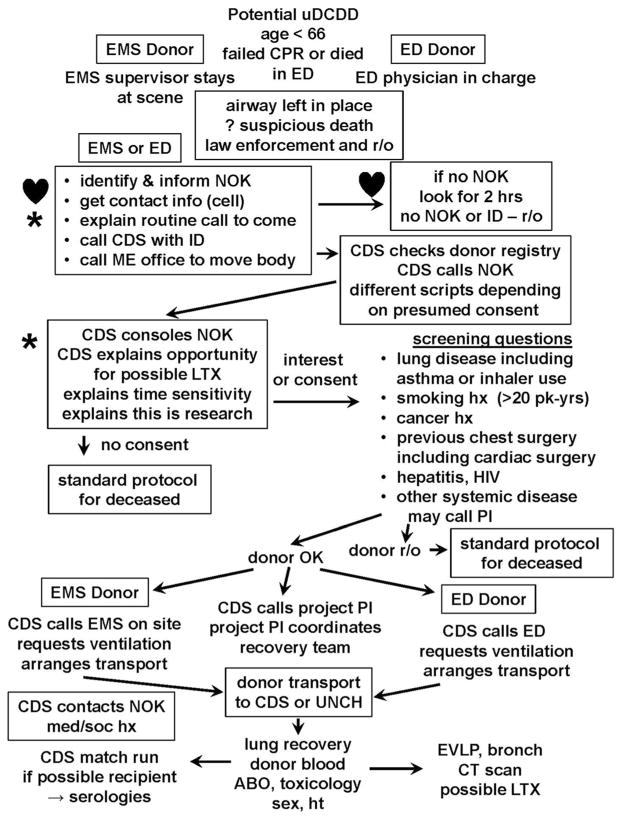
Description:In April 2014, the American Journal of Transplantation published a report on the first lung transplant in the United States recovered from an uncontrolled donation after circulatory determination of death donor (uDCDD), assessed by ex vivo lung perfusion (EVLP). The article identified logistical and ethical issues related to introduction of lung transplant from uDCDDs. In an open clinical trial, we have Food and Drug Administration and Institutional Review Board approval to transplant lungs recovered from uDCDDs judged suitable after EVLP. Through this project and other experiences with lung recovery from uDCDDs, we have identified solutions to many logistical challenges and have addressed ethical issues surrounding lung transplant from uDCDDs that were mentioned in this case report. Here, we discuss those challenges, including issues related to recovery of other solid organs from uDCDDs. Despite logistical challenges, uDCDDs could solve the critical shortage of lungs for transplant. Furthermore, by avoiding the deleterious impact of brain death and days of positive pressure ventilation, and by using opportunities to treat lungs in the decedent or during EVLP, lungs recovered from uDCDDs may ultimately prove to be better than lungs currently being transplanted from conventional brain-dead organ donors.
-
Subjects:
-
Source:Am J Transplant. 15(8):2031-2036.
-
Pubmed ID:25873272
-
Pubmed Central ID:PMC5491386
-
Document Type:
-
Funding:
-
Place as Subject:
-
Volume:15
-
Issue:8
-
Download URL:
-
File Type:
 [PDF - 355.89 KB]
 -
Collection(s):
-
Main Document Checksum:urn:sha256:92fb425f68548766eb6cbaf3dab8d68505b8e5b7825debcd4ea7f0312016879f
Supporting Files


File Language:
English
 Was this page helpful?
 Found an issue?

CDC STACKS serves as an archival repository of CDC-published products including
scientific findings, journal articles, guidelines, recommendations, or other public health information authored or
co-authored by CDC or funded partners.
As a repository, CDC STACKS retains documents in their original published format to ensure public access to scientific information.
As a repository, CDC STACKS retains documents in their original published format to ensure public access to scientific information.
You May Also Like
COLLECTION
CDC Public Access