



The Effect of Antibiotic Exposure and Specimen Volume on the Detection of Bacterial Pathogens in Children With Pneumonia
Supporting Files

-
Jun 15 2017 ; 6-15-
-
Available in CDC Stacks on May 27, 2017, 12:00 AM
File Language:
English
Details
-
Alternative Title:Clin Infect Dis
-
Personal Author:Driscoll, Amanda J. ; Deloria Knoll, Maria ; Hammitt, Laura L. ; Baggett, Henry C. ; Brooks, W. Abdullah ; Feikin, Daniel R. ; Kotloff, Karen L. ; Levine, Orin S. ; Madhi, Shabir A. ; O’Brien, Katherine L. ; Scott, J. Anthony G. ; Thea, Donald M. ; Howie, Stephen R. C. ; Adrian, Peter V. ; Ahmed, Dilruba ; DeLuca, Andrea N. ; Ebruke, Bernard E. ; Gitahi, Caroline ; Higdon, Melissa M. ; Kaewpan, Anek ; Karani, Angela ; Karron, Ruth A. ; Mazumder, Razib ; McLellan, Jessica ; Moore, David P. ; Mwananyanda, Lawrence ; Park, Daniel E. ; Prosperi, Christine ; Rhodes, Julia ; Saifullah, Md. ; Seidenberg, Phil ; Sow, Samba O. ; Tamboura, Boubou ; Zeger, Scott L. ; Murdoch, David R.
-
Corporate Authors:
-
Description:Background.
Antibiotic exposure and specimen volume are known to affect pathogen detection by culture. Here we assess their effects on bacterial pathogen detection by both culture and polymerase chain reaction (PCR) in children.
Methods.
PERCH (Pneumonia Etiology Research for Child Health) is a case-control study of pneumonia in children aged 1–59 months investigating pathogens in blood, nasopharyngeal/oropharyngeal (NP/OP) swabs, and induced sputum by culture and PCR. Antibiotic exposure was ascertained by serum bioassay, and for cases, by a record of antibiotic treatment prior to specimen collection. Inoculated blood culture bottles were weighed to estimate volume.
Results.
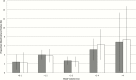
Antibiotic exposure ranged by specimen type from 43.5% to 81.7% in 4223 cases and was detected in 2.3% of 4863 controls. Antibiotics were associated with a 45% reduction in blood culture yield and approximately 20% reduction in yield from induced sputum culture. Reduction in yield of Streptococcus pneumoniae from NP culture was approximately 30% in cases and approximately 32% in controls. Several bacteria had significant but marginal reductions (by 5%–7%) in detection by PCR in NP/OP swabs from both cases and controls, with the exception of S. pneumoniae in exposed controls, which was detected 25% less frequently compared to nonexposed controls. Bacterial detection in induced sputum by PCR decreased 7% for exposed compared to nonexposed cases. For every additional 1 mL of blood culture specimen collected, microbial yield increased 0.51% (95% confidence interval, 0.47%–0.54%), from 2% when volume was ≤1 mL to approximately 6% for ≥3 mL.
Conclusions.
Antibiotic exposure and blood culture volume affect detection of bacterial pathogens in children with pneumonia and should be accounted for in studies of etiology and in clinical management. -
Subjects:
- Supplement Article
- pneumonia
- blood culture
- antibiotic exposure
- children.
- Anti-Bacterial Agents
- Bacteria
- Bacteriological Techniques
- Case-Control Studies
- Child, Preschool
- Female
- Humans
- Infant
- Infant, Newborn
- Internationality
- Male
- Molecular Diagnostic Techniques
- Nasopharynx
- Oropharynx
- Pneumonia, Bacterial
- Real-Time Polymerase Chain Reaction
- Sputum
- Streptococcus pneumoniae
-
Source:Clin Infect Dis. 2017; 64(Suppl 3):S368-S377
-
Pubmed ID:28575366
-
Pubmed Central ID:PMC5447850
-
Document Type:
-
Funding:
-
Volume:64
-
Download URL:
-
File Type:
 [PDF - 304.61 KB]
 -
Collection(s):
-
Main Document Checksum:urn:sha256:0f9f3fa7676f2058401139b507715974201387d183a898ca6e9c58a85cee3d72
Supporting Files


File Language:
English
 Was this page helpful?
 Found an issue?


CDC STACKS serves as an archival repository of CDC-published products including
scientific findings, journal articles, guidelines, recommendations, or other public health information authored or
co-authored by CDC or funded partners.
As a repository, CDC STACKS retains documents in their original published format to ensure public access to scientific information.
As a repository, CDC STACKS retains documents in their original published format to ensure public access to scientific information.
You May Also Like
COLLECTION
CDC Public Access