



Limited Utility of Polymerase Chain Reaction in Induced Sputum Specimens for Determining the Causes of Childhood Pneumonia in Resource-Poor Settings: Findings From the Pneumonia Etiology Research for Child Health (PERCH) Study
Supporting Files

-
Jun 15 2017
-
Available in CDC Stacks on May 27, 2017, 12:00 AM
File Language:
English
Details
-
Alternative Title:Clin Infect Dis
-
Personal Author:Thea, Donald M. ; Seidenberg, Phil ; Park, Daniel E. ; Mwananyanda, Lawrence ; Fu, Wei ; Shi, Qiyuan ; Baggett, Henry C. ; Brooks, W. Abdullah ; Feikin, Daniel R. ; Howie, Stephen R.C. ; Knoll, Maria Deloria ; Kotloff, Karen L. ; Levine, Orin S. ; Madhi, Shabir A. ; O’Brien, Katherine L. ; Scott, J. Anthony G. ; Antonio, Martin ; Awori, Juliet O. ; Baillie, Vicky L. ; DeLuca, Andrea N. ; Driscoll, Amanda J. ; Higdon, Melissa M. ; Hossain, Lokman ; Jahan, Yasmin ; Karron, Ruth A. ; Kazungu, Sidi ; Li, Mengying ; Moore, David P. ; Morpeth, Susan C. ; Ofordile, Ogochukwu ; Prosperi, Christine ; Sangwichian, Ornuma ; Sawatwong, Pongpun ; Sylla, Mamadou ; Tapia, Milagritos D. ; Zeger, Scott L. ; Murdoch, David R. ; Hammitt, Laura L.
-
Corporate Authors:
-
Description:Background.
Sputum examination can be useful in diagnosing the cause of pneumonia in adults but is less well established in children. We sought to assess the diagnostic utility of polymerase chain reaction (PCR) for detection of respiratory viruses and bacteria in induced sputum (IS) specimens from children hospitalized with severe or very severe pneumonia.
Methods.
Among children aged 1–59 months, we compared organism detection by multiplex PCR in IS and nasopharyngeal/oropharyngeal (NP/OP) specimens. To assess whether organism presence or density in IS specimens was associated with chest radiographic evidence of pneumonia (radiographic pneumonia), we compared prevalence and density in IS specimens from children with radiographic pneumonia and children with suspected pneumonia but without chest radiographic changes or clinical or laboratory findings suggestive of pneumonia (nonpneumonia group).
Results.
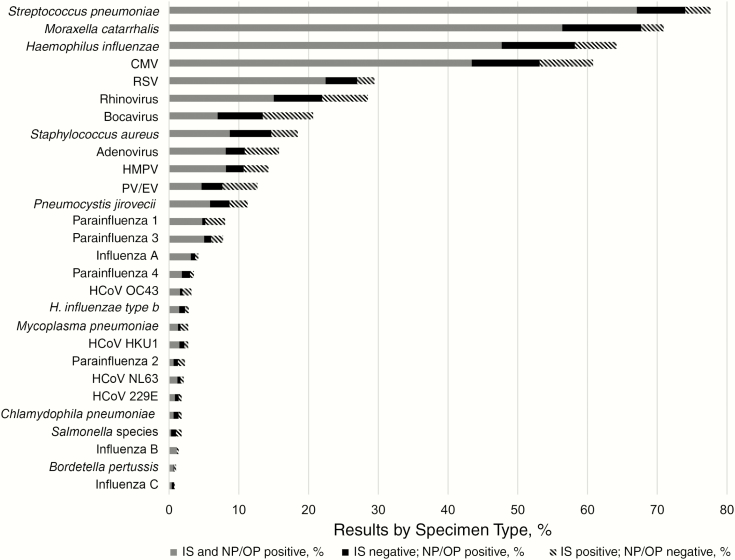
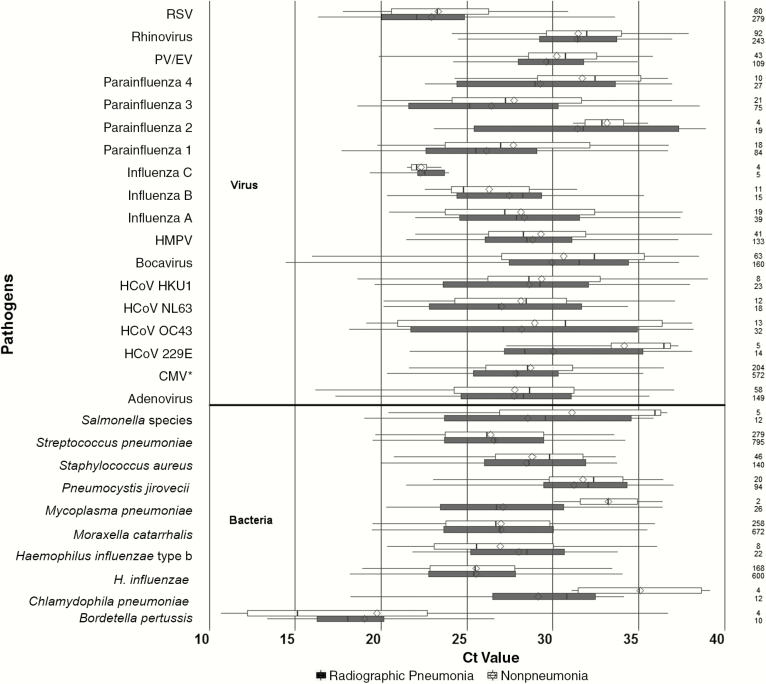
Among 4232 cases with World Health Organization–defined severe or very severe pneumonia, we identified 1935 (45.7%) with radiographic pneumonia and 573 (13.5%) with nonpneumonia. The organism detection yield was marginally improved with IS specimens (96.2% vs 92.4% for NP/OP specimens for all viruses combined P = .41; 96.9% vs 93.3% for all bacteria combined P = .01). After accounting for presence in NP/OP specimens, no organism was detected more frequently in the IS specimens from the radiographic pneumonia compared with the nonpneumonia cases. Among high-quality IS specimens, there were no statistically significant differences in organism density, except with cytomegalovirus, for which there was a higher quantity in the IS specimens from cases with radiographic pneumonia compared with the nonpneumonia cases (median cycle threshold value, 27.9 vs 28.5, respectively; P = .01).
Conclusions.
Using advanced molecular methods with IS specimens provided little additional diagnostic information beyond that obtained with NP/OP swab specimens. -
Subjects:
- Supplement Article
- induced sputum
- PCR
- pneumonia etiology
- nasopharyngeal swab
- community-acquired pneumonia.
- Bacteria
- Child Health
- Child, Hospitalized
- Child, Preschool
- Community-Acquired Infections
- Female
- Health Resources
- Humans
- Infant
- Infant, Newborn
- Lung
- Male
- Molecular Diagnostic Techniques
- Nasopharynx
- Pneumonia
- Pneumonia, Bacterial
- Pneumonia, Viral
- Real-Time Polymerase Chain Reaction
- Respiratory System
- Sputum
- Viruses
-
Source:Clin Infect Dis. 2017; 64(Suppl 3):S289-S300
-
Pubmed ID:28575363
-
Pubmed Central ID:PMC5447848
-
Document Type:
-
Funding:
-
Volume:64
-
Download URL:
-
File Type:
 [PDF - 564.49 KB]
 -
Collection(s):
-
Main Document Checksum:urn:sha-512:e5e0be66ff8ce6bdae9d48e5bb0d3a493ab5cb91b1e2cac7f85eab29ea95db92515f3444c7f31762d5613cdf09e49c8f85d5a5e578794cd3e5f26861f1c6a2b4
Supporting Files


File Language:
English
 Was this page helpful?
 Found an issue?


CDC STACKS serves as an archival repository of CDC-published products including
scientific findings, journal articles, guidelines, recommendations, or other public health information authored or
co-authored by CDC or funded partners.
As a repository, CDC STACKS retains documents in their original published format to ensure public access to scientific information.
As a repository, CDC STACKS retains documents in their original published format to ensure public access to scientific information.
You May Also Like
COLLECTION
CDC Public Access