



Potential short-term neurobehavioral alterations in children associated with a peak pesticide spray season: The Mother's Day flower harvest in Ecuador
Supporting Files

-
5 2017 ; 5-2017
-
Available in CDC Stacks on 2018-05-01T00:00:00Z
File Language:
English
Details
-
Alternative Title:Neurotoxicology
-
Personal Author:
-
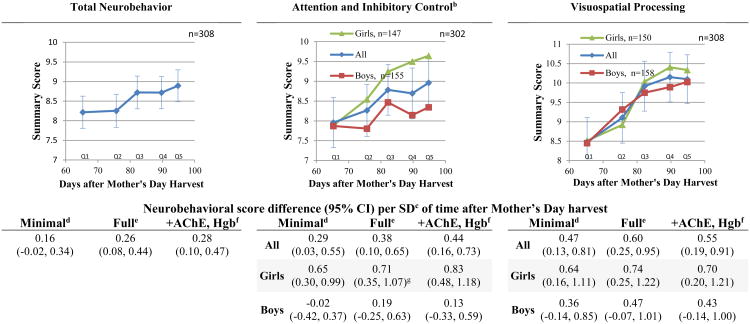
Description:Background ; Exposures to cholinesterase inhibitor pesticides (e.g. organophosphates) have been associated with children's neurobehavioral alterations, including attention deficit and impulsivity. Animal studies have observed transient alterations in neurobehavioral performance in relation to cholinesterase inhibitor pesticide exposures; however, limited evidence exists regarding transient effects in humans. ; Methods ; We estimated the associations between neurobehavioral performance and time after Mother's Day flower harvest (the end of a heightened pesticide usage period) among 308 4-to 9-year-old children living in floricultural communities in Ecuador in 2008 who participated in the ESPINA study. Children's neurobehavior was examined once (NEPSY-II: 11 subtests covering 5 domains), between 63-100 days (SD: 10.8 days) after Mother's Day harvest (blood acetylcholinesterase activity levels can take 82 days to normalize after irreversible inhibition with organophosphates). ; Results ; The mean (SD) neurobehavioral scaled scores across domains ranged from 6.6 (2.4) to 9.9 (3.3); higher values reflect greater performance. Children examined sooner after Mother's Day had lower neurobehavioral scores than children examined later, in the domains of (score difference per 10.8 days, 95%CI): Attention/Inhibitory Control (0.38, 0.10-0.65), Visuospatial Processing (0.60, 0.25-0.95) and Sensorimotor (0.43, 0.10-0.77). Scores were higher with longer time post-harvest among girls (vs. boys) in Attention/Inhibitory Control. ; Conclusions ; Our findings, although cross-sectional, are among the first in non-worker children to suggest that a peak pesticide use period may transiently affect neurobehavioral performance, as children examined sooner after the flower harvest had lower neurobehavioral performance than children examined later. Studies assessing pre- and post-exposure measures are needed.
-
Subjects:
- Acetylcholinesterase
- Attention
- Child
- Child, Preschool
- Cholinesterase Inhibitors
- Cross-Sectional Studies
- Developmental Disabilities
- Ecuador
- Environmental Exposure
- Executive Function
- Female
- Humans
- Inhibition, Psychological
- Learning
- Male
- Memory
- Neuropsychological Tests
- Organophosphate Poisoning
- Pesticides
- Psychomotor Performance
- Seasons
-
Keywords:
-
Source:Neurotoxicology. 60:125-133
-
Pubmed ID:28188819
-
Pubmed Central ID:PMC5447476
-
Document Type:
-
Funding:
-
Volume:60
-
Download URL:
-
File Type:
 [PDF - 594.46 KB]
 -
Collection(s):
-
Main Document Checksum:urn:sha-512:96c6c5ea9f6c2a405a4a81d3711a6bdabe44ac55637cf94e434b0a2d3d6b118f87a1cd94841a151c0bd57a52d682dbad4070c28bd693109a1cc9ac42e7b40dc3
Supporting Files


File Language:
English
 Was this page helpful?
 Found an issue?



CDC STACKS serves as an archival repository of CDC-published products including
scientific findings, journal articles, guidelines, recommendations, or other public health information authored or
co-authored by CDC or funded partners.
As a repository, CDC STACKS retains documents in their original published format to ensure public access to scientific information.
As a repository, CDC STACKS retains documents in their original published format to ensure public access to scientific information.
You May Also Like
COLLECTION
CDC Public Access