



Blood pressure after a heightened pesticide spray period among children living in agricultural communities in Ecuador
Supporting Files

-
8 2019 ; 8-2019
-
Available in CDC Stacks on August 01, 2020, 12:00 AM
File Language:
English
Details
-
Alternative Title:Environ Res
-
Personal Author:
-
Description:Introduction
Agricultural pesticide spray periods increase the pesticide exposure potential of children living nearby and growing evidence indicates that they may affect children’s health. We examined the association of time following a heightened agricultural production period, the Mother’s Day flower harvest (May), with children’s blood pressure (BP).
Methods
We included cross-sectional information of 313 children ages 4-9 years in Ecuadorian agricultural communities (the ESPINA study). Examinations occurred during a period of low flower production, but within 63-100 days (mean= 81.5, SD= 10.9) following the Mother’s Day harvest. BP was measured twice using a pediatric sphygmomanometer and BP percentiles appropriate for age, gender and height were calculated.
Results
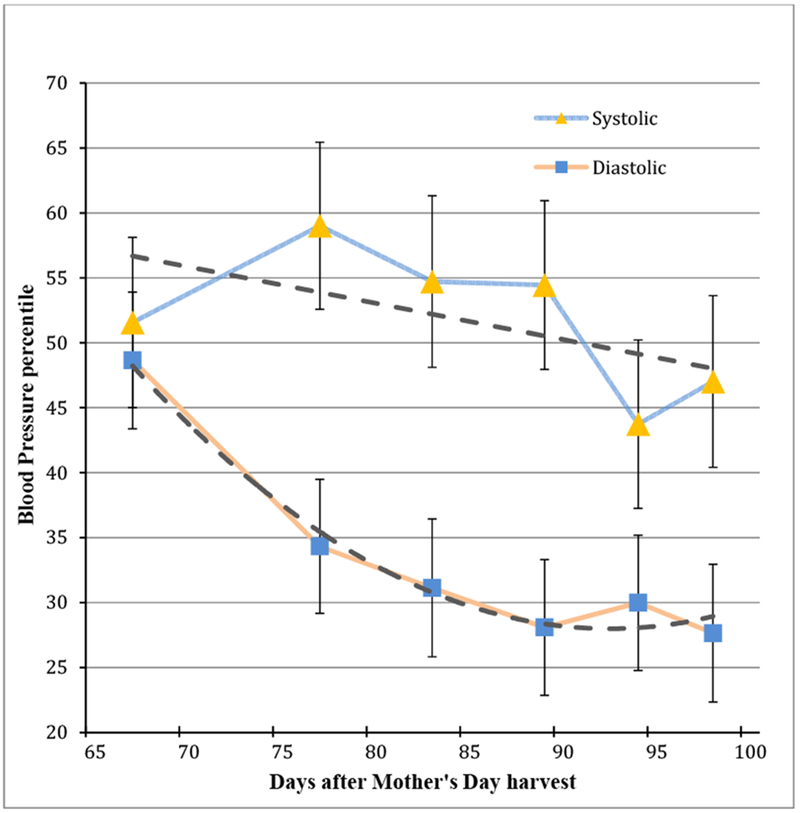
Participants were 51% male, 1.6% hypertensive and 7.7% had elevated BP. The mean (SD) BP percentiles were: systolic: 51.7 (23.9); diastolic: 33.3 (20.3). There was an inverse relationship between of time after the spray season with percentiles of systolic (difference β per 10.9 days after the harvest: −4.3 95%CI: −6.9, −1.7) and diastolic BP (β: −7.5 −9.6, −5.4) after adjusting for race, heart rate and BMI-for-age z-score. A curvilinear association with diastolic BP was observed. For every 10.9 days that a child was examined sooner after the harvest, the OR of elevated BP/hypertension doubled (OR: 2.0, 95% CI: 1.3, 3.1). Time after the harvest was positively associated with acetylcholinesterase.
Conclusions
Children examined sooner after a heightened pesticide spray period had higher blood pressure and pesticide exposure markers than children examined later. Further studies with multiple exposure-outcome measures across pesticide spray periods are needed. -
Subjects:
-
Keywords:
-
Source:Environ Res. 175:335-342
-
Pubmed ID:31150932
-
Pubmed Central ID:PMC6571166
-
Document Type:
-
Funding:
-
Volume:175
-
Download URL:
-
File Type:
 [PDF - 554.98 KB]
 -
Collection(s):
-
Main Document Checksum:urn:sha-512:1bb6c41dae6726f7c33c17ac30f7e2eb0a157d21c24f371b79f0793acbd1a1c23c73ad563bd1b2bc8e36d203e7bd6598c1fd11a68257503adbbdfa0c21e9c147
Supporting Files


File Language:
English
 Was this page helpful?
 Found an issue?



CDC STACKS serves as an archival repository of CDC-published products including
scientific findings, journal articles, guidelines, recommendations, or other public health information authored or
co-authored by CDC or funded partners.
As a repository, CDC STACKS retains documents in their original published format to ensure public access to scientific information.
As a repository, CDC STACKS retains documents in their original published format to ensure public access to scientific information.
You May Also Like
COLLECTION
CDC Public Access