


Association studies of low-frequency coding variants in nonsyndromic cleft lip with or without cleft palate
Supporting Files

-
6 2017
-
File Language:
English
Details
-
Alternative Title:Am J Med Genet A
-
Personal Author:Leslie, Elizabeth J. ; Carlson, Jenna C. ; Shaffer, John R. ; Buxó, Carmen J. ; Castilla, Eduardo E. ; Christensen, Kaare ; Deleyiannis, Frederic W.B. ; Field, L. Leigh ; Hecht, Jacqueline T. ; Moreno, Lina ; Orioli, Ieda M. ; Padilla, Carmencita ; Vieira, Alexandre R. ; Wehby, George L. ; Feingold, Eleanor ; Weinberg, Seth M. ; Murray, Jeffrey C. ; Marazita, Mary L. ; Leslie, Elizabeth J. ; Carlson, Jenna C. ; Shaffer, John R. ; Buxó, Carmen J. ; Castilla, Eduardo E. ; Christensen, Kaare ; Deleyiannis, Frederic W.B. ; Field, L. Leigh ; Hecht, Jacqueline T. ; Moreno, Lina ; Orioli, Ieda M. ; Padilla, Carmencita ; Vieira, Alexandre R. ; Wehby, George L. ; Feingold, Eleanor ; Weinberg, Seth M. ; Murray, Jeffrey C. ; Marazita, Mary L.
-
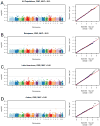
Description:Nonsyndromic cleft lip with or without cleft palate (NSCL/P) is a group of common human birth defects with complex etiology. Although genome-wide association studies have successfully identified a number of risk loci, these loci only account for about 20% of the heritability of orofacial clefts. The "missing" heritability may be found in rare variants, copy number variants, or interactions. In this study, we investigated the role of low-frequency variants genotyped in 1995 cases and 1626 controls on the Illumina HumanCore + Exome chip. We performed two statistical tests, Sequence Kernel Association Test (SKAT) and Combined Multivariate and Collapsing (CMC) method using two minor allele frequency cutoffs (1% and 5%). We found that a burden of low-frequency coding variants in N4BP2, CDSN, PRTG, and AHRR were associated with increased risk of NSCL/P. Low-frequency variants in other genes were associated with decreased risk of NSCL/P. These results demonstrate that low-frequency variants contribute to the genetic etiology of NSCL/P.
-
Subjects:
-
Source:Am J Med Genet A. 173(6):1531-1538 ; Am J Med Genet A. 173(6):1531-1538
-
Pubmed ID:28425186
-
Pubmed Central ID:PMC5444956
-
Document Type:
-
Funding:R01 DE014667/DE/NIDCR NIH HHSUnited States/ ; R25 MD007607/MD/NIMHD NIH HHSUnited States/ ; U54 MD007587/MD/NIMHD NIH HHSUnited States/ ; K99 DE025060/DE/NIDCR NIH HHSUnited States/ ; HHSN268201200008C/HL/NHLBI NIH HHSUnited States/ ; R01 DE016148/DE/NIDCR NIH HHSUnited States/ ; R01 DE011948/DE/NIDCR NIH HHSUnited States/ ; U01 DE024425/DE/NIDCR NIH HHSUnited States/ ; R00 DE025060/DE/NIDCR NIH HHSUnited States/ ; R21 DE016930/DE/NIDCR NIH HHSUnited States/ ; K99 DE024571/DE/NIDCR NIH HHSUnited States/ ; R01 DD000295/DD/NCBDD CDC HHSUnited States/ ; R37 DE008559/DE/NIDCR NIH HHSUnited States/ ; R01 DE011931/DE/NIDCR NIH HHSUnited States/ ; HHSN268201200008I/HL/NHLBI NIH HHSUnited States/ ; R01 DE009886/DE/NIDCR NIH HHSUnited States/
-
Volume:173
-
Issue:6
-
Collection(s):
-
Main Document Checksum:urn:sha256:a5c373cd1d564d311487c135561515e3999628c1970c1db322021d53d379736b
-
Download URL:
-
File Type:
 [PDF
- 208.83 KB
]
[PDF
- 208.83 KB
]
Supporting Files


File Language:
English
ON THIS PAGE

CDC STACKS serves as an archival repository of CDC-published products including
scientific findings,
journal articles, guidelines, recommendations, or other public health information authored or
co-authored by CDC or funded partners.
As a repository, CDC STACKS retains documents in their original published format to ensure public access to scientific information.
As a repository, CDC STACKS retains documents in their original published format to ensure public access to scientific information.
You May Also Like
COLLECTION
CDC Public Access