



Insecticide-Treated Nets and Protection against Insecticide-Resistant Malaria Vectors in Western Kenya
Supporting Files
Public Domain

-
May 2017
File Language:
English
Details
-
Alternative Title:Emerg Infect Dis
-
Personal Author:Ochomo, Eric ; Chahilu, Mercy ; Cook, Jackie ; Kinyari, Teresa ; Bayoh, Nabie M. ; West, Philippa ; Kamau, Luna ; Osangale, Aggrey ; Ombok, Maurice ; Njagi, Kiambo ; Mathenge, Evan ; Muthami, Lawrence ; Subramaniam, Krishanthi ; Knox, Tessa ; Mnavaza, Abraham ; Donnelly, Martin James ; Kleinschmidt, Immo ; Mbogo, Charles
-
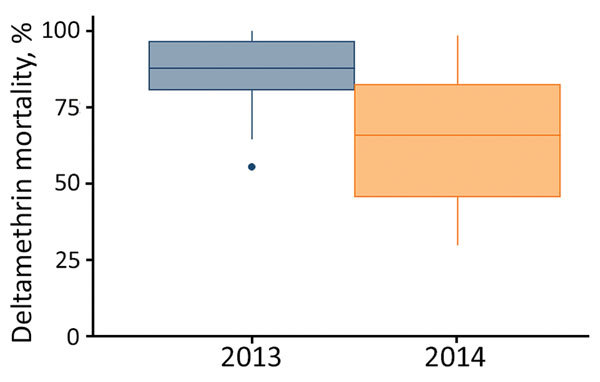
Description:Insecticide resistance might reduce the efficacy of malaria vector control. In 2013 and 2014, malaria vectors from 50 villages, of varying pyrethroid resistance, in western Kenya were assayed for resistance to deltamethrin. Long-lasting insecticide-treated nets (LLIN) were distributed to households at universal coverage. Children were recruited into 2 cohorts, cleared of malaria-causing parasites, and tested every 2 weeks for reinfection. Infection incidence rates for the 2 cohorts were 2.2 (95% CI 1.9-2.5) infections/person-year and 2.8 (95% CI 2.5-3.0) infections/person-year. LLIN users had lower infection rates than non-LLIN users in both low-resistance (rate ratio 0.61, 95% CI 0.42-0.88) and high-resistance (rate ratio 0.55, 95% CI 0.35-0.87) villages (p = 0.63). The association between insecticide resistance and infection incidence was not significant (p = 0.99). Although the incidence of infection was high among net users, LLINs provided significant protection (p = 0.01) against infection with malaria parasite regardless of vector insecticide resistance.
-
Subjects:
-
Source:Emerg Infect Dis. 23(5):758-764.
-
Pubmed ID:28418293
-
Pubmed Central ID:PMC5403037
-
Document Type:
-
Place as Subject:
-
Volume:23
-
Issue:5
-
Download URL:
-
File Type:
 [PDF - 928.27 KB]
 -
Collection(s):
-
Main Document Checksum:urn:sha256:baaee9f7293eb1e858bf0c41c557da02c18b4acb98284fa7c57e8d20c30aeb70
Supporting Files


File Language:
English
 Was this page helpful?
 Found an issue?


CDC STACKS serves as an archival repository of CDC-published products including
scientific findings, journal articles, guidelines, recommendations, or other public health information authored or
co-authored by CDC or funded partners.
As a repository, CDC STACKS retains documents in their original published format to ensure public access to scientific information.
As a repository, CDC STACKS retains documents in their original published format to ensure public access to scientific information.
You May Also Like
COLLECTION
Emerging Infectious Diseases