



Hodgkin lymphoma incidence in California Hispanics: Influence of nativity and tumor Epstein–Barr virus
Supporting Files

-
Apr 11 2014
-
Available in CDC Stacks on 2018-01-09T00:00:00Z
File Language:
English
Details
-
Alternative Title:Cancer Causes Control
-
Personal Author:
-
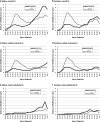
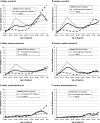
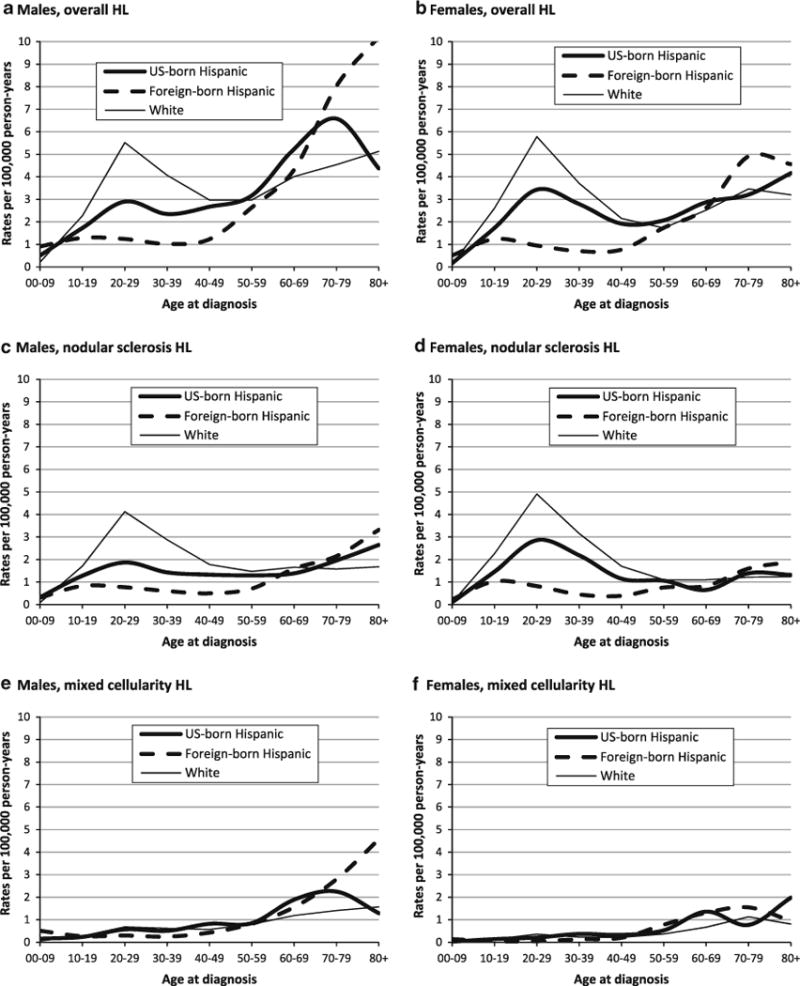
Description:Purpose ; For classical Hodgkin lymphoma (HL), migrant studies could elucidate contributions of environmental factors (including Epstein–Barr virus (EBV)) to the lower rates in non-whites. Given the well-described etiologic complexity of HL, this research requires a large, immigrant population, such as California Hispanics. ; Methods ; With 1988–2004 California Cancer Registry data (2,595 Hispanic, 8,637 white HL cases) and tumor cell EBV status on a subset (218 Hispanics, 656 whites), we calculated ethnicity- and nativity-specific HL incidence rates simultaneously by age, sex, and histologic subtype, and tumor cell EBV prevalence. ; Results ; Compared with white rates, Hispanic HL rates were lower overall (70 %) and for nodular sclerosis HL, particularly among young adults (60–65 % for females). However, they were higher among children (200 %) and older adults, and for mixed cellularity HL. Compared with rates in foreign-born Hispanics, rates in US-born Hispanics were higher among young adults (>threefold in females), lower for children and adults over age 70, and consistently intermediate compared with rates in whites. EBV tumor prevalence was 67, 32, and 23 % among foreign-born Hispanics, US-born Hispanics, and whites, respectively, although with variation by age, sex, and histology. ; Conclusions ; Findings strongly implicate environmental influences, such as nativity-related sociodemographic differences, on HL occurrence. In addition, lower young adult rates and higher EBV prevalence in US-born Hispanics than in whites raise questions about the duration/extent of environmental change for affecting HL rates and also point to ethnic differences in genetic susceptibility. Lesser variation in mixed cellularity HL rates and greater variation in rates for females across groups suggest less modifiable factors interacting with environmental influences.
-
Subjects:
-
Source:Cancer Causes Control. 25(6):709-725.
-
Pubmed ID:24722952
-
Pubmed Central ID:PMC5759958
-
Document Type:
-
Funding:HHSN261201000035C/PC,CA/None/None ; HHSN261201000140C/CA/NCI NIH HHS/United States ; R01CA65661/CA/NCI NIH HHS/United States ; N01-PC-65107/PC/NCI NIH HHS/United States ; N02 PC015105/PC/NCI NIH HHS/United States ; R03CA63245/CA/NCI NIH HHS/United States ; P50CA096888/CA/NCI NIH HHS/United States ; HHSN261201000035I/CA/NCI NIH HHS/United States ; HHSN261201000034C/CA/NCI NIH HHS/United States ; U58 DP003862/DP/NCCDPHP CDC HHS/United States ; N01PC35136/CA/NCI NIH HHS/United States ; P30 CA124435/CA/NCI NIH HHS/United States ; P50 CA096888/CA/NCI NIH HHS/United States ; N01 PC035137/PC/NCI NIH HHS/United States
-
Place as Subject:
-
Volume:25
-
Issue:6
-
Download URL:
-
File Type:
 [PDF - 603.80 KB]
 -
Collection(s):
-
Main Document Checksum:urn:sha256:85216485ff619af8427abe0603468eb1d47fb19ab7ae9e34a1b21cf03b4b7f4f
Supporting Files


File Language:
English
 Was this page helpful?
 Found an issue?


CDC STACKS serves as an archival repository of CDC-published products including
scientific findings, journal articles, guidelines, recommendations, or other public health information authored or
co-authored by CDC or funded partners.
As a repository, CDC STACKS retains documents in their original published format to ensure public access to scientific information.
As a repository, CDC STACKS retains documents in their original published format to ensure public access to scientific information.
You May Also Like
COLLECTION
CDC Public Access