


Comparison of Sputum-Culture Conversion for Mycobacterium bovis and M. tuberculosis
Supporting Files
Public Domain

-
Mar 2017
-
Details
-
Alternative Title:Emerg Infect Dis
-
Personal Author:
-
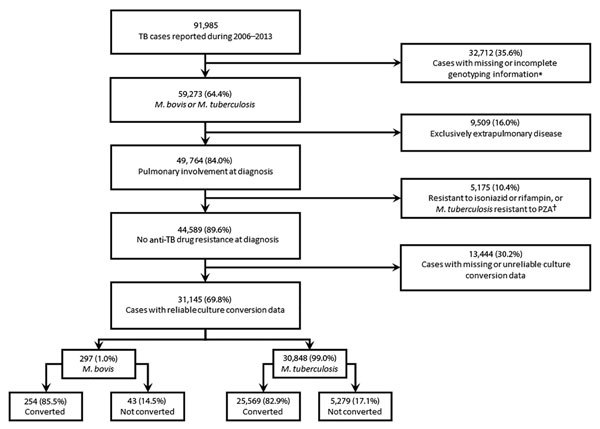
Description:Current US guidelines recommend longer treatment for tuberculosis (TB) caused by pyrazinamide-resistant organisms (e.g., Mycobacterium bovis) than for M. tuberculosis TB. We compared treatment response times for patients with M. bovis TB and M. tuberculosis TB reported in the United States during 2006-2013. We included culture-positive, pulmonary TB patients with genotyping results who received standard 4-drug treatment at the time of diagnosis. Time to sputum-culture conversion was defined as time between treatment start date and date of first consistently culture-negative sputum. We analyzed 297 case-patients with M. bovis TB and 30,848 case-patients with M. tuberculosis TB. After 2 months of treatment, 71% of M. bovis and 65% of M. tuberculosis TB patients showed conversion of sputum cultures to negative. Likelihood of culture conversion was higher for M. bovis than for M. tuberculosis, even after controlling for treatment administration type, sex, and a composite indicator of bacillary burden.
-
Subjects:
-
Source:Emerg Infect Dis. 23(3):456-462.
-
Pubmed ID:28221125
-
Pubmed Central ID:PMC5382750
-
Document Type:
-
Volume:23
-
Issue:3
-
Collection(s):
-
Main Document Checksum:urn:sha256:a527fffea3bc11b8b6b3fbd413e0d94e9b2268b56d6a4a46e97f6e369cb9f47c
-
Download URL:
-
File Type:
 [PDF
- 1.02 MB
]
[PDF
- 1.02 MB
]
Supporting Files


ON THIS PAGE


CDC STACKS serves as an archival repository of CDC-published products including
scientific findings,
journal articles, guidelines, recommendations, or other public health information authored or
co-authored by CDC or funded partners.
As a repository, CDC STACKS retains documents in their original published format to ensure public access to scientific information.
As a repository, CDC STACKS retains documents in their original published format to ensure public access to scientific information.
You May Also Like
COLLECTION
Emerging Infectious Diseases