



Evaluation of sputum culture conversion as a prognostic marker for end-of-treatment outcome inpatients with multidrug-resistant tuberculosis
Supporting Files

-
3 2015 ; 3-2015
-
Available in CDC Stacks on March 01, 2016, 12:00 AM
File Language:
English
Details
-
Alternative Title:Lancet Respir Med
-
Personal Author:Kurbatova, Ekaterina V. ; Cegielski, J. Peter ; Lienhardt, Christian ; Akksilp, Rattanawadee ; Bayona, Jaime ; Becerra, Mercedes C. ; Caoili, Janice ; Contreras, Carmen ; Dalton, Tracy ; Danilovits, Manfred ; Demikhova, Olga V. ; Ershova, Julia ; Gammino, Victoria M. ; Gelmanova, Irina ; Heilig, Charles M. ; Jou, Ruwen ; Kazennyy, Boris ; Keshavjee, Salmaan ; Kim, Hee Jin ; Kliiman, Kai ; Kvasnovsky, Charlotte ; Leimane, Vaira ; Mitnick, Carole D. ; Quelapio, Imelda ; Riekstina, Vija ; Smith, Sarah E. ; Tupasi, Thelma ; van der Walt, Martie ; Vasilyeva, Irina A. ; Via, Laura E. ; Viiklepp, Piret ; Volchenkov, Grigory ; Walker, Allison Taylor ; Wolfgang, Melanie ; Yagui, Martin ; Zignol, Matteo
-
Description:Background
To assess the validity of sputum culture conversion (SCC) on solid media at varying time points and the time to SCC as prognostic markers for end-of-treatment outcome in multidrug-resistant (MDR) tuberculosis (TB) patients.
Methods
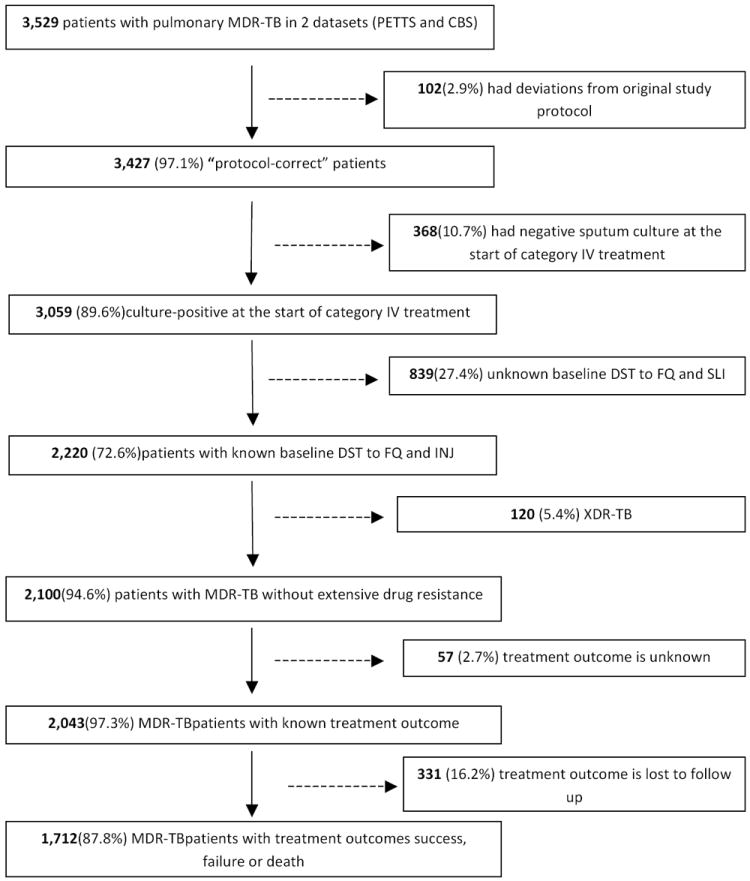
Data on1,712 MDR-TB patients from two large cohort studies were analyzed. Measures of association were determined using random effects multivariable logistic regression. Predictive values were calculated using bivariate random-effects generalized linear mixed model.
Findings
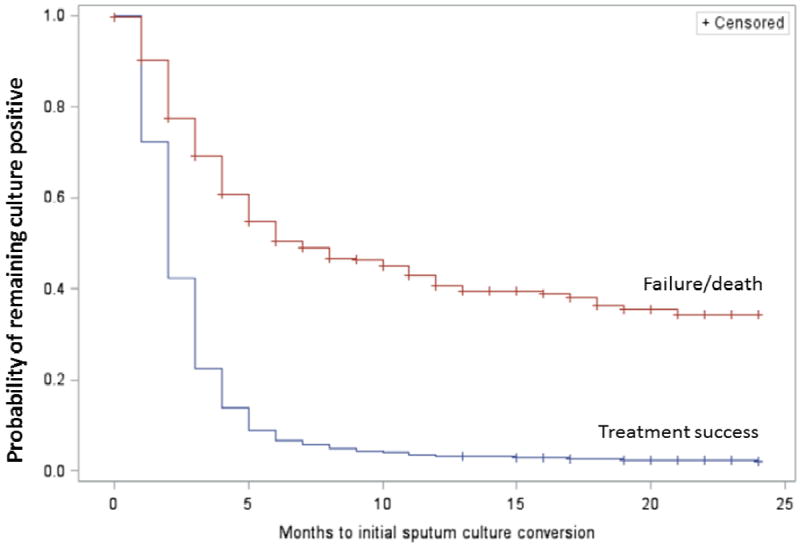
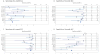
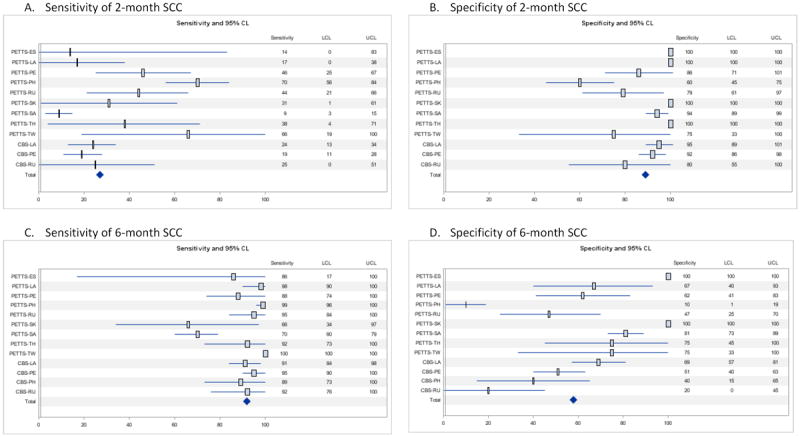
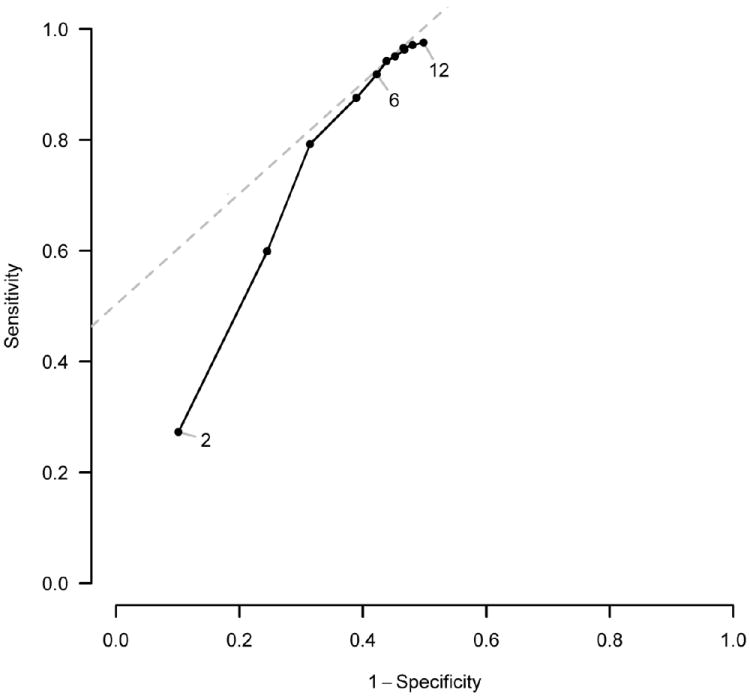
Times to SCC and SCC status at 6 months were significantly associated with treatment success compared to failure or death. SCC status at 2 months was significantly associated with treatment success among patients without known HIV infection only. The overall association of SCC with a successful outcome was substantially stronger at 6 months (adjusted odds ratio aOR=14.07, 95% CI 10.05–19.71) than at 2 months (HIV-negative patients: aOR=4.12 2.25–7.54; HIV unknown: aOR=3.59 1.96–6.58, HIV-positive: aOR=0.38 0.12–1.18). The 2-month SCC had low sensitivity (27%) and high specificity (90%) for predicting treatment success. Conversely, 6-month SCC status had high sensitivity (92%), but moderate specificity (58%). The maximum combined sensitivity and specificity for SCC was reached between the 6th and 10th month of treatment.
Interpretation
Time to SCC, SCC status at 6 months, and SCC status at 2 months among patients without known HIV infection can be considered proxy markers of end-of-treatment outcome in MDR-TB patients, but the overall association with treatment success is substantially stronger for 6-month compared to 2-month SCC.
Funding
USAID, the US CDC, the Division of Intramural Research of NIAID/NIH, and the Republic of Korea’s CDC. -
Subjects:
-
Keywords:
-
Source:Lancet Respir Med. 2015; 3(3):201-209
-
Pubmed ID:25726085
-
Pubmed Central ID:PMC4401426
-
Document Type:
-
Funding:
-
Volume:3
-
Issue:3
-
Download URL:
-
File Type:
 [PDF - 447.74 KB]
 -
Collection(s):
-
Main Document Checksum:urn:sha256:deab06518eeed68375316c77c5792edc97ed83a09eaca4f0d35cf3d12c2d3331
Supporting Files


File Language:
English
 Was this page helpful?
 Found an issue?


CDC STACKS serves as an archival repository of CDC-published products including
scientific findings, journal articles, guidelines, recommendations, or other public health information authored or
co-authored by CDC or funded partners.
As a repository, CDC STACKS retains documents in their original published format to ensure public access to scientific information.
As a repository, CDC STACKS retains documents in their original published format to ensure public access to scientific information.
You May Also Like
COLLECTION
CDC Public Access