



Epidemiology of Invasive Haemophilus influenzae Disease, Europe, 2007–2014
Supporting Files
Public Domain

-
Mar 2017
-
File Language:
English
Details
-
Alternative Title:Emerg Infect Dis
-
Personal Author:
-
Corporate Authors:
-
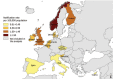
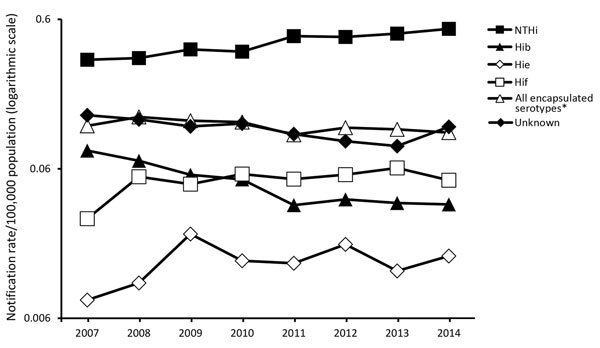
Description:We describe the epidemiology of invasive Haemophilus influenzae disease during 2007-2014 in 12 European countries and assess overall H. influenzae disease trends by serotype and patient age. Mean annual notification rate was 0.6 cases/100,000 population, with an increasing annual trend of 3.3% (95% CI 2.3% to 4.3%). The notification rate was highest for patients <1 month of age (23.4 cases/100,000 population). Nontypeable H. influenzae (NTHi) caused 78% of all cases and showed increasing trends among persons <1 month and >20 years of age. Serotype f cases showed an increasing trend among persons >60 years of age. Serotype b cases showed decreasing trends among persons 1-5 months, 1-4 years, and >40 years of age. Sustained success of routine H. influenzae serotype b vaccination is evident. Surveillance systems must adopt a broad focus for invasive H. influenzae disease. Increasing reports of NTHi, particularly among neonates, highlight the potential benefit of a vaccine against NTHi.
-
Subjects:
-
Source:Emerg Infect Dis. 23(3):396-404.
-
Pubmed ID:28220749
-
Pubmed Central ID:PMC5382729
-
Document Type:
-
Place as Subject:
-
Volume:23
-
Issue:3
-
Collection(s):
-
Main Document Checksum:urn:sha256:559e68e4439b0ef1e14a9176388b99684c96d08b99e33acd1568675bc71b96ec
-
Download URL:
-
File Type:
 [PDF
- 1.27 MB
]
[PDF
- 1.27 MB
]
Supporting Files


File Language:
English
 Was this page helpful?
 Found an issue?




CDC STACKS serves as an archival repository of CDC-published products including
scientific findings,
journal articles, guidelines, recommendations, or other public health information authored or
co-authored by CDC or funded partners.
As a repository, CDC STACKS retains documents in their original published format to ensure public access to scientific information.
As a repository, CDC STACKS retains documents in their original published format to ensure public access to scientific information.
You May Also Like
COLLECTION
Emerging Infectious Diseases