



Genome-wide meta-analyses of nonsyndromic orofacial clefts identify novel associations between FOXE1 and all orofacial clefts, and TP63 and cleft lip with or without cleft palate
Supporting Files

-
3 2017 ; 3-2017
-
Available in CDC Stacks on 2018-03-01T00:00:00Z
File Language:
English
Details
-
Alternative Title:Hum Genet
-
Personal Author:Leslie, Elizabeth J. ; Carlson, Jenna C. ; Shaffer, John R. ; Butali, Azeez ; Buxó, Carmen J. ; Castilla, Eduardo E. ; Christensen, Kaare ; Deleyiannis, Fred W.-B. ; Field, L. Leigh ; Hecht, Jacqueline T. ; Moreno, Lina ; Orioli, Ieda M. ; Padilla, Carmencita ; Vieira, Alexandre R. ; Wehby, George L. ; Feingold, Eleanor ; Weinberg, Seth M. ; Murray, Jeffrey C. ; Beaty, Terri H. ; Marazita, Mary L.
-
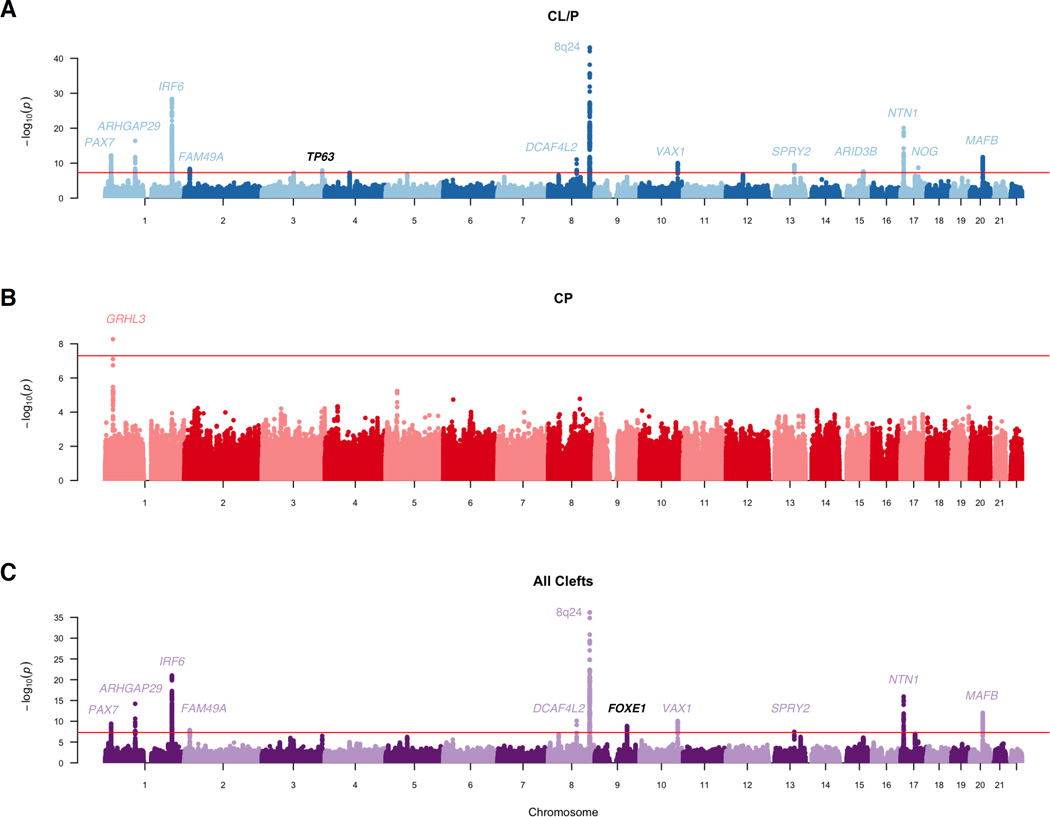
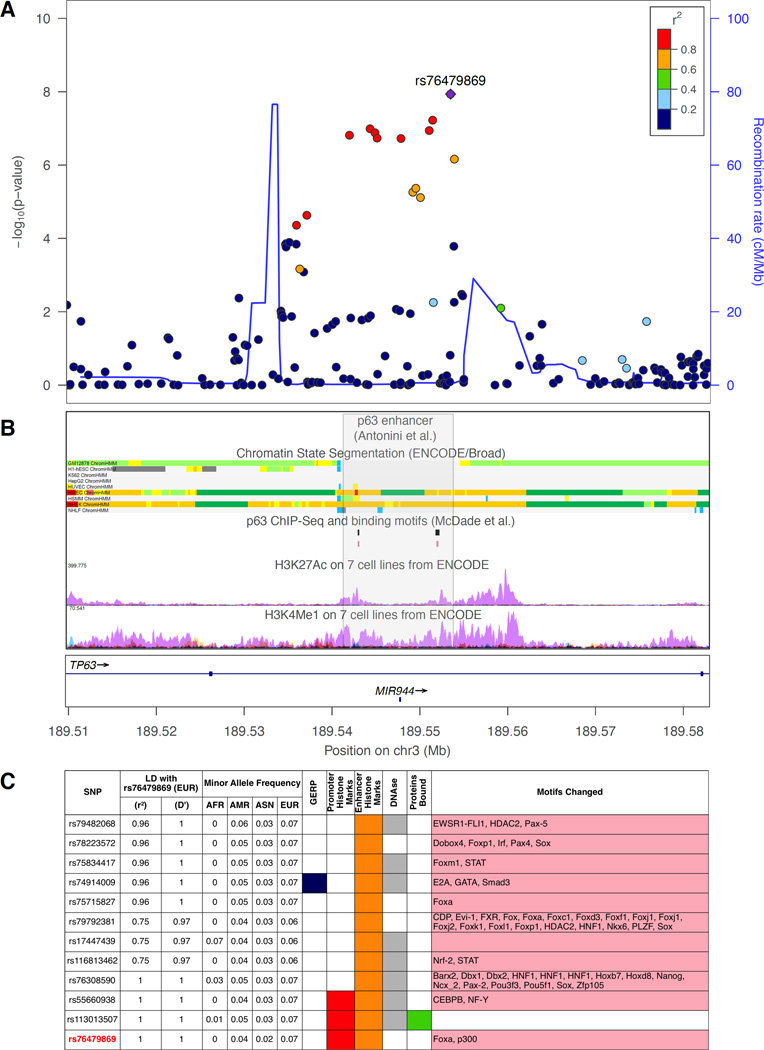
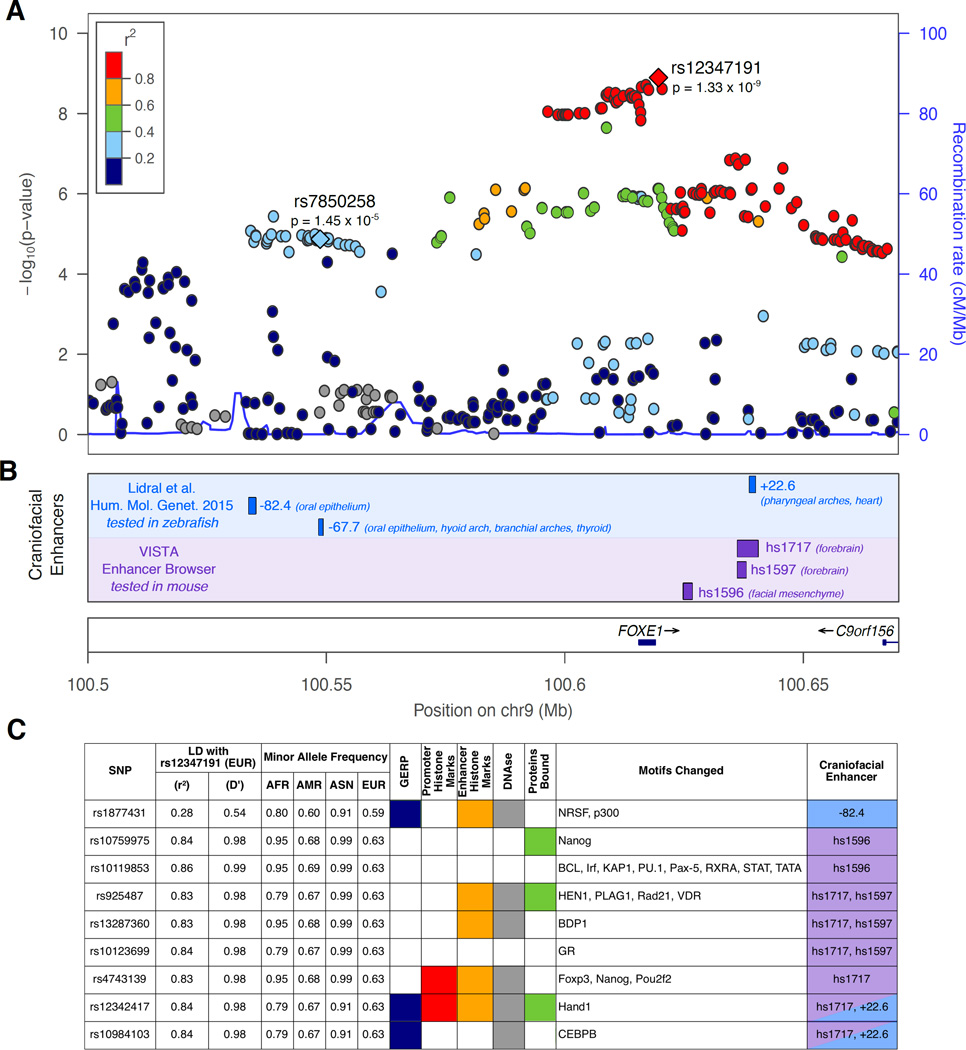
Description:Nonsyndromic orofacial clefts (OFCs) are a heterogeneous group of common craniofacial birth defects with complex etiologies that include genetic and environmental risk factors. OFCs are commonly categorized as cleft lip with or without cleft palate (CL/P) and cleft palate alone (CP), which have historically been analyzed as distinct entities. Genes for both CL/P and CP have been identified via multiple genome-wide linkage and association studies (GWAS); however, altogether, known variants account for a minority of the estimated heritability in risk to these craniofacial birth defects. We performed genome-wide meta-analyses of CL/P, CP, and all OFCs across two large, multiethnic studies. We then performed population-specific meta-analyses in sub-samples of Asian and European ancestry. In addition to observing associations with known variants, we identified a novel genome-wide significant association between SNPs located in an intronic TP63 enhancer and CL/P (p = 1.16 × 10|). Several novel loci with compelling candidate genes approached genome-wide significance on 4q21.1 (SHROOM3), 12q13.13 (KRT18), and 8p21 (NRG1). In the analysis of all OFCs combined, SNPs near FOXE1 reached genome-wide significance (p = 1.33 × 10|). Our results support the highly heterogeneous nature of OFCs and illustrate the utility of meta-analysis for discovering new genetic risk factors.
-
Keywords:
-
Source:Hum Genet. 136(3):275-286
-
Pubmed ID:28054174
-
Pubmed Central ID:PMC5317097
-
Document Type:
-
Funding:R01 DE014667/DE/NIDCR NIH HHSUnited States/ ; U54 MD007587/MD/NIMHD NIH HHSUnited States/ ; K99 DE025060/DE/NIDCR NIH HHSUnited States/ ; HHSN268201200008C/HL/NHLBI NIH HHSUnited States/ ; R01 DE014581/DE/NIDCR NIH HHSUnited States/ ; R01 DE011948/DE/NIDCR NIH HHSUnited States/ ; U01 DE024425/DE/NIDCR NIH HHSUnited States/ ; R00 DE025060/DE/NIDCR NIH HHSUnited States/ ; R21 DE016930/DE/NIDCR NIH HHSUnited States/ ; K99 DE024571/DE/NIDCR NIH HHSUnited States/ ; R01 DD000295/DD/NCBDD CDC HHSUnited States/ ; R37 DE008559/DE/NIDCR NIH HHSUnited States/ ; R01 DE011931/DE/NIDCR NIH HHSUnited States/ ; R25 MD007607/MD/NIMHD NIH HHSUnited States/ ; U01 DE018993/DE/NIDCR NIH HHSUnited States/ ; R00 DE024571/DE/NIDCR NIH HHSUnited States/ ; R01 DE016148/DE/NIDCR NIH HHSUnited States/ ; HHSN268201200008I/HL/NHLBI NIH HHSUnited States/ ; R01 DE009886/DE/NIDCR NIH HHSUnited States/
-
Volume:136
-
Issue:3
-
Download URL:
-
File Type:
 [PDF - 1.20 MB]
 -
Collection(s):
-
Main Document Checksum:urn:sha256:cc572ad8090b16c1a926d871b04854832c32306033754ff0468c3a5188376dba
Supporting Files


File Language:
English
 Was this page helpful?
 Found an issue?


CDC STACKS serves as an archival repository of CDC-published products including
scientific findings, journal articles, guidelines, recommendations, or other public health information authored or
co-authored by CDC or funded partners.
As a repository, CDC STACKS retains documents in their original published format to ensure public access to scientific information.
As a repository, CDC STACKS retains documents in their original published format to ensure public access to scientific information.
You May Also Like
COLLECTION
CDC Public Access