


Chemotherapy Decisions and Patient Experience with the Recurrence Score Assay for Early-Stage Breast Cancer
Supporting Files

-
Oct 24 2016
-
File Language:
English
Details
-
Alternative Title:Cancer
-
Personal Author:
-
Description:Background
The 21-gene recurrence score assay (RS) stratifies early-stage, estrogen receptor-positive breast cancer by recurrence risk. Few studies have examined how physicians use RS to recommend adjuvant systemic chemotherapy or patient experiences with testing and decision-making.
Methods
We surveyed 3,880 women treated for breast cancer in 2013-2014, identified by the Los Angeles County and Georgia SEER registries (response rate: 71%). Women reported chemotherapy recommendations, chemotherapy receipt, testing experiences, and decision satisfaction. Registries linked tumor data, RS, and surveys. Regression models examined factors associated with chemotherapy recommendations and receipt by RS and subgroups.
Results
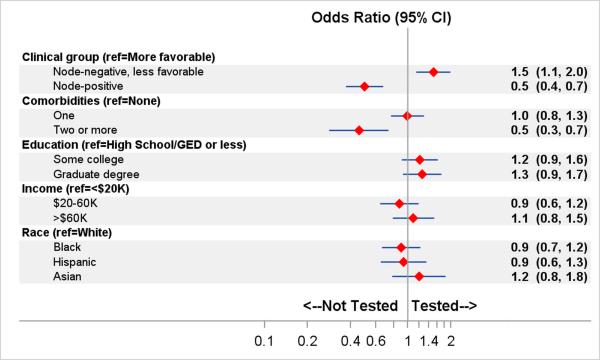
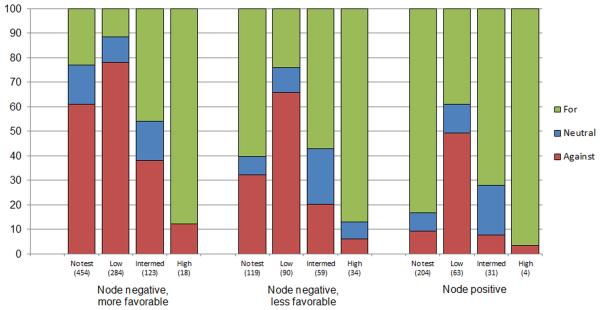
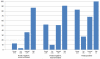
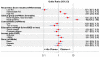
Of 1,527 patients with Stage I-II, ER/PR(+), HER2-negative disease: 778 received RS (62.6% for node-negative favorable, 24.3% in node-negative, unfavorable, and 13.0% in node-positive disease, p<.001). Overall, 47.2% of patients received a recommendation against chemotherapy and 40.6% received a recommendation for it. RS results correlated with recommendations: nearly all patients with high scores (31-100) received a chemotherapy recommendation (86.9%-96.5% across clinical subgroups), while the majority of patients with low-risk results (0-18) received a recommendation against it (49.2%-78.2% across subgroups). Most patients with high RS received chemotherapy (87.0%, 91.1%, 100% across subgroups), while few patients with low scores received it (2.9%, 9.5%, 26.6% across subgroups). There were no substantial racial/ethnic differences in testing and treatment. Women were largely satisfied with RS and chemotherapy decisions.
Conclusions
Oncologists use RS to personalize treatment, even in node-positive disease. High satisfaction and absence of disparities in testing and treatment suggests that precision medicine advances have improved systemic breast cancer treatment.
-
Subjects:
-
Source:Cancer. 123(1):43-51
-
Pubmed ID:27775837
-
Pubmed Central ID:PMC5161570
-
Document Type:
-
Funding:HHSN261201000140C/CA/NCI NIH HHS/United States ; HHSN261201000035C/CA/NCI NIH HHS/United States ; HHSN261201300015C/RC/CCR NIH HHS/United States ; HHSN261201000035I/CA/NCI NIH HHS/United States ; HHSN261201000034C/CA/NCI NIH HHS/United States ; U58 DP003862/DP/NCCDPHP CDC HHS/United States ; P01 CA163233/CA/NCI NIH HHS/United States ; U58 DP003875/DP/NCCDPHP CDC HHS/United States
-
Volume:123
-
Issue:1
-
Collection(s):
-
Main Document Checksum:urn:sha256:ed3a3d88a9fcecb33a75c34234ba3bbf9fcefae68c6dfbb97108835df8e30b07
-
Download URL:
-
File Type:
 [PDF
- 471.05 KB
]
[PDF
- 471.05 KB
]
Supporting Files


File Language:
English
ON THIS PAGE



CDC STACKS serves as an archival repository of CDC-published products including
scientific findings,
journal articles, guidelines, recommendations, or other public health information authored or
co-authored by CDC or funded partners.
As a repository, CDC STACKS retains documents in their original published format to ensure public access to scientific information.
As a repository, CDC STACKS retains documents in their original published format to ensure public access to scientific information.
You May Also Like
COLLECTION
CDC Public Access