



Estimating HIV Incidence among Adults in Kenya and Uganda: A Systematic Comparison of Multiple Methods
Supporting Files
Public Domain

-
Mar 07 2011
File Language:
English
Details
-
Alternative Title:PLoS One
-
Personal Author:Kim, Andrea A. ; Hallett, Timothy ; Stover, John ; Gouws, Eleanor ; Musinguzi, Joshua ; Mureithi, Patrick K. ; Bunnell, Rebecca ; Hargrove, John ; Mermin, Jonathan ; Kaiser, Reinhard K. ; Barsigo, Anne ; Ghys, Peter D.
-
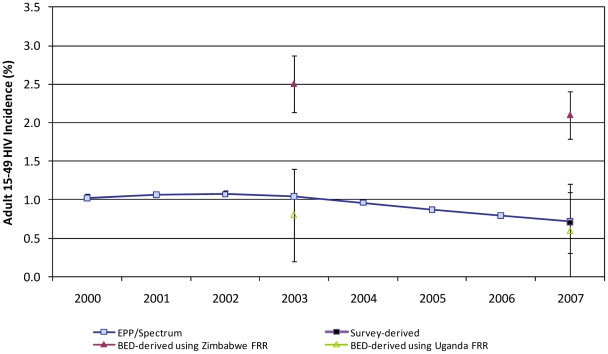
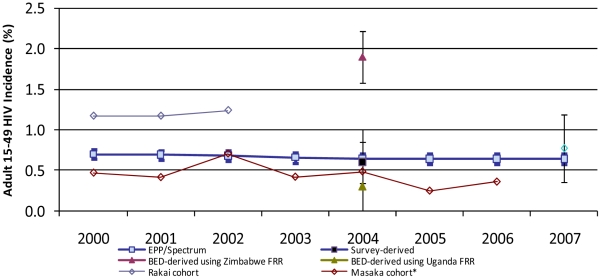
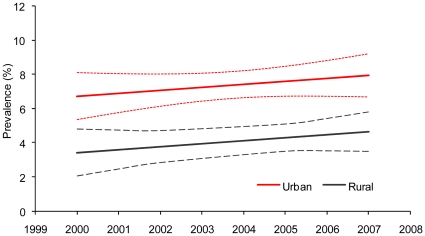
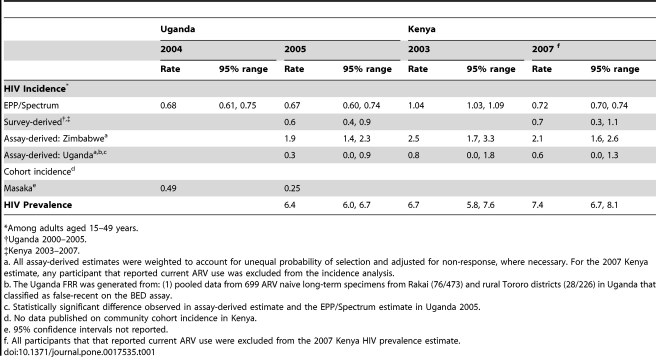
Description:Background ; Several approaches have been used for measuring HIV incidence in large areas, yet each presents specific challenges in incidence estimation. ; Methodology/Principal Findings ; We present a comparison of incidence estimates for Kenya and Uganda using multiple methods: 1) Epidemic Projections Package (EPP) and Spectrum models fitted to HIV prevalence from antenatal clinics (ANC) and national population-based surveys (NPS) in Kenya (2003, 2007) and Uganda (2004/2005); 2) a survey-derived model to infer age-specific incidence between two sequential NPS; 3) an assay-derived measurement in NPS using the BED IgG capture enzyme immunoassay, adjusted for misclassification using a locally derived false-recent rate (FRR) for the assay; (4) community cohorts in Uganda; (5) prevalence trends in young ANC attendees. EPP/Spectrum-derived and survey-derived modeled estimates were similar: 0.67 uncertainty range: 0.60, 0.74 and 0.6 confidence interval: (CI) 0.4, 0.9, respectively, for Uganda (2005) and 0.72 uncertainty range: 0.70, 0.74 and 0.7 CI 0.3, 1.1, respectively, for Kenya (2007). Using a local FRR, assay-derived incidence estimates were 0.3 CI 0.0, 0.9 for Uganda (2004/2005) and 0.6 CI 0, 1.3 for Kenya (2007). Incidence trends were similar for all methods for both Uganda and Kenya. ; Conclusions/Significance ; Triangulation of methods is recommended to determine best-supported estimates of incidence to guide programs. Assay-derived incidence estimates are sensitive to the level of the assay's FRR, and uncertainty around high FRRs can significantly impact the validity of the estimate. Systematic evaluations of new and existing incidence assays are needed to the study the level, distribution, and determinants of the FRR to guide whether incidence assays can produce reliable estimates of national HIV incidence.
-
Subjects:
-
Source:PLoS One. 6(3).
-
Document Type:
-
Place as Subject:
-
Volume:6
-
Issue:3
-
Download URL:
-
File Type:
 [PDF - 351.90 KB]
 -
Collection(s):
-
Main Document Checksum:urn:sha-512:634d91f8046e039d725c0f532e43979baff0869fc1cade37eb371a6c58f464a02551276b3cdca80cc7932d0dd6e55eae27fdaaf02613d8ce11ca7fe48da41dc0
Supporting Files


File Language:
English
 Was this page helpful?
 Found an issue?




CDC STACKS serves as an archival repository of CDC-published products including
scientific findings, journal articles, guidelines, recommendations, or other public health information authored or
co-authored by CDC or funded partners.
As a repository, CDC STACKS retains documents in their original published format to ensure public access to scientific information.
As a repository, CDC STACKS retains documents in their original published format to ensure public access to scientific information.
You May Also Like
COLLECTION
CDC Public Access