



Whole-Genome Characterization of Epidemic Neisseria meningitidis Serogroup C and Resurgence of Serogroup W, Niger, 2015
Supporting Files
Public Domain

-
Oct 2016
Details
-
Alternative Title:Emerg Infect Dis
-
Personal Author:Kretz, Cecilia B. ; Retchless, Adam C. ; Sidikou, Fati ; Issaka, Bassira ; Ousmane, Sani ; Schwartz, Stephanie ; Tate, Ashley H. ; Pana, Assimawè ; Njanpop-Lafourcade, Berthe-Marie ; Nzeyimana, Innocent ; Nse, Ricardo Obama ; Deghmane, Ala-Eddine ; Hong, Eva ; Brynildsrud, Ola Brønstad ; Novak, Ryan T. ; Meyer, Sarah A. ; Oukem-Boyer, Odile Ouwe Missi ; Ronveaux, Olivier ; Caugant, Dominique A. ; Taha, Muhamed-Kheir ; Wang, Xin
-
Corporate Authors:
-
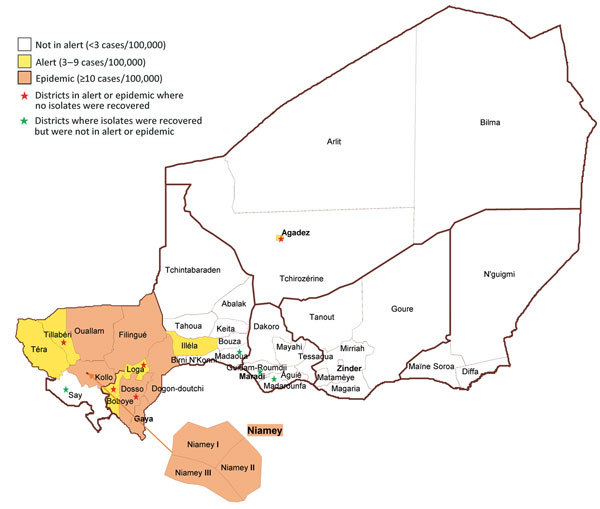
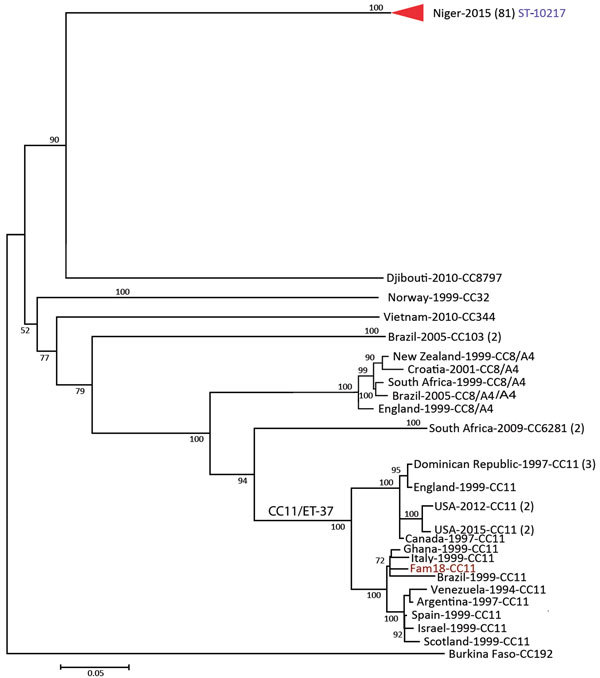
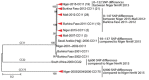
Description:In 2015, Niger reported the largest epidemic of Neisseria meningitidis serogroup C (NmC) meningitis in sub-Saharan Africa. The NmC epidemic coincided with serogroup W (NmW) cases during the epidemic season, resulting in a total of 9,367 meningococcal cases through June 2015. To clarify the phylogenetic association, genetic evolution, and antibiotic determinants of the meningococcal strains in Niger, we sequenced the genomes of 102 isolates from this epidemic, comprising 81 NmC and 21 NmW isolates. The genomes of 82 isolates were completed, and all 102 were included in the analysis. All NmC isolates had sequence type 10217, which caused the outbreaks in Nigeria during 2013-2014 and for which a clonal complex has not yet been defined. The NmC isolates from Niger were substantially different from other NmC isolates collected globally. All NmW isolates belonged to clonal complex 11 and were closely related to the isolates causing recent outbreaks in Africa.
-
Subjects:
-
Source:Emerg Infect Dis. 22(10):1762-1768.
-
Pubmed ID:27649262
-
Pubmed Central ID:PMC5038424
-
Document Type:
-
Volume:22
-
Issue:10
-
Download URL:
-
File Type:
 [PDF - 1.53 MB]
 -
Collection(s):
-
Main Document Checksum:urn:sha256:d377a298c571aad0ecf6fd839b8c4003cfd6d2f3f8a0841c4f13f7cae7a6a850
Supporting Files


 Was this page helpful?
 Found an issue?


CDC STACKS serves as an archival repository of CDC-published products including
scientific findings, journal articles, guidelines, recommendations, or other public health information authored or
co-authored by CDC or funded partners.
As a repository, CDC STACKS retains documents in their original published format to ensure public access to scientific information.
As a repository, CDC STACKS retains documents in their original published format to ensure public access to scientific information.
You May Also Like
COLLECTION
Emerging Infectious Diseases