



Use of a Comprehensive HIV Care Cascade for Evaluating HIV Program Performance: Findings From 4 Sub-Saharan African Countries
Supporting Files

-
10 1 2015 ; 10-1-
-
Available in CDC Stacks on November 03, 2016, 12:00 AM
File Language:
English
Details
-
Alternative Title:J Acquir Immune Defic Syndr
-
Personal Author:
-
Description:Background
The traditional HIV treatment cascade has been noted to have limitations. A proposed comprehensive HIV care cascade that uses cohort methodology offers additional information as it accounts for all patients. Using data from 4 countries, we compare patient outcomes using both approaches.
Methods
Data from 390,603 HIV-infected adults (>15 years) enrolled at 217 facilities in Kenya, Mozambique, Rwanda, and Tanzania from 2005 to 2011 were included. Outcomes of all patients at 3, 6, and 12 months after enrollment were categorized as optimal, suboptimal, or poor. Optimal outcomes included retention in care, antiretroviral therapy (ART) initiation, and documented transfer. Suboptimal outcomes included retention in care without ART initiation among eligible patients or those without eligibility data. Poor outcomes included loss to follow-up and death.
Results
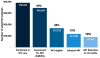
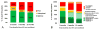
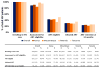
The comprehensive HIV care cascade demonstrated that at 3, 6 and 12 months, 58%, 51%, and 49% of patients had optimal outcomes; 22%, 12%, and 7% had suboptimal outcomes, and 20%, 37% and 44% had poor outcomes. Of all patients enrolled in care, 56% were retained in care at 12 months after enrollment. In comparison, the traditional HIV treatment cascade found 89% of patients enrolled in HIV care were assessed for ART eligibility, of whom 48% were determined to be ART-eligible with 70% initiating ART, and 78% of those initiated on ART retained at 12 months.
Conclusions
The comprehensive HIV care cascade follows outcomes of all patients, including pre-ART patients, who enroll in HIV care over time and uses quality of care parameters for categorizing outcomes. The comprehensive HIV care cascade provides complementary information to that of the traditional HIV treatment cascade and is a valuable tool for monitoring HIV program performance. -
Keywords:
-
Source:J Acquir Immune Defic Syndr. 70(2):e44-e51
-
Pubmed ID:26375466
-
Pubmed Central ID:PMC5094356
-
Document Type:
-
Funding:
-
Volume:70
-
Issue:2
-
Download URL:
-
File Type:
 [PDF - 884.65 KB]
 -
Collection(s):
-
Main Document Checksum:urn:sha256:34712bc62b722a0c5fd992b8282463d7ddb240226daec309aaf15aad20df02c9
Supporting Files


File Language:
English
 Was this page helpful?
 Found an issue?





CDC STACKS serves as an archival repository of CDC-published products including
scientific findings, journal articles, guidelines, recommendations, or other public health information authored or
co-authored by CDC or funded partners.
As a repository, CDC STACKS retains documents in their original published format to ensure public access to scientific information.
As a repository, CDC STACKS retains documents in their original published format to ensure public access to scientific information.
You May Also Like
COLLECTION
CDC Public Access