


Hepatocellular Carcinoma Risk in Hepatitis B Virus Infected Alaska Native Children and Young Adults: Retrospective Cohort Analysis
Supporting Files

-
Aug 30 2016
-
File Language:
English
Details
-
Alternative Title:J Pediatr
-
Personal Author:
-
Description:Objectives
To evaluate the hepatocellular carcinoma (HCC) risk in hepatitis B virus (HBV)-infected Alaska Native (AN) children and young adults.
Study design
Retrospective analysis of a population-based cohort of HBV-infected AN persons followed during 1982–2012. All HBV-infected persons were offered HCC screening regardless of age using alpha-fetoprotein (AFP) every 6 months; persons with an elevated AFP or persons at high-risk for HCC, such as cirrhosis, family history of HCC, were offered ultrasound. We calculated the HCC incidence/1,000 person-years from date of cohort entry until death, diagnosis of HCC, or attaining the age of 40 years (males) or 50 years (females).
Results
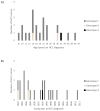
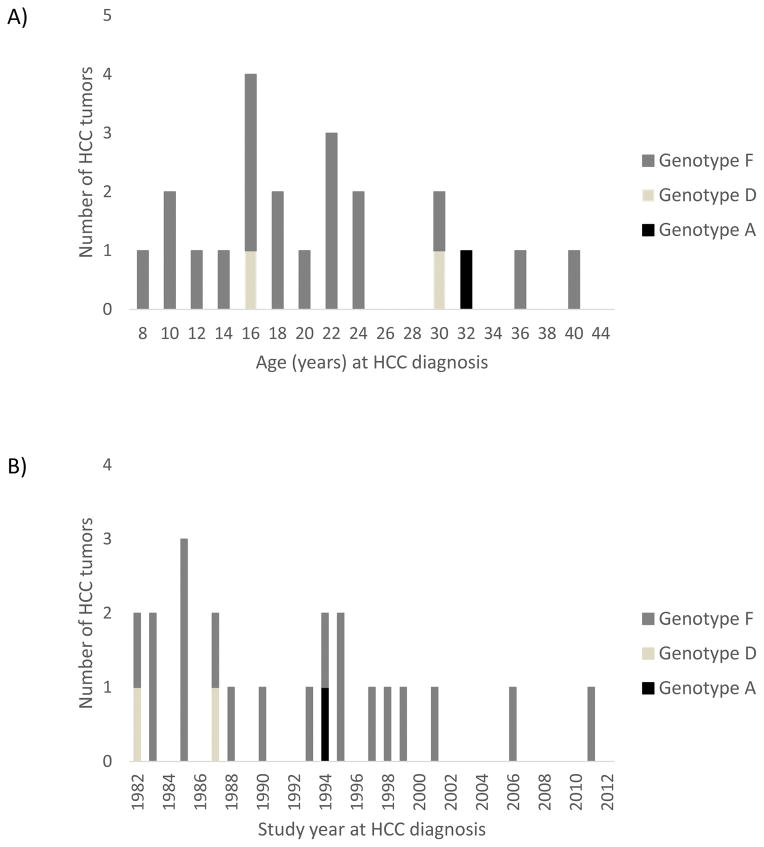
We followed 1083 HBV-infected persons (56% male) comprising 5 genotypes (A2 [12.5%], B6 [1.7%], C [5.3%], D [49.7%], F1 [18.6%], unknown [12.4%]) for a median of 23.4 years/person. We observed 22 HCC cases (incidence/1,000 person-years follow-up: 1.0); 19 HCC cases among persons with genotype F1. There was no significant difference in HCC incidence between males (1.4) and females (0.6). The HCC incidence was significantly higher for persons with genotype F1 (4.4) compared with genotype A2 (0.4) and D (0.2) and remained higher among persons with HBV genotype F1 excluding persons with HCC family history/cirrhosis (1.9).
Conclusions
HBV genotype F1-infected AN children and young adults are at high risk for HCC and should receive HCC surveillance. For HBV-infected males and females age <40 and <50 years, respectively, in regions of the world with a high genotype F prevalence, testing/confirming genotype F can identify persons who could benefit from HCC surveillance.
-
Subjects:
-
Source:J Pediatr. 178:206-213.
-
Pubmed ID:27590612
-
Pubmed Central ID:PMC5085839
-
Document Type:
-
Funding:
-
Volume:178
-
Collection(s):
-
Main Document Checksum:urn:sha256:cf6cc7b6bdd356c0cad123b13d22379c42bcf843710838061c17cf2f91061486
-
Download URL:
-
File Type:
 [PDF
- 258.25 KB
]
[PDF
- 258.25 KB
]
Supporting Files


File Language:
English
ON THIS PAGE

CDC STACKS serves as an archival repository of CDC-published products including
scientific findings,
journal articles, guidelines, recommendations, or other public health information authored or
co-authored by CDC or funded partners.
As a repository, CDC STACKS retains documents in their original published format to ensure public access to scientific information.
As a repository, CDC STACKS retains documents in their original published format to ensure public access to scientific information.
You May Also Like
COLLECTION
CDC Public Access