


Heterogeneity of breast cancer subtypes and survival among Hispanic women with invasive breast cancer in California
Supporting Files

-
Feb 28 2014
-
File Language:
English
Details
-
Alternative Title:Breast Cancer Res Treat
-
Personal Author:
-
Description:Purpose
There are limited data regarding breast cancer subtypes among Hispanic women. The current study assessed the distribution and prognosis of molecular subtypes defined by joint expression of the hormone receptors (HR; estrogen and progesterone) and human epidermal growth factor receptor 2 (HER2).
Methods
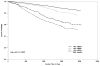
Using California Cancer Registry data, we identified Hispanic women diagnosed with invasive breast cancer from 2005–2010. Breast cancer subtypes were defined as HR+/HER2−, HR+/HER2+, HR−/HER2+, and HR−/HER2− (triple negative). We estimated breast cancer subtype frequencies and used polytomous logistic regression, Kaplan Meier survival plots and Cox regression to examine differences in relation to demographic and clinical characteristics.
Results
Among 16,380 Hispanic women with breast cancer, HR+/HER− subtype was most common (63%), followed by triple negative (16%), HR+/HER2+ (14%) and HR−/HER2+ (8%). Women in lower SES neighborhoods had greater risk of triple negative and HR−/HER2+ subtypes relative to HR+/HER2− (p<0.05). Hispanic women with triple negative and HR−/HER2+ tumors experienced poorer survival than those with HR+/HER− tumors. Breast cancer-specific mortality increased with decreasing SES, relative to the highest SES quintile, from HR=1.38 for quintile 4 to HR=1.76 for quintile 1 (lowest SES level).
Conclusion
Our findings indicate that Hispanic women residing in low SES neighborhoods had significantly increased risk of developing and dying from HR− than HR+ breast cancers. Similar patterns of subtype frequency and prognosis among California Hispanic women and studies of other racial/ethnic groups underscore the need to better understand the impact of SES on risk factor exposures that increase the risk of breast cancer subtypes with poor prognosis.
-
Subjects:
-
Source:Breast Cancer Res Treat. 144(3):625-634.
-
Pubmed ID:24658879
-
Pubmed Central ID:PMC4045012
-
Document Type:
-
Funding:HHSN261201000034C/PHS HHS/United States ; HHSN261201000140C/CA/NCI NIH HHS/United States ; HHSN261201000035C/CA/NCI NIH HHS/United States ; HHSN261201000035C/PHS HHS/United States ; U58 DP000807/DP/NCCDPHP CDC HHS/United States ; Z99 CA999999/Intramural NIH HHS/United States ; HHSN261201000035I/CA/NCI NIH HHS/United States ; HHSN261201000034C/CA/NCI NIH HHS/United States ; HHSN261201000140C/PHS HHS/United States
-
Place as Subject:
-
Volume:144
-
Issue:3
-
Collection(s):
-
Main Document Checksum:urn:sha256:707bc4afbf37f0509b003128708e985046850baed11051909c0bf1c264b3b98a
-
Download URL:
-
File Type:
 [PDF
- 156.22 KB
]
[PDF
- 156.22 KB
]
Supporting Files


File Language:
English
ON THIS PAGE


CDC STACKS serves as an archival repository of CDC-published products including
scientific findings,
journal articles, guidelines, recommendations, or other public health information authored or
co-authored by CDC or funded partners.
As a repository, CDC STACKS retains documents in their original published format to ensure public access to scientific information.
As a repository, CDC STACKS retains documents in their original published format to ensure public access to scientific information.
You May Also Like
COLLECTION
CDC Public Access