


Spatially-Explicit Simulation Modeling of Ecological Response to Climate Change: Methodological Considerations in Predicting Shifting Population Dynamics of Infectious Disease Vectors
Supporting Files

-
9 1 2013
-
File Language:
English
Details
-
Alternative Title:ISPRS Int J Geoinf
-
Personal Author:
-
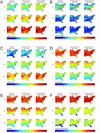
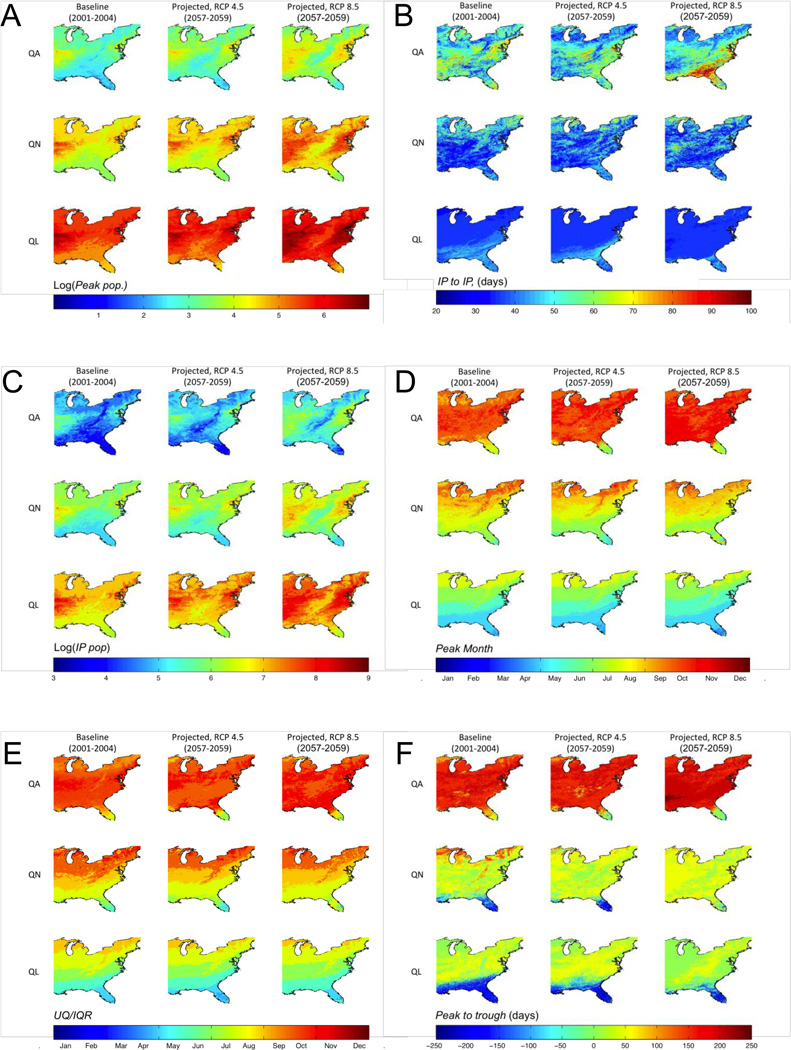
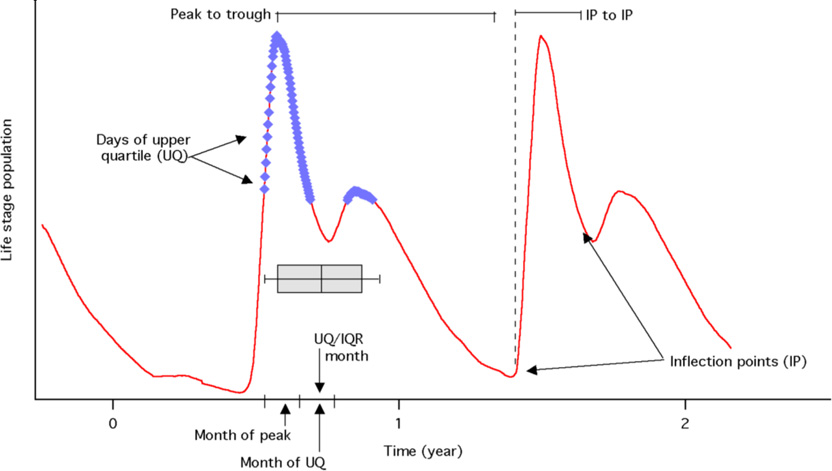
Description:Poikilothermic disease vectors can respond to altered climates through spatial changes in both population size and phenology. Quantitative descriptors to characterize, analyze and visualize these dynamic responses are lacking, particularly across large spatial domains. In order to demonstrate the value of a spatially explicit, dynamic modeling approach, we assessed spatial changes in the population dynamics of |, the Lyme disease vector, using a temperature-forced population model simulated across a grid of 4 × 4 km cells covering the eastern United States, using both modeled (Weather Research and Forecasting (WRF) 3.2.1) baseline/current (2001-2004) and projected (Representative Concentration Pathway (RCP) 4.5 and RCP 8.5; 2057-2059) climate data. Ten dynamic population features (DPFs) were derived from simulated populations and analyzed spatially to characterize the regional population response to current and future climate across the domain. Each DPF under the current climate was assessed for its ability to discriminate observed Lyme disease risk and known vector presence/absence, using data from the US Centers for Disease Control and Prevention. Peak vector population and month of peak vector population were the DPFs that performed best as predictors of current Lyme disease risk. When examined under baseline and projected climate scenarios, the spatial and temporal distributions of DPFs shift and the seasonal cycle of key questing life stages is compressed under some scenarios. Our results demonstrate the utility of spatial characterization, analysis and visualization of dynamic population responses-including altered phenology-of disease vectors to altered climate.
-
Keywords:
-
Source:ISPRS Int J Geoinf. 2013; 2(3):645-664
-
Pubmed ID:24772388
-
Pubmed Central ID:PMC3997168
-
Document Type:
-
Funding:
-
Volume:2
-
Issue:3
-
Collection(s):
-
Main Document Checksum:urn:sha256:8ed71ed8b28345640f2574ebdcc01ba7cbc1ac9b23fffb4ab9b1631cdb929ee7
-
Download URL:
-
File Type:
 [PDF
- 811.15 KB
]
[PDF
- 811.15 KB
]
Supporting Files


File Language:
English
ON THIS PAGE




CDC STACKS serves as an archival repository of CDC-published products including
scientific findings,
journal articles, guidelines, recommendations, or other public health information authored or
co-authored by CDC or funded partners.
As a repository, CDC STACKS retains documents in their original published format to ensure public access to scientific information.
As a repository, CDC STACKS retains documents in their original published format to ensure public access to scientific information.
You May Also Like
COLLECTION
CDC Public Access