



Optimizing matching and analysis combinations for estimating causal effects
Supporting Files

-
Mar 16 2016
File Language:
English
Details
-
Alternative Title:Sci Rep
-
Personal Author:
-
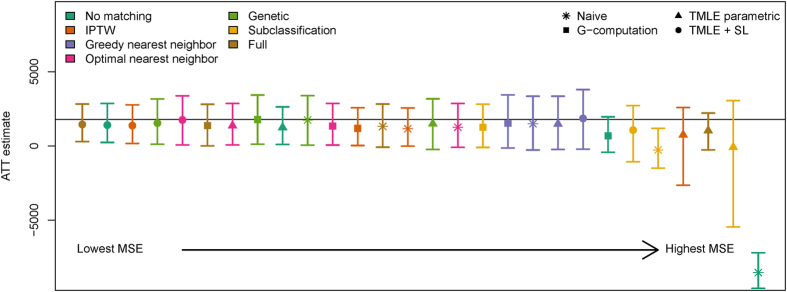
Description:Matching methods are common in studies across many disciplines. However, there is limited evidence on how to optimally combine matching with subsequent analysis approaches to minimize bias and maximize efficiency for the quantity of interest. We conducted simulations to compare the performance of a wide variety of matching methods and analysis approaches in terms of bias, variance, and mean squared error (MSE). We then compared these approaches in an applied example of an employment training program. The results indicate that combining full matching with double robust analysis performed best in both the simulations and the applied example, particularly when combined with machine learning estimation methods. To reduce bias, current guidelines advise researchers to select the technique with the best post-matching covariate balance, but this work finds that such an approach does not always minimize mean squared error (MSE). These findings have important implications for future research utilizing matching. To minimize MSE, investigators should consider additional diagnostics, and use of simulations tailored to the study of interest to identify the optimal matching and analysis combination.
-
Subjects:
-
Source:Sci Rep. 2016; 6.
-
Pubmed ID:26980444
-
Pubmed Central ID:PMC4793248
-
Document Type:
-
Funding:
-
Volume:6
-
Download URL:
-
File Type:
 [PDF - 722.04 KB]
 -
Collection(s):
-
Main Document Checksum:urn:sha256:90bbb476642255853d49b5e193cfad1609dbc915839c94d1465454509551b19d
Supporting Files


File Language:
English
 Was this page helpful?
 Found an issue?




CDC STACKS serves as an archival repository of CDC-published products including
scientific findings, journal articles, guidelines, recommendations, or other public health information authored or
co-authored by CDC or funded partners.
As a repository, CDC STACKS retains documents in their original published format to ensure public access to scientific information.
As a repository, CDC STACKS retains documents in their original published format to ensure public access to scientific information.
You May Also Like
COLLECTION
CDC Public Access