


Virulence and Evolution of West Nile Virus, Australia, 1960–2012
Supporting Files
Public Domain

-
Aug 2016
-
File Language:
English
Details
-
Alternative Title:Emerg Infect Dis
-
Personal Author:Prow, Natalie A. ; Edmonds, Judith H. ; Williams, David T. ; Setoh, Yin X. ; Bielefeldt-Ohmann, Helle ; Suen, Willy W. ; Hobson-Peters, Jody ; van den Hurk, Andrew F. ; Pyke, Alyssa T. ; Hall-Mendelin, Sonja ; Northill, Judith A. ; Johansen, Cheryl A. ; Warrilow, David ; Wang, Jianning ; Kirkland, Peter D. ; Doggett, Stephen ; Andrade, Christy C. ; Brault, Aaron C. ; Khromykh, Alexander A. ; Hall, Roy A.
-
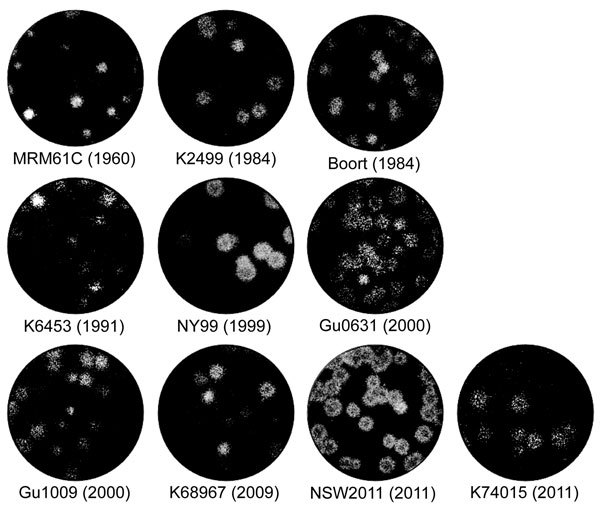
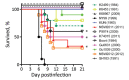
Description:Worldwide, West Nile virus (WNV) causes encephalitis in humans, horses, and birds. The Kunjin strain of WNV (WNVKUN) is endemic to northern Australia, but infections are usually asymptomatic. In 2011, an unprecedented outbreak of equine encephalitis occurred in southeastern Australia; most of the ≈900 reported cases were attributed to a newly emerged WNVKUN strain. To investigate the origins of this virus, we performed genetic analysis and in vitro and in vivo studies of 13 WNVKUN isolates collected from different regions of Australia during 1960-2012. Although no disease was recorded for 1984, 2000, or 2012, isolates collected during those years (from Victoria, Queensland, and New South Wales, respectively) exhibited levels of virulence in mice similar to that of the 2011 outbreak strain. Thus, virulent strains of WNVKUN have circulated in Australia for >30 years, and the first extensive outbreak of equine disease in Australia probably resulted from a combination of specific ecologic and epidemiologic conditions.
-
Subjects:
-
Source:Emerg Infect Dis. 22(8):1353-1362.
-
Pubmed ID:27433830
-
Pubmed Central ID:PMC4982165
-
Document Type:
-
Place as Subject:
-
Volume:22
-
Issue:8
-
Collection(s):
-
Main Document Checksum:urn:sha256:7d918739a2e5221e0aad9f29262c3bf3f23e87d7d843ac3a53ed111ef617904c
-
Download URL:
-
File Type:
 [PDF
- 1.60 MB
]
[PDF
- 1.60 MB
]
Supporting Files


File Language:
English
ON THIS PAGE






CDC STACKS serves as an archival repository of CDC-published products including
scientific findings,
journal articles, guidelines, recommendations, or other public health information authored or
co-authored by CDC or funded partners.
As a repository, CDC STACKS retains documents in their original published format to ensure public access to scientific information.
As a repository, CDC STACKS retains documents in their original published format to ensure public access to scientific information.
You May Also Like
COLLECTION
Emerging Infectious Diseases