



Response to Emergence of Middle East Respiratory Syndrome Coronavirus, Abu Dhabi, United Arab Emirates, 2013–2014
Supporting Files
Public Domain

-
Jul 2016
File Language:
English
Details
-
Alternative Title:Emerg Infect Dis
-
Personal Author:Al Hosani, Farida Ismail ; Pringle, Kimberly ; Al Mulla, Mariam ; Kim, Lindsay ; Pham, Huong ; Alami, Negar N. ; Khudhair, Ahmed ; Hall, Aron J. ; Aden, Bashir ; El Saleh, Feda ; Al Dhaheri, Wafa ; Al Bandar, Zyad ; Bunga, Sudhir ; Abou Elkheir, Kheir ; Tao, Ying ; Hunter, Jennifer C. ; Nguyen, Duc ; Turner, Andrew ; Pradeep, Krishna ; Sasse, Jurgen ; Weber, Stefan ; Tong, Suxiang ; Whitaker, Brett L. ; Haynes, Lia M. ; Curns, Aaron ; Gerber, Susan I.
-
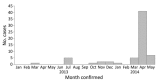
Description:In January 2013, several months after Middle East respiratory syndrome coronavirus (MERS-CoV) was first identified in Saudi Arabia, Abu Dhabi, United Arab Emirates, began surveillance for MERS-CoV. We analyzed medical chart and laboratory data collected by the Health Authority-Abu Dhabi during January 2013-May 2014. Using real-time reverse transcription PCR, we tested respiratory tract samples for MERS-CoV and identified 65 case-patients. Of these patients, 23 (35%) were asymptomatic at the time of testing, and 4 (6%) showed positive test results for >3 weeks (1 had severe symptoms and 3 had mild symptoms). We also identified 6 clusters of MERS-CoV cases. This report highlights the potential for virus shedding by mildly ill and asymptomatic case-patients. These findings will be useful for MERS-CoV management and infection prevention strategies.
-
Subjects:
-
Source:Emerg Infect Dis. 22(7):1162-1168.
-
Pubmed ID:27314227
-
Pubmed Central ID:PMC4918155
-
Document Type:
-
Place as Subject:
-
Location:
-
Volume:22
-
Issue:7
-
Download URL:
-
File Type:
 [PDF - 495.04 KB]
 -
Collection(s):
-
Main Document Checksum:urn:sha256:14f33e31ff4350df40474f8736cd32029a2f32e1fb58cb1fc77f0a5bac471ad4
Supporting Files


File Language:
English
 Was this page helpful?
 Found an issue?


CDC STACKS serves as an archival repository of CDC-published products including
scientific findings, journal articles, guidelines, recommendations, or other public health information authored or
co-authored by CDC or funded partners.
As a repository, CDC STACKS retains documents in their original published format to ensure public access to scientific information.
As a repository, CDC STACKS retains documents in their original published format to ensure public access to scientific information.
You May Also Like
COLLECTION
Emerging Infectious Diseases