


High MICs for Vancomycin and Daptomycin and Complicated Catheter-Related Bloodstream Infections with Methicillin-Sensitive Staphylococcus aureus
Supporting Files
Public Domain

-
Jun 2016
-
Details
-
Alternative Title:Emerg Infect Dis
-
Personal Author:San-Juan, Rafael ; Viedma, Esther ; Chaves, Fernando ; Lalueza, Antonio ; Fortún, Jesús ; Loza, Elena ; Pujol, Miquel ; Ardanuy, Carmen ; Morales, Isabel ; de Cueto, Marina ; Resino-Foz, Elena ; Morales-Cartagena, Alejandra ; Rico, Alicia ; Romero, María P. ; Orellana, María Ángeles ; López-Medrano, Francisco ; Fernández-Ruiz, Mario ; Aguado, José María
-
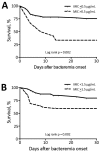
Description:We investigated the prognostic role of high MICs for antistaphylococcal agents in patients with methicillin-sensitive Staphylococcus aureus catheter-related bloodstream infection (MSSA CRBSI). We prospectively reviewed 83 episodes from 5 centers in Spain during April 2011-June 2014 that had optimized clinical management and analyzed the relationship between E-test MICs for vancomycin, daptomycin, oxacillin, and linezolid and development of complicated bacteremia by using multivariate analysis. Complicated MSSA CRBSI occurred in 26 (31.3%) patients; MICs for vancomycin and daptomycin were higher in these patients (optimal cutoff values for predictive accuracy = 1.5 μg/mL and 0.5 μg/mL). High MICs for vancomycin (hazard ratio 2.4, 95% CI 1.2-5.5) and daptomycin (hazard ratio 2.4, 95% CI 1.1-5.9) were independent risk factors for development of complicated MSSA CRBSI. Our data suggest that patients with MSSA CRBSI caused by strains that have high MICs for vancomycin or daptomycin are at increased risk for complications.
-
Subjects:
-
Source:Emerg Infect Dis. 22(6):1057-1066.
-
Pubmed ID:27192097
-
Pubmed Central ID:PMC4880091
-
Document Type:
-
Volume:22
-
Issue:6
-
Collection(s):
-
Main Document Checksum:urn:sha256:5ad7336dfb0ff87d4dd32c86c72ad6ed4d41daab51fb44572ee3b86afda026c6
-
Download URL:
-
File Type:
 [PDF
- 1.52 MB
]
[PDF
- 1.52 MB
]
Supporting Files


ON THIS PAGE


CDC STACKS serves as an archival repository of CDC-published products including
scientific findings,
journal articles, guidelines, recommendations, or other public health information authored or
co-authored by CDC or funded partners.
As a repository, CDC STACKS retains documents in their original published format to ensure public access to scientific information.
As a repository, CDC STACKS retains documents in their original published format to ensure public access to scientific information.
You May Also Like
COLLECTION
Emerging Infectious Diseases