


Etiology and Risk Factors of Acute Gastroenteritis in a Taipei Emergency Department: Clinical Features for Bacterial Gastroenteritis
Supporting Files
Public Domain

-
Dec 05 2015
-
Details
-
Alternative Title:J Epidemiol
-
Personal Author:
-
Description:Background
The causative pathogen is rarely identified in the emergency department (ED), since the results of cultures are usually unavailable. As a result, antimicrobial treatment may be overused. The aim of our study was to investigate the pathogens, risk factors of acute gastroenteritis, and predictors of acute bacterial gastroenteritis in the ED.
Methods
We conducted a matched case-control study of 627 stool samples and 612 matched pairs.
Results
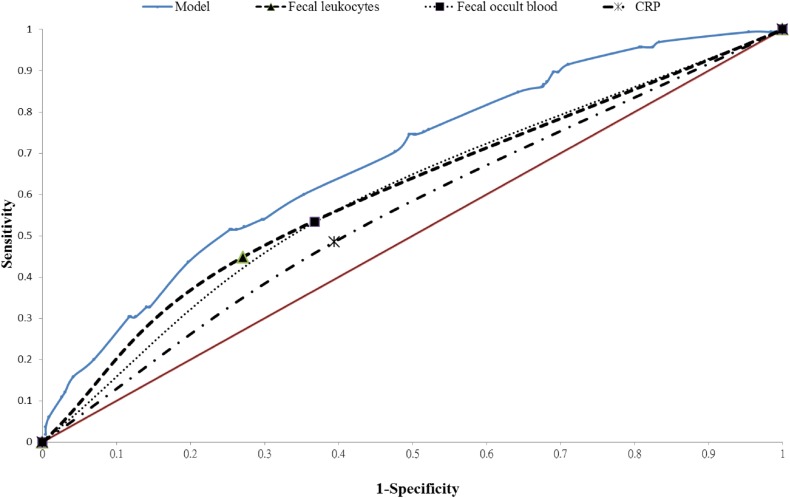
Viruses (41.3%) were the leading cause of gastroenteritis, with noroviruses (32.2%) being the most prevalent, followed by bacteria (26.8%) and Giardia lamblia (12.4%). Taking antacids (adjusted odds ratio [aOR] 4.10; 95% confidence interval [CI], 2.57–6.53), household members/classmates with gastroenteritis (aOR 4.69; 95% CI, 2.76–7.96), attending a banquet (aOR 2.29; 95% CI, 1.64–3.20), dining out (aOR 1.70; 95% CI, 1.13–2.54), and eating raw oysters (aOR 3.10; 95% CI, 1.61–5.94) were highly associated with gastroenteritis. Elders (aOR 1.04; 05% CI, 1.02–1.05), those with CRP >10 mg/L (aOR 2.04; 95% CI, 1.15–3.62), or those who were positive for fecal leukocytes (aOR 2.04; 95% CI, 1.15–3.62) or fecal occult blood (aOR 1.97; 95% CI, 1.03–3.77) were more likely to be hospitalized in ED. In addition, presence of fecal leukocytes (time ratio [TR] 1.22; 95% CI, 1.06–1.41), abdominal pain (TR 1.20; 95% CI, 1.07–1.41), and frequency of vomiting (TR 0.79; 95% CI, 0.64–0.98) were significantly associated with the duration of acute gastroenteritis. Presence of fecal leukocytes (aOR 2.08; 95% CI, 1.42–3.05), winter season (aOR 0.45; 95% CI, 0.28–0.74), frequency of diarrhea (aOR 1.69; 95% CI, 1.01–2.83), and eating shrimp or crab (aOR 1.53; 95% CI, 1.05–2.23) were highly associated with bacterial gastroenteritis. The area under the receiver operating characteristic curve of the final model was 0.68 (95% CI, 0.55–0.63).
Conclusions
Acute bacterial gastroenteritis was highly associated with season, frequency of diarrhea, frequency of vomiting, and eating shrimp or crab.
-
Subjects:
-
Source:J Epidemiol. 2015; 26(4):216-223.
-
Pubmed ID:26639752
-
Pubmed Central ID:PMC4808689
-
Document Type:
-
Volume:26
-
Issue:4
-
Collection(s):
-
Main Document Checksum:urn:sha256:7e4e3b9799abe6156dceb69d1a0e7cb70c7320e94ef9aed051d614f4ae37c003
-
Download URL:
-
File Type:
 [PDF
- 588.13 KB
]
[PDF
- 588.13 KB
]
Supporting Files


ON THIS PAGE

CDC STACKS serves as an archival repository of CDC-published products including
scientific findings,
journal articles, guidelines, recommendations, or other public health information authored or
co-authored by CDC or funded partners.
As a repository, CDC STACKS retains documents in their original published format to ensure public access to scientific information.
As a repository, CDC STACKS retains documents in their original published format to ensure public access to scientific information.
You May Also Like
COLLECTION
CDC Public Access