



Knowledge, Attitudes and Beliefs Related to Seasonal Influenza Vaccine among Pregnant Women in Thailand
Supporting Files

-
4 19 2016 ; 4-19-
-
Available in CDC Stacks on 2017-04-19T00:00:00Z
File Language:
English
Details
-
Alternative Title:Vaccine
-
Personal Author:
-
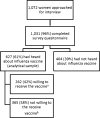
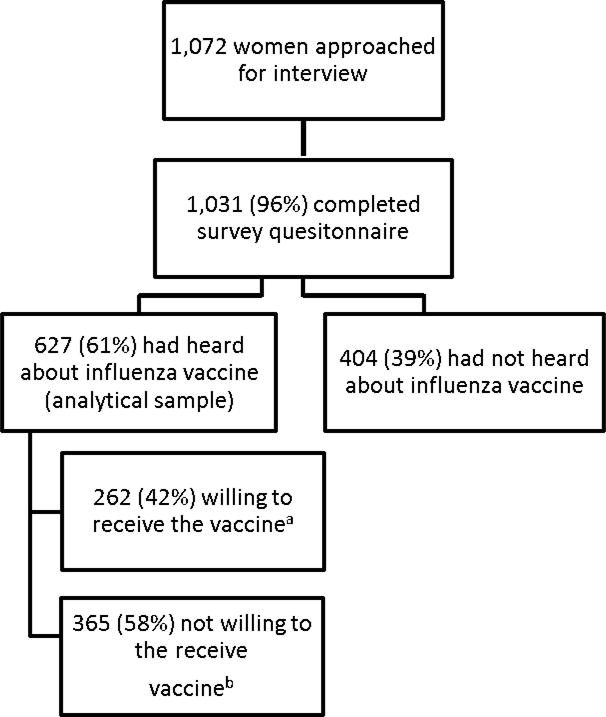
Description:Background ; In 2009, Thailand recommended pregnant women be prioritized for influenza vaccination. Vaccine uptake among Thai pregnant women is lower than other high-risk groups. ; Methods ; During December 2012-April 2013, we conducted a cross-sectional survey of a convenience sample of Thai pregnant women aged ≥15 years attending antenatal clinics at public hospitals in 8 of 77 provinces. A self-administered questionnaire covered knowledge, attitudes, and beliefs related to influenza vaccination using the Health Belief Model. We examined factors associated with willingness to be vaccinated using log-binomial regression models. ; Results ; The survey was completed by 1,031 (96%) of 1,072 pregnant women approached. A total of 627 (61%) women had heard about influenza vaccine and were included in the analysis, of whom 262 (42%) were willing to be vaccinated, 155 (25%) had received a healthcare provider recommendation for influenza vaccination and 25 (4%) had received the influenza vaccine during the current pregnancy. In unadjusted models, high levels of perceptions of susceptibility (prevalence ratio PR 1.5, 95% CI 1.2–2.0), high levels of belief in the benefits of vaccination (PR 2.3, 95% CI 1.7–3.1), moderate (PR 1.7, 95% CI 1.2–2.3) and high (PR 3.4, 95% CI 2.6–4.5) levels of encouragement by others to be vaccinated (i.e., cues to action) were positively associated with willingness to be vaccinated. Moderate (PR 0.5, 95% CI 0.4–0.7) and high levels of (PR 0.5, 95% CI 0.4–0.8) perceived barriers were negatively associated with willingness to be vaccinated. In the final adjusted model, only moderate (PR 1.5, 95% CI 1.1–2.0) and high levels of cues to action (PR 2.7, 95% CI 2.0–3.6) were statistically associated with willingness to be vaccinated. ; Conclusion ; Cues to action were associated with willingness to be vaccinated and can be used to inform communication strategies during the vaccine campaign to increase influenza vaccination among Thai pregnant women.
-
Subjects:
-
Keywords:
-
Source:Vaccine. 34(18):2141-2146
-
Pubmed ID:26854910
-
Pubmed Central ID:PMC4811693
-
Document Type:
-
Funding:
-
Volume:34
-
Issue:18
-
Download URL:
-
File Type:
 [PDF - 125.18 KB]
 -
Collection(s):
-
Main Document Checksum:urn:sha256:40813d49cd1aa2e7e39f65a481fb5654af9fc121f60c4382d5c63dd8ef6f9951
Supporting Files


File Language:
English
 Was this page helpful?
 Found an issue?

CDC STACKS serves as an archival repository of CDC-published products including
scientific findings, journal articles, guidelines, recommendations, or other public health information authored or
co-authored by CDC or funded partners.
As a repository, CDC STACKS retains documents in their original published format to ensure public access to scientific information.
As a repository, CDC STACKS retains documents in their original published format to ensure public access to scientific information.
You May Also Like
COLLECTION
CDC Public Access