


Principles of connectivity among morphologically defined cell types in adult neocortex
Supporting Files

-
Nov 27 2015
-
Details
-
Alternative Title:Science
-
Personal Author:
-
Description:Introduction
The intricate microcircuitry of the cerebral cortex is thought to be a critical substrate from which arise the impressive capabilities of the mammalian brain. Until now, our knowledge of the stereotypical connectivity in neocortical microcircuits has been pieced together from individual studies of the connectivity between small numbers of neuronal cell types. Here, we provide unbiased, large-scale profiling of neuronal cell types and connections to reveal the essential building blocks of the cortex and the principles governing their assembly into cortical circuits. Using advanced techniques for tissue slicing, multiple simultaneous whole-cell recording, and morphological reconstruction, we are able to provide a comprehensive view of the connectivity between diverse types of neurons, particularly among types of γ-aminobutyric acid–releasing (GABAergic) interneurons, in the adult animal.
Rationale
We took advantage of a method for preparing high-quality slices of adult tissue and combined this technique with octuple simultaneous, whole-cell recordings followed by an improved staining method that allowed detailed recovery of axonal and dendritic arbor morphology. These data allowed us to perform a census of morphologically and electrophysiologically defined neuronal types (primarily GABAergic interneurons) in neocortical layers 1, 2/3, and 5 (L1, L23, and L5, respectively) and to observe their connectivity patterns in adult animals.
Results
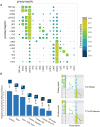
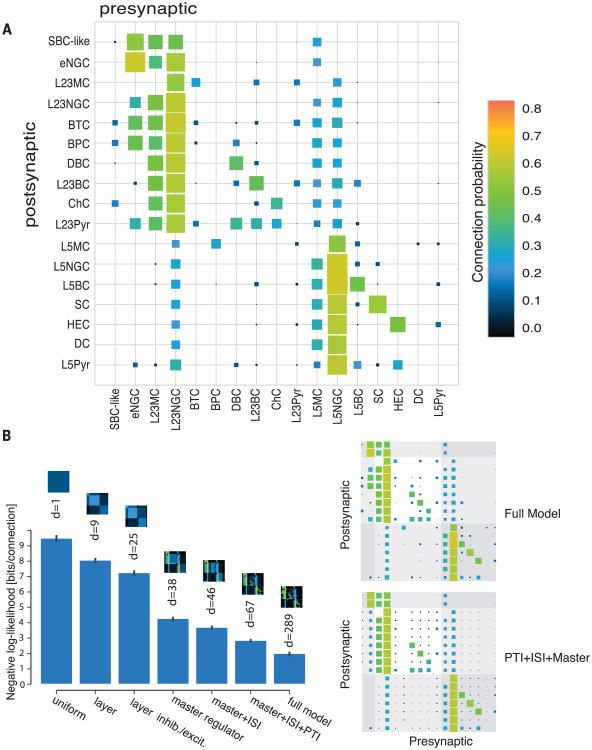
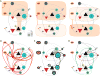
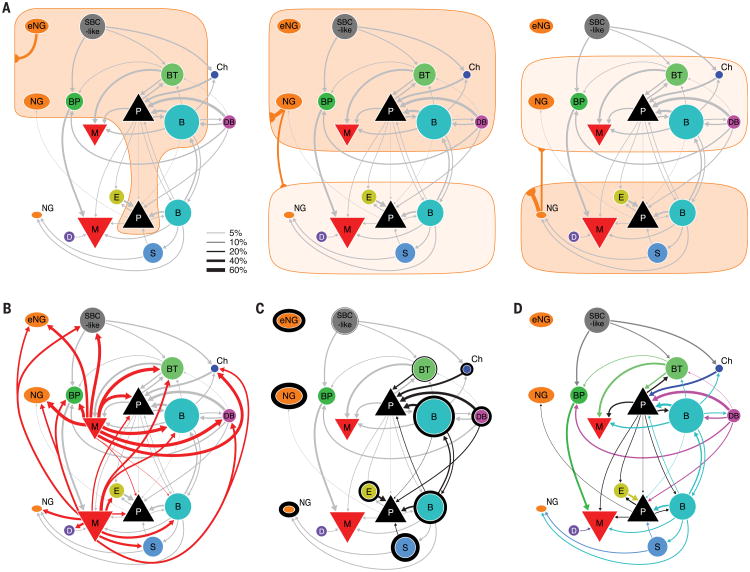
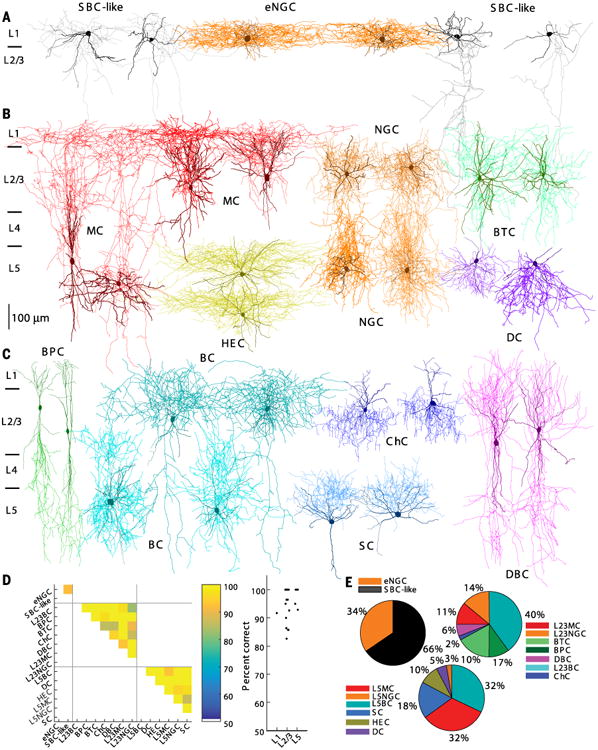
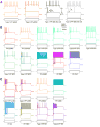
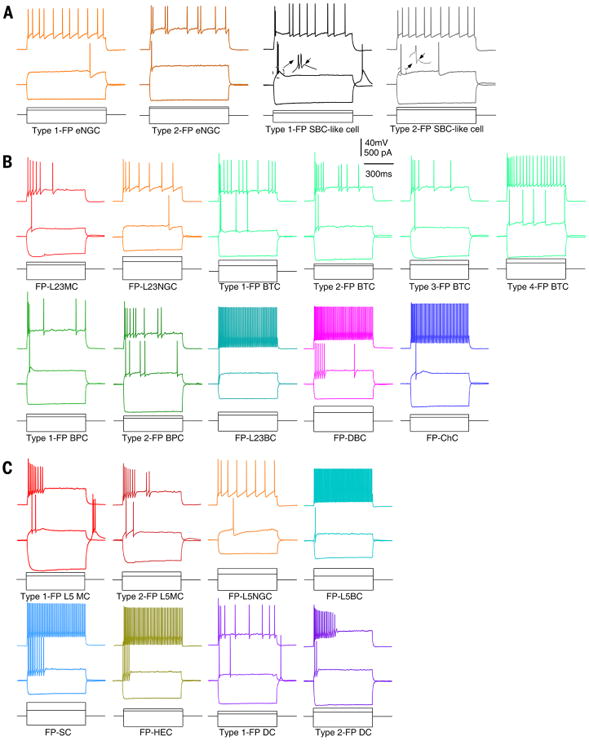
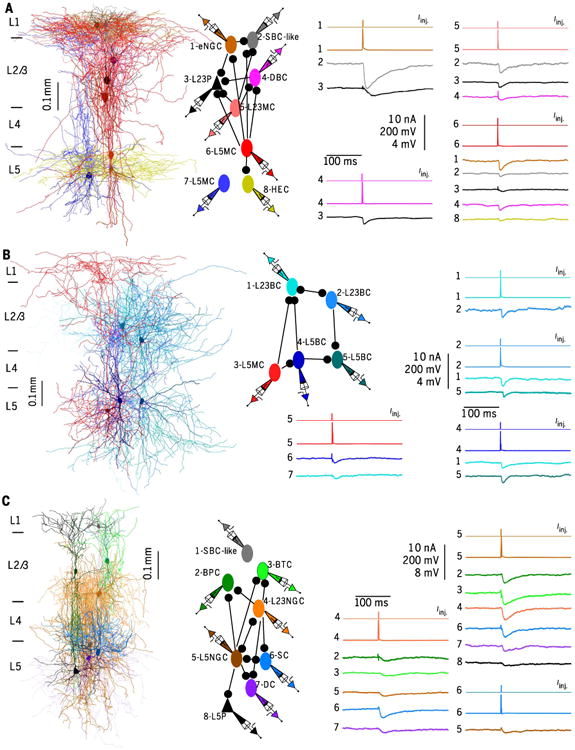
Our large-scale, comprehensive profiling of neocortical neurons differentiated 15 major types of interneurons, in addition to two lamina-defined types of pyramidal neurons (L23 and L5). Cortical interneurons comprise two types in L1 (eNGC and SBC-like), seven in L23 (L23MC, L23NGC, BTC, BPC, DBC, L23BC, and ChC), and six in L5 (L5MC, L5NGC, L5BC, SC, HEC, and DC) (see the figure). Each type has stereotypical electrophysiological properties and morphological features and can be differentiated from all others by cell type-specific axonal geometry and axonal projection patterns. Importantly, each type of neuron has its own characteristic input-output connectivity profile, connecting with other constituent neuronal types with varying degrees of specificity in postsynaptic targets, laminar location, and synaptic characteristics. Despite specific connection patterns for each cell type, we found that a small number of simple connectivity motifs are repeated across layers and cell types defining a canonical cortical microcircuit.
Conclusion
Our comprehensive profiling of neuronal cell types and connections in adult neocortex provides the most complete wiring diagram of neocortical microcircuits to date. Compared with current genetic labels for cell class, which paint the cortex in broad strokes, our analysis of morphological and electrophysiological properties revealed new cell classes and allowed us to derive a small number of simple connectivity rules that were repeated across layers and cell types. This detailed blueprint of cortical wiring should aid efforts to identify specific circuit abnormalities in animal models of brain disease and may eventually provide a path toward the development of comprehensive circuit-based, cell type-specific interventions.
-
Subjects:
-
Source:Science. 350(6264):aac9462.
-
Pubmed ID:26612957
-
Pubmed Central ID:PMC4809866
-
Document Type:
-
Funding:DP1 EY023176/EY/NEI NIH HHS/United States ; DP1 OD008301/OD/NIH HHS/United States ; DP1EY023176/DP/NCCDPHP CDC HHS/United States ; DP1OD008301/OD/NIH HHS/United States ; F30MH095440/MH/NIMH NIH HHS/United States ; P30EY002520/EY/NEI NIH HHS/United States ; R21 EB016223/EB/NIBIB NIH HHS/United States ; R21EB016223/EB/NIBIB NIH HHS/United States ; T32EB006350/EB/NIBIB NIH HHS/United States ; T32EY07001/EY/NEI NIH HHS/United States ; T32GM007330/GM/NIGMS NIH HHS/United States
-
Volume:350
-
Issue:6264
-
Collection(s):
-
Main Document Checksum:urn:sha256:41bd1b9bbd1a5d3cb2a792a501c8990bd1bc37993325bc5f489e4d7b1f10ebd8
-
Download URL:
-
File Type:
 [PDF
- 1.31 MB
]
[PDF
- 1.31 MB
]
Supporting Files


ON THIS PAGE




CDC STACKS serves as an archival repository of CDC-published products including
scientific findings,
journal articles, guidelines, recommendations, or other public health information authored or
co-authored by CDC or funded partners.
As a repository, CDC STACKS retains documents in their original published format to ensure public access to scientific information.
As a repository, CDC STACKS retains documents in their original published format to ensure public access to scientific information.
You May Also Like
COLLECTION
CDC Public Access