



Analytical Validation of Quantitative Real-Time PCR Methods for Quantification of Trypanosoma cruzi DNA in Blood Samples from Chagas Disease Patients
Supporting Files

-
9 2015 ; 9-2015
-
Available in CDC Stacks on January 04, 2016, 12:00 AM
File Language:
English
Details
-
Alternative Title:J Mol Diagn
-
Personal Author:Ramírez, Juan Carlos ; Cura, Carolina Inés ; Moreira, Otacilio da Cruz ; Lages-Silva, Eliane ; Juiz, Natalia ; Velázquez, Elsa ; Ramírez, Juan David ; Alberti, Anahí ; Pavia, Paula ; Flores-Chávez, María Delmans ; Muñoz-Calderón, Arturo ; Pérez-Morales, Deyanira ; Santalla, José ; Guedes, Paulo Marcos da Matta ; Peneau, Julie ; Marcet, Paula ; Padilla, Carlos ; Cruz-Robles, David ; Valencia, Edward ; Crisante, Gladys Elena ; Greif, Gonzalo ; Zulantay, Inés ; Costales, Jaime Alfredo ; Alvarez-Martínez, Miriam ; Martínez, Norma Edith ; Villarroel, Rodrigo ; Villarroel, Sandro ; Sánchez, Zunilda ; Bisio, Margarita ; Parrado, Rudy ; Galvão, Lúcia Maria da Cunha ; da Câmara, Antonia Cláudia Jácome ; Espinoza, Bertha ; de Noya, Belkisyole Alarcón ; Puerta, Concepción ; Riarte, Adelina ; Diosque, Patricio ; Sosa-Estani, Sergio ; Guhl, Felipe ; Ribeiro, Isabela ; Aznar, Christine ; Britto, Constança ; Yadón, Zaida Estela ; Schijman, Alejandro G.
-
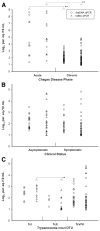
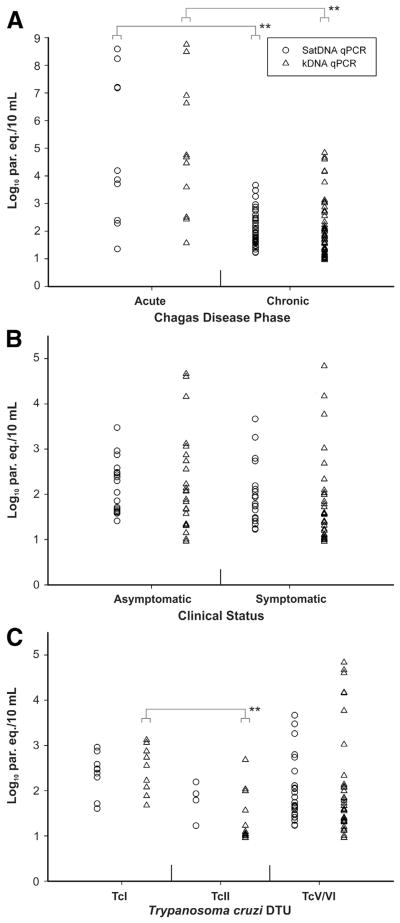
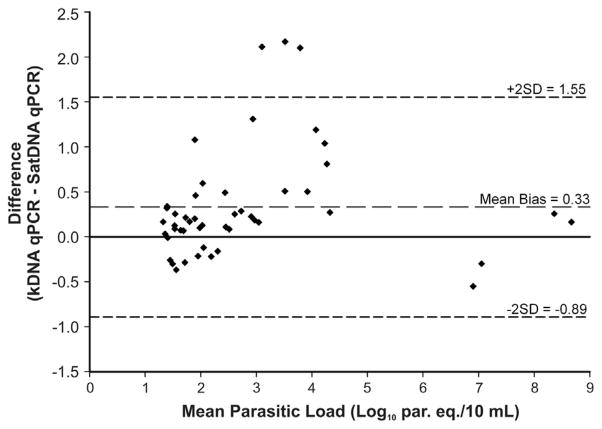
Description:An international study was performed by 26 experienced PCR laboratories from 14 countries to assess the performance of duplex quantitative real-time PCR (qPCR) strategies on the basis of TaqMan probes for detection and quantification of parasitic loads in peripheral blood samples from Chagas disease patients. Two methods were studied: Satellite DNA (SatDNA) qPCR and kinetoplastid DNA (kDNA) qPCR. Both methods included an internal amplification control. Reportable range, analytical sensitivity, limits of detection and quantification, and precision were estimated according to international guidelines. In addition, inclusivity and exclusivity were estimated with DNA from stocks representing the different Trypanosoma cruzi discrete typing units and Trypanosoma rangeli and Leishmania spp. Both methods were challenged against 156 blood samples provided by the participant laboratories, including samples from acute and chronic patients with varied clinical findings, infected by oral route or vectorial transmission. kDNA qPCR showed better analytical sensitivity than SatDNA qPCR with limits of detection of 0.23 and 0.70 parasite equivalents/mL, respectively. Analyses of clinical samples revealed a high concordance in terms of sensitivity and parasitic loads determined by both SatDNA and kDNA qPCRs. This effort is a major step toward international validation of qPCR methods for the quantification of T. cruzi DNA in human blood samples, aiming to provide an accurate surrogate biomarker for diagnosis and treatment monitoring for patients with Chagas disease.
-
Keywords:
-
Source:J Mol Diagn. 17(5):605-615
-
Pubmed ID:26320872
-
Pubmed Central ID:PMC4698797
-
Document Type:
-
Funding:
-
Volume:17
-
Issue:5
-
Download URL:
-
File Type:
 [PDF - 487.12 KB]
 -
Collection(s):
-
Main Document Checksum:urn:sha256:acac8c68afb90912c5718ef7312d9cda7f07b304ea0536f0d017a4423157ab49
Supporting Files


File Language:
English
 Was this page helpful?
 Found an issue?

CDC STACKS serves as an archival repository of CDC-published products including
scientific findings, journal articles, guidelines, recommendations, or other public health information authored or
co-authored by CDC or funded partners.
As a repository, CDC STACKS retains documents in their original published format to ensure public access to scientific information.
As a repository, CDC STACKS retains documents in their original published format to ensure public access to scientific information.
You May Also Like
COLLECTION
CDC Public Access