



Community-Acquired Pneumonia Requiring Hospitalization among U.S. Children
Supporting Files

-
2015/02/26
-
Available in CDC Stacks on January 28, 2016, 12:00 AM
File Language:
English
Details
-
Alternative Title:N Engl J Med
-
Personal Author:Jain, Seema ; Williams, Derek J. ; Arnold, Sandra R. ; Ampofo, Krow ; Bramley, Anna M. ; Reed, Carrie ; Stockmann, Chris ; Anderson, Evan J. ; Grijalva, Carlos G. ; Self, Wesley H. ; Zhu, Yuwei ; Patel, Anami ; Hymas, Weston ; Chappell, James D. ; Kaufman, Robert A. ; Kan, J. Herman ; Dansie, David ; Lenny, Noel ; Hillyard, David R. ; Haynes, Lia M. ; Levine, Min ; Lindstrom, Stephen ; Winchell, Jonas M. ; Katz, Jacqueline M. ; Erdman, Dean ; Schneider, Eileen ; Hicks, Lauri A. ; Wunderink, Richard G. ; Edwards, Kathryn M. ; Pavia, Andrew T. ; McCullers, Jonathan A. ; Finelli, Lyn
-
Corporate Authors:
-
Description:Background
U.S. incidence estimates of pediatric community-acquired pneumonia hospitalizations based on prospective data collection are limited. Updated estimates with radiographic confirmation and current laboratory diagnostics are needed.
Methods
We conducted active population-based surveillance for community-acquired pneumonia requiring hospitalization among children <18 years in three hospitals in Memphis, Nashville, and Salt Lake City. We excluded children with recent hospitalization and severe immunosuppression. Blood and respiratory specimens were systematically collected for pathogen detection by multiple modalities. Chest radiographs were independently reviewed by study radiologists. We calculated population-based incidence rates of community-acquired pneumonia hospitalizations, overall and by age and pathogen.
Results
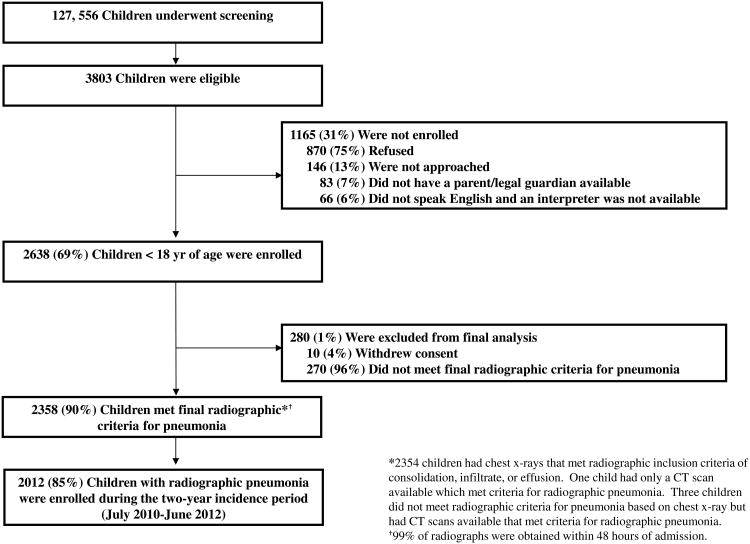
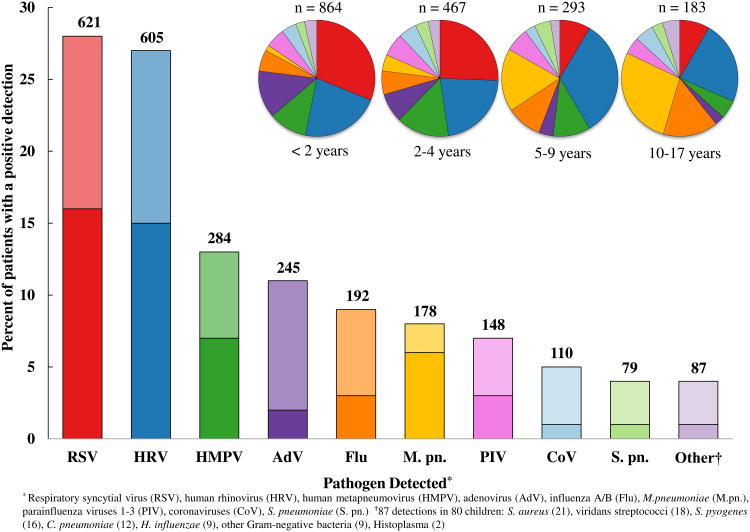
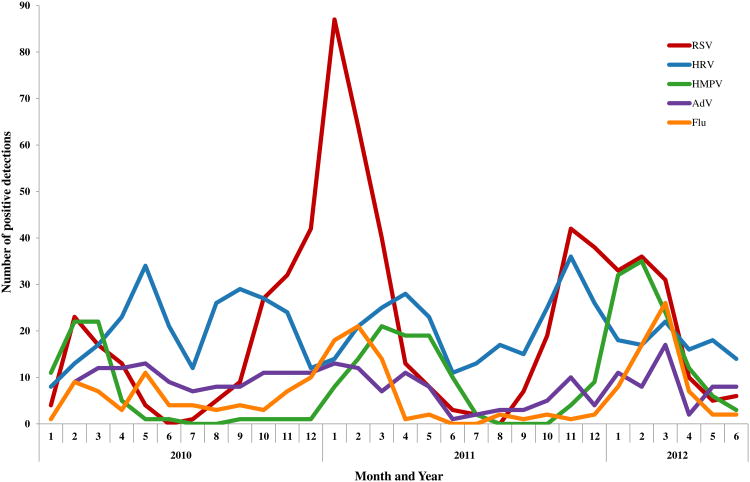
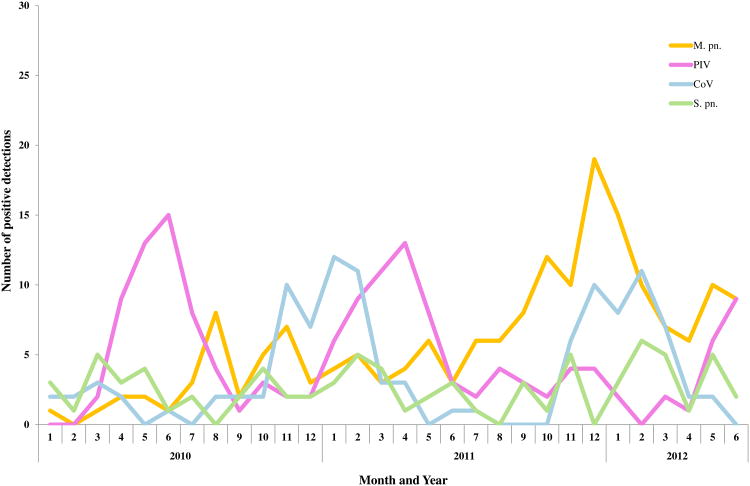
From January 2010-June 2012, we enrolled 2638 (69%) of 3803 eligible children; 2358 (89%) had radiographic pneumonia. Median age was 2 years (interquartile range 1-6); 497 (21%) children required intensive care, and three (<1%) died. Among 2222 children with radiographic pneumonia and specimens available for both bacterial and viral testing, a viral and/or bacterial pathogen was detected in 1802 (81%); ≥1 virus in 1472 (66%), bacteria in 175 (8%), and bacterial-viral co-detection in 155 (7%). Annual pneumonia incidence was 15.7/10,000 children 95% confidence interval (CI) 14.9-16.5, with highest rates among children <2 years 62.2/10,000 (CI 57.6-67.1). Respiratory syncytial virus (37% vs. 8%), adenovirus (15% vs. 3%), and human metapneumovirus (15% vs. 8%) were more commonly detected in children <5 years compared with older children; Mycoplasma pneumoniae (19% vs. 3%) was more common in children ≥5 years.
Conclusions
Pediatric community-acquired pneumonia hospitalization burden was highest among the very young, with respiratory viruses most commonly detected. -
Subjects:
-
Keywords:
-
Source:N Engl J Med. 372(9):835-845
-
Pubmed ID:25714161
-
Pubmed Central ID:PMC4697461
-
Document Type:
-
Funding:U18 IP000490/IP/NCIRD CDC HHSUnited States/ ; U18 IP000299/IP/NCIRD CDC HHSUnited States/ ; U18 IP000489/IP/NCIRD CDC HHSUnited States/ ; U18 IP000301/IP/NCIRD CDC HHSUnited States/ ; K23 AI104779/AI/NIAID NIH HHSUnited States/ ; U18 IP000488/IP/NCIRD CDC HHSUnited States/ ; K23 GM110469/GM/NIGMS NIH HHSUnited States/ ; CC999999/Intramural CDC HHSUnited States/ ; U18 IP000303/IP/NCIRD CDC HHSUnited States/ ; U18 IP000302/IP/NCIRD CDC HHSUnited States/ ; U18 IP000491/IP/NCIRD CDC HHSUnited States/
-
Genre:
-
Volume:372
-
Issue:9
-
Download URL:
-
File Type:
 [PDF - 988.32 KB]
 -
Collection(s):
-
Main Document Checksum:urn:sha-512:4485c0c432de07753b396dd90f055824bd4ad931027139e205aca2a00c7991a06809ad132276ec733d12b6599029b6e5b376829a1fab451e448f10445a8f2e7c
Supporting Files


File Language:
English
 Was this page helpful?
 Found an issue?




CDC STACKS serves as an archival repository of CDC-published products including
scientific findings, journal articles, guidelines, recommendations, or other public health information authored or
co-authored by CDC or funded partners.
As a repository, CDC STACKS retains documents in their original published format to ensure public access to scientific information.
As a repository, CDC STACKS retains documents in their original published format to ensure public access to scientific information.
You May Also Like
COLLECTION
CDC Public Access