


Use of genomic panels to determine risk of developing type 2 diabetes in the general population: a targeted evidence-based review
Supporting Files

-
Mar 14 2013
-
File Language:
English
Details
-
Alternative Title:Genet Med
-
Personal Author:
-
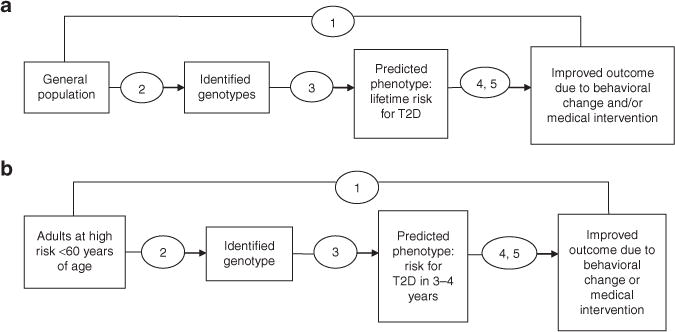
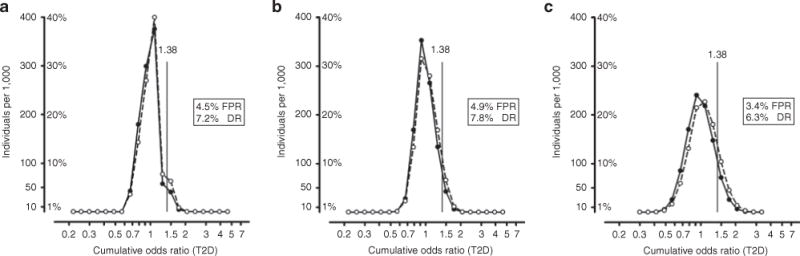
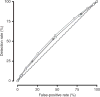
Description:This evidence review addresses whether type 2 diabetes genomic risk panels improve health outcomes (e.g., reduce rates of developing type 2 diabetes) in low- or high-risk adults; two clinical scenarios promulgated by commercial companies offering such testing. Evidence for the analytic validity of available genomic profiles was inadequate. Clinical validity ranged from inadequate to convincing for 30 variants identified on five type 2 diabetes genomic panels and by genome-wide association studies. Eight common variants were identified for general population use; evidence credibility based on published criteria was strong for two variants, moderate for two variants, and weak for four variants. TCF7L2 had the largest per-allele odds ratio of 1.39 (95% confidence interval 1.33-1.46). Models combining the best four, best eight, and all 30 variants used summary effect sizes, reported genotype frequencies, and assumed independent effects. Areas under the curve were 0.547, 0.551, and 0.570, respectively. In high-risk populations, per-allele odds ratios for TCF7L2 alone were similar to those of the general population. TCF7L2, in combination with other variants, yielded minimal improvement in risk reclassification. Evidence on TCF7L2 clinical validity was adequate. Three studies addressed the clinical utility of intervention effectiveness, stratified by TCF7L2 genotype; none found significant interactions. Clinical utility evidence was inadequate. In addition to analytic validity and clinical utility knowledge gaps, additional gaps were identified regarding how to inform, produce, and evaluate models combining multiple variants.
-
Subjects:
-
Source:Genet Med. 15(8):600-611.
-
Pubmed ID:23492876
-
Pubmed Central ID:PMC4684162
-
Document Type:
-
Funding:
-
Volume:15
-
Issue:8
-
Collection(s):
-
Main Document Checksum:urn:sha256:751e14d964145cc36c645a11e27af7469447136c46e095a538c4b668539dae3b
-
Download URL:
-
File Type:
 [PDF
- 418.17 KB
]
[PDF
- 418.17 KB
]
Supporting Files


File Language:
English
ON THIS PAGE


CDC STACKS serves as an archival repository of CDC-published products including
scientific findings,
journal articles, guidelines, recommendations, or other public health information authored or
co-authored by CDC or funded partners.
As a repository, CDC STACKS retains documents in their original published format to ensure public access to scientific information.
As a repository, CDC STACKS retains documents in their original published format to ensure public access to scientific information.
You May Also Like
COLLECTION
CDC Public Access