


Incidence and Etiology of Acute Lower Respiratory Tract Infections in Hospitalized Children Younger Than 5 Years in Rural Thailand
Supporting Files

-
Feb 2014
-
File Language:
English
Details
-
Alternative Title:Pediatr Infect Dis J
-
Personal Author:Hasan, Reem ; Rhodes, Julia ; Thamthitiwat, Somsak ; Olsen, Sonja J. ; Prapasiri, Prabda ; Naorat, Sathapana ; Chittaganpitch, Malinee ; Henchaichon, Sununta ; Dejsirilert, Surang ; Srisaengchai, Prasong ; Sawatwong, Pongpun ; Jorakate, Possawat ; Kaewpan, Anek ; Fry, Alicia M. ; Erdman, Dean ; Chuananon, Somchai ; Amornintapichet, Tussanee ; Maloney, Susan A. ; Baggett, Henry C.
-
Description:Background
Pneumonia remains a leading cause of under-five morbidity and mortality globally. Comprehensive incidence, epidemiologic and etiologic data are needed to update prevention and control strategies.
Methods
We conducted active, population-based surveillance for hospitalized cases of acute lower respiratory tract infections (ALRI) among children <5 years of age in rural thailand. ALRI cases were systematically sampled for an etiology study that tested nasopharyngeal specimens by polymerase chain reaction; children without ALRI were enrolled as controls from outpatient clinics.
Results
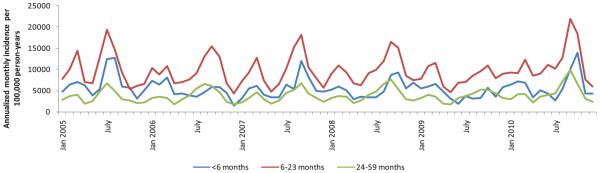
We identified 28,543 hospitalized ALRI cases from 2005 to 2010. Among the 49% with chest radiographs, 63% had findings consistent with pneumonia as identified by 2 study radiologists. The hospitalized ALRI incidence rate was 5772 per 100,000 child-years (95% confidence interval: 5707, 5837) and was higher in boys versus girls (incidence rate ratio 1.38, 95% confidence interval: 1.35–1.41) and in children 6–23 months of age versus other age groups (incidence rate ratio 1.76, 95% confidence interval: 1.69–1.84). Viruses most commonly detected in ALRI cases were respiratory syncytial virus (19.5%), rhinoviruses (18.7%), bocavirus (12.8%) and influenza viruses (8%). Compared with controls, ALRI cases were more likely to test positive for respiratory syncytial virus, influenza, adenovirus, human metapneumovirus and parainfluenza viruses 1 and 3 (P ≤ 0.01 for all). Bloodstream infections, most commonly Streptococcus pneumoniae and nontyphoidal Salmonella, accounted for 1.8% of cases.
Conclusions
Our findings underscore the high burden of hospitalization for ALRI and the importance of viral pathogens among children in Thailand. Interventions targeting viral pathogens coupled with improved diagnostic approaches, especially for bacteria, are critical for better understanding of ALRI etiology, prevention and control.
-
Subjects:
-
Source:Pediatr Infect Dis J. 33(2):e45-e52
-
Pubmed ID:24030346
-
Pubmed Central ID:PMC4667718
-
Document Type:
-
Funding:
-
Place as Subject:
-
Volume:33
-
Issue:2
-
Collection(s):
-
Main Document Checksum:urn:sha256:df7ccd49be7e192b8b22ce3fdce7f90a5950fadb49a7589eac719144ae637d12
-
Download URL:
-
File Type:
 [PDF
- 651.97 KB
]
[PDF
- 651.97 KB
]
Supporting Files


File Language:
English
ON THIS PAGE


CDC STACKS serves as an archival repository of CDC-published products including
scientific findings,
journal articles, guidelines, recommendations, or other public health information authored or
co-authored by CDC or funded partners.
As a repository, CDC STACKS retains documents in their original published format to ensure public access to scientific information.
As a repository, CDC STACKS retains documents in their original published format to ensure public access to scientific information.
You May Also Like
COLLECTION
CDC Public Access