


A heritable missense polymorphism in CDKN2A confers strong risk of childhood acute lymphoblastic leukemia and is preferentially selected during clonal evolution
Supporting Files

-
Nov 2 2015
-
Details
-
Alternative Title:Cancer Res
-
Personal Author:Walsh, Kyle M. ; de Smith, Adam J. ; Hansen, Helen M. ; Smirnov, Ivan V. ; Gonseth, Semira ; Endicott, Alyson A. ; Xiao, Jianqiao ; Rice, Terri ; Fu, Cecilia H. ; McCoy, Lucie S. ; Lachance, Daniel H. ; Eckel-Passow, Jeanette E. ; Wiencke, John K. ; Jenkins, Robert B. ; Wrensch, Margaret R. ; Ma, Xiaomei ; Metayer, Catherine ; Wiemels, Joseph L.
-
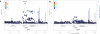
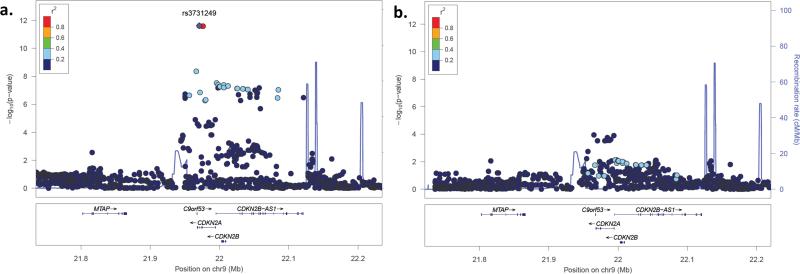
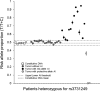
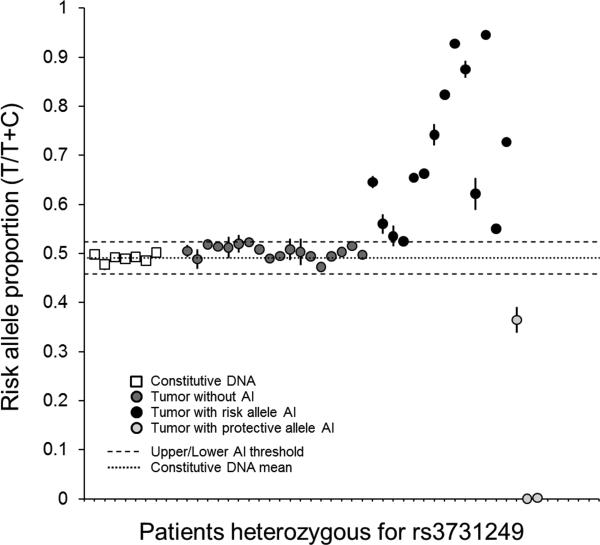
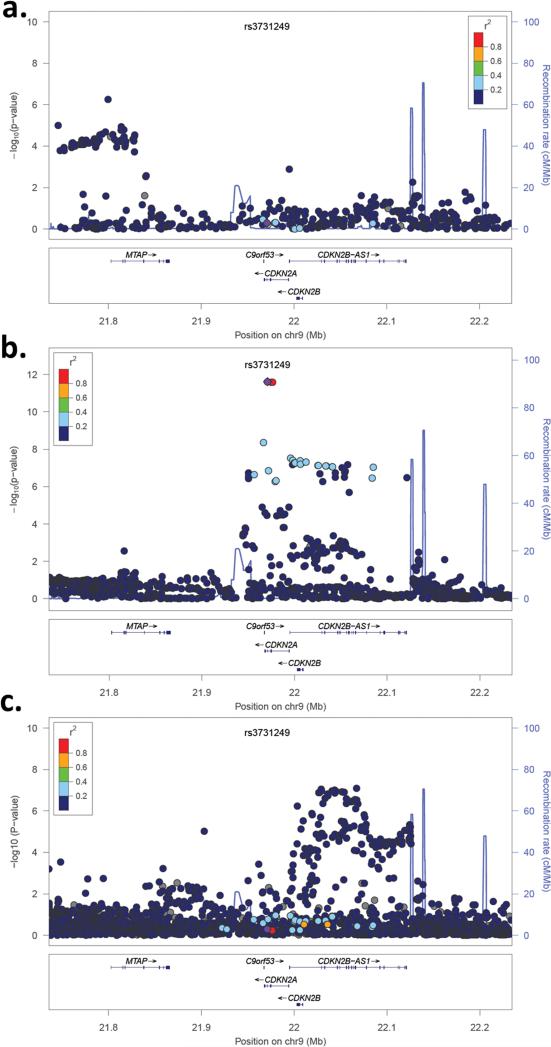
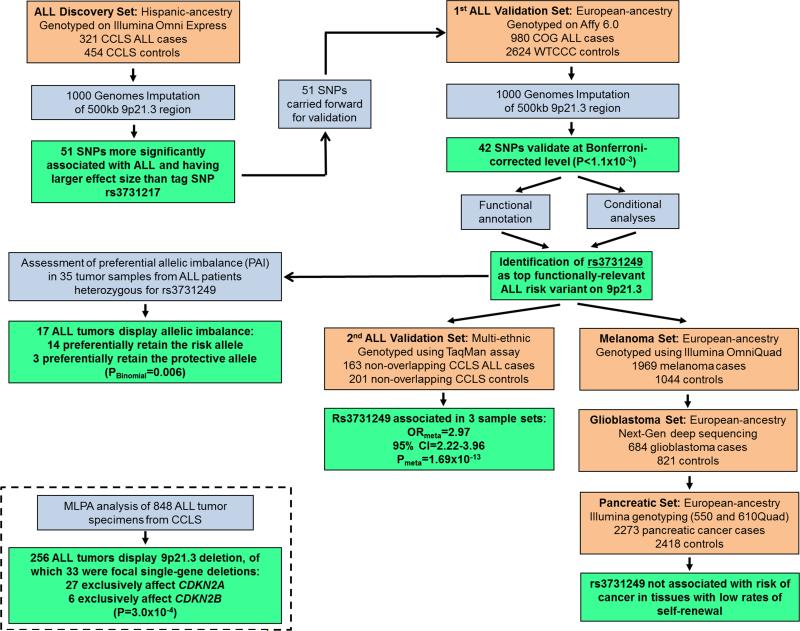
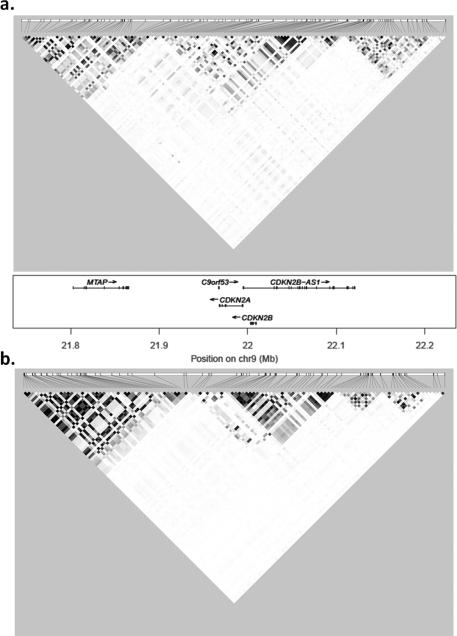
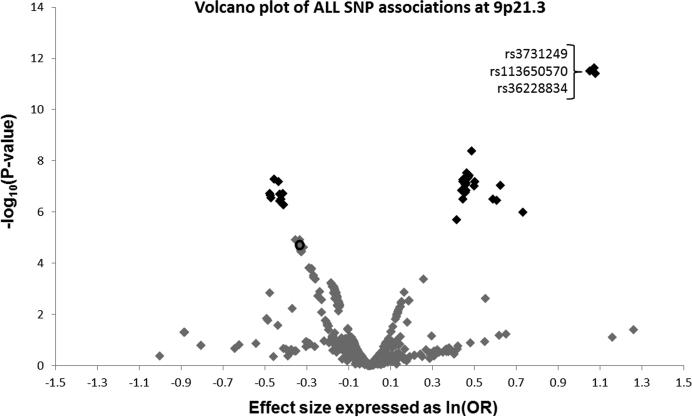
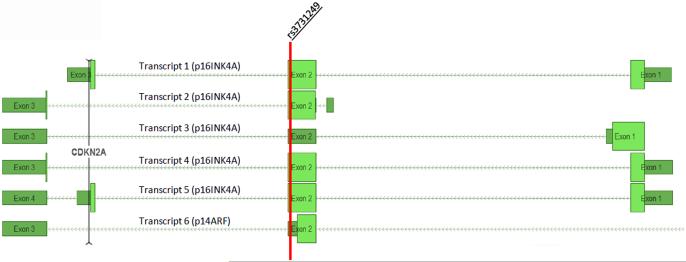
Description:Genome-wide association studies (GWAS) have identified SNPs in six genes that are associated with childhood acute lymphoblastic leukemia (ALL). A lead SNP was found to occur on chromosome 9p21.3, a region that is deleted in 30% of childhood ALLs, suggesting the presence of causal polymorphisms linked to ALL risk. We used SNP genotyping and imputation-based fine-mapping of a multiethnic ALL case-control population (Ncases = 1,464, Ncontrols = 3,279) to identify variants of large effect within 9p21.3. We identified a CDKN2A missense variant (rs3731249) with 2% allele frequency in controls that confers three-fold increased risk of ALL in children of European ancestry (OR, 2.99; P = 1.51 × 10(-9)) and Hispanic children (OR, 2.77; P = 3.78 × 10(-4)). Moreover, of 17 patients whose tumors displayed allelic imbalance at CDKN2A, 14 preferentially retained the risk allele and lost the protective allele (PBinomial = 0.006), suggesting that the risk allele provides a selective advantage during tumor growth. Notably, the CDKN2A variant was not significantly associated with melanoma, glioblastoma, or pancreatic cancer risk, implying that this polymorphism specifically confers ALL risk but not general cancer risk. Taken together, our findings demonstrate that coding polymorphisms of large effect can underlie GWAS "hits" and that inherited polymorphisms may undergo directional selection during clonal expansion of tumors.
-
Subjects:
-
Source:Cancer Res. 75(22):4884-4894.
-
Pubmed ID:26527286
-
Pubmed Central ID:PMC4651745
-
Document Type:
-
Funding:R01CA155461/CA/NCI NIH HHS/United States ; R21 CA158568/CA/NCI NIH HHS/United States ; P50 CA108961/CA/NCI NIH HHS/United States ; R01 CA133996/CA/NCI NIH HHS/United States ; P50 CA097007/CA/NCI NIH HHS/United States ; HHSN261201000035/CA/NCI NIH HHS/United States ; RC1 NS068222/NS/NINDS NIH HHS/United States ; R01 CA142665/CA/NCI NIH HHS/United States ; R25 CA112355/CA/NCI NIH HHS/United States ; R01 ES011740/ES/NIEHS NIH HHS/United States ; R37 CA036401/CA/NCI NIH HHS/United States ; U24 CA114766/CA/NCI NIH HHS/United States ; RC4 CA156449/CA/NCI NIH HHS/United States ; HHSN261201000034/CA/NCI NIH HHS/United States ; R01 CA140729/CA/NCI NIH HHS/United States ; P50 CA097257/CA/NCI NIH HHS/United States ; P30 CA021765/CA/NCI NIH HHS/United States ; R01 CA155461/CA/NCI NIH HHS/United States ; R25CA112355/CA/NCI NIH HHS/United States ; P01ES018172/ES/NIEHS NIH HHS/United States ; P01 ES018172/ES/NIEHS NIH HHS/United States ; P30 CA015083/CA/NCI NIH HHS/United States ; U10 CA098543/CA/NCI NIH HHS/United States ; R01ES09137/ES/NIEHS NIH HHS/United States ; U58 DP003862/DP/NCCDPHP CDC HHS/United States ; R01 CA036401/CA/NCI NIH HHS/United States ; R01 ES009137/ES/NIEHS NIH HHS/United States ; HHSN261201000140/CA/NCI NIH HHS/United States ; HHSN261201000035/PC,CA/None/None ; P50 CA093459/CA/NCI NIH HHS/United States ; U01 GM092666/GM/NIGMS NIH HHS/United States ; R01 CA052689/CA/NCI NIH HHS/United States
-
Volume:75
-
Issue:22
-
Collection(s):
-
Main Document Checksum:urn:sha256:20b0bc3ddfa4e4490116dc456f02fd7524adf4ad01a077d1b52a20f29cc9bc76
-
Download URL:
-
File Type:
 [PDF
- 1.71 MB
]
[PDF
- 1.71 MB
]
Supporting Files


ON THIS PAGE


CDC STACKS serves as an archival repository of CDC-published products including
scientific findings,
journal articles, guidelines, recommendations, or other public health information authored or
co-authored by CDC or funded partners.
As a repository, CDC STACKS retains documents in their original published format to ensure public access to scientific information.
As a repository, CDC STACKS retains documents in their original published format to ensure public access to scientific information.
You May Also Like
COLLECTION
CDC Public Access