



Arsenic exposure and hepatitis E virus infection during pregnancy
Supporting Files

-
10 2015 ; 10-2015
-
Available in CDC Stacks on October 01, 2016, 12:00 AM
File Language:
English
Details
-
Alternative Title:Environ Res
-
Personal Author:Heaney, Christopher D. ; Kmush, Brittany ; Navas-Acien, Ana ; Francesconi, Kevin ; Gössler, Walter ; Schulze, Kerry ; Fairweather, DeLisa ; Mehra, Sucheta ; Nelson, Kenrad E. ; Klein, Sabra L. ; Li, Wei ; Ali, Hasmot ; Shaikh, Saijuddin ; Merrill, Rebecca D. ; Wu, Lee ; West, Keith P. ; Christian, Parul ; Labrique, Alain B.
-
Description:Background
Arsenic has immunomodulatory properties and may have the potential to alter susceptibility to infection in humans.
Objectives
We aimed to assess the relation of arsenic exposure during pregnancy with immune function and hepatitis E virus (HEV) infection, defined as seroconversion during pregnancy and postpartum.
Methods
We assessed IgG seroconversion to HEV between 1st and 3rd trimester (TM) and 3 months postpartum (PP) among 1100 pregnancies in a multiple micronutrient supplementation trial in rural Bangladesh. Forty women seroconverted to HEV and were matched with 40 non-seroconverting women (controls) by age, parity and intervention. We assessed urinary inorganic arsenic plus methylated species (∑As) (µg/L) at 1st and 3rd TM and plasma cytokines (pg/mL) at 1st and 3rd TM and 3 months PP.
Results
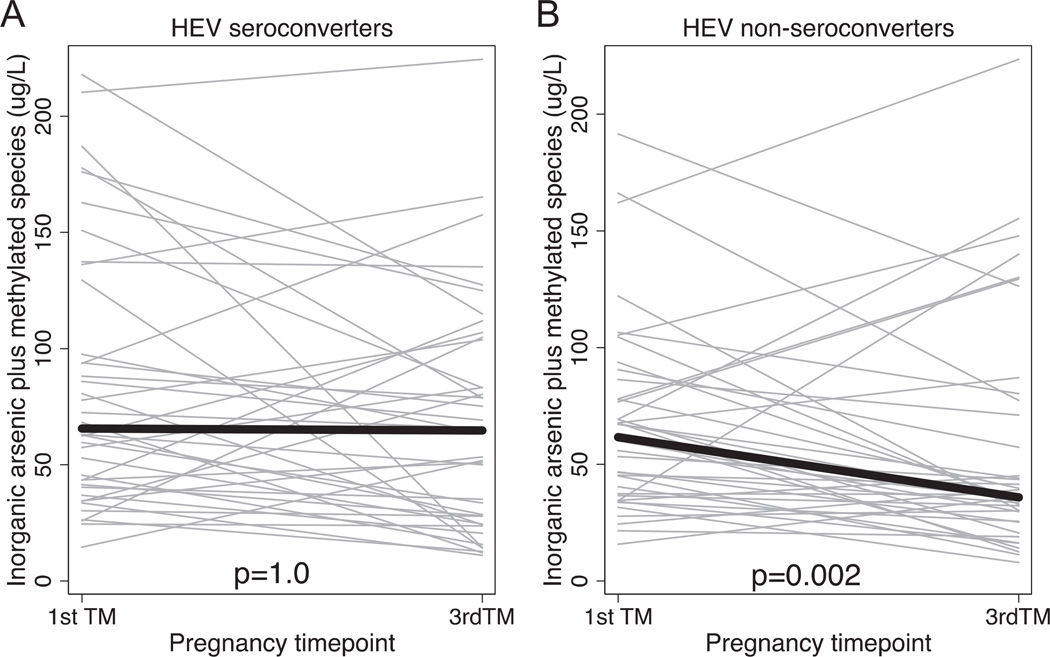
HEV seroconverters’ urinary ∑As was elevated throughout pregnancy. Non-seroconverters’ urinary ∑As was similar to HEV seroconverters at 1st TM but declined at 3rd TM. The adjusted odds ratio (95% confidence interval) of HEV seroconversion was 2.17 (1.07, 4.39) per interquartile range (IQR) increase in average-pregnancy urinary ∑As. Increased urinary ∑As was associated with increased concentrations of IL-2 during the 1st and 3rd TM and 3 months PP among HEV seroconverters but not non-seroconverters.
Conclusions
The relation of urinary arsenic during pregnancy with incident HEV seroconversion and with IL-2 levels among HEV-seroconverting pregnant women suggests arsenic exposure during pregnancy may enhance susceptibility to HEV infection. -
Subjects:
- Adolescent
- Adult
- Antibodies, Viral
- Arsenic
- Bangladesh
- Case-Control Studies
- Cytokines
- Disease Susceptibility
- Environmental Exposure
- Environmental Pollutants
- Female
- Hepatitis E
- Hepatitis E virus
- Humans
- Immunoglobulin G
- Pregnancy
- Pregnancy Trimester, First
- Pregnancy Trimester, Third
- Seroconversion
- Young Adult
-
Keywords:
-
Source:Environ Res. 142:273-280
-
Pubmed ID:26186135
-
Pubmed Central ID:PMC4609253
-
Document Type:
-
Funding:K01 OH010193/OH/NIOSH CDC HHSUnited States/ ; R56 AI068813/AI/NIAID NIH HHSUnited States/ ; R01HL111938/HL/NHLBI NIH HHSUnited States/ ; P30ES003819/ES/NIEHS NIH HHSUnited States/ ; R56 AI068813-01A2/AI/NIAID NIH HHSUnited States/ ; R01ES021367/ES/NIEHS NIH HHSUnited States/ ; R21 ES024414/ES/NIEHS NIH HHSUnited States/ ; 1K01OH010193-01A1/OH/NIOSH CDC HHSUnited States/ ; R01 HL111938/HL/NHLBI NIH HHSUnited States/ ; R01 ES021367/ES/NIEHS NIH HHSUnited States/ ; P30 ES003819/ES/NIEHS NIH HHSUnited States/
-
Volume:142
-
Download URL:
-
File Type:
 [PDF - 519.67 KB]
 -
Collection(s):
-
Main Document Checksum:urn:sha-512:8c13f01d898e8da8002927bbc2453bae3f153b25dfa843f41cc5bcd310322854a5eda3aec0c23c2aa29e50a87ee31db784c54a9540579d09dcc6dac404ab818b
Supporting Files


File Language:
English
 Was this page helpful?
 Found an issue?

CDC STACKS serves as an archival repository of CDC-published products including
scientific findings, journal articles, guidelines, recommendations, or other public health information authored or
co-authored by CDC or funded partners.
As a repository, CDC STACKS retains documents in their original published format to ensure public access to scientific information.
As a repository, CDC STACKS retains documents in their original published format to ensure public access to scientific information.
You May Also Like
COLLECTION
CDC Public Access