



Effectiveness of Automated Notification and Customer Service Call Centers for Timely and Accurate Reporting of Critical Values: A Laboratory Medicine Best Practices Systematic Review and Meta-Analysis
Supporting Files

-
2012/09/01
-
Available in CDC Stacks on 2015-07-29T00:00:00Z
File Language:
English
Details
-
Alternative Title:Clin Biochem
-
Personal Author:Liebow, Edward B. ; Derzon, James H. ; Fontanesi, John ; Favoretto, Alessandra M. ; Baetz, Rich Ann ; Shaw, Colleen ; Thompson, Pamela ; Mass, Diana ; Christenson, Robert ; Epner, Paul ; Snyder, Susan R.
-
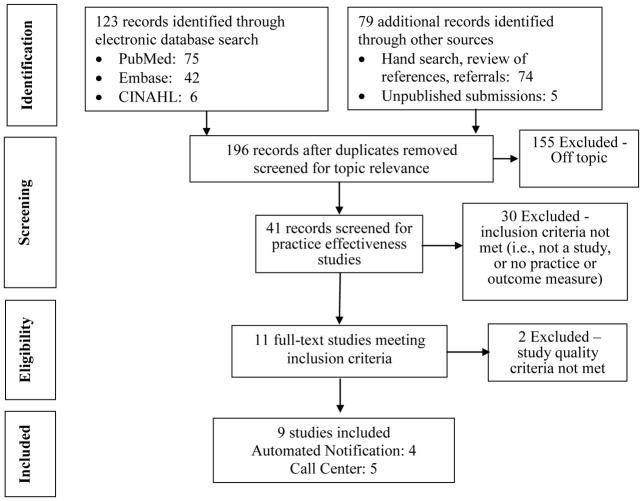
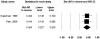
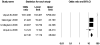
Description:Objective ; To conduct a systematic review of automatic notification methods and consider evidence-based recommendations for best practices in improving the timeliness and accuracy of critical value reporting. ; Results ; 196 bibliographic records were identified, with nine meeting review inclusion criteria. Four studies examined automated notification systems and five assessed call center performance. Average improvement from implementing automated notification systems is d = 0.42 (95% CI = 0.2 - 0.62) while the average odds ratio for call centers is OR = 22.1 (95% CI = 17.1 - 28.6). ; Conclusions ; The evidence, though suggestive, is not sufficient to make a recommendation for or against using automated notification systems as a best practice to improve the timeliness and accuracy of critical value reporting in an in-patient care setting. Call centers, however, are effective in improving the timeliness and accuracy of critical value reporting in an in-patient care setting, and are recommended as an "evidence-based best practice."
-
Keywords:
- Clinical laboratory information systems
- critical care methods
- hospital laboratory organization and administration
- medical laboratory personnel organization and administration
- Centers for Disease Control and Prevention, U.S.
- Databases, Factual
- Evidence-Based Practice
- Humans
- Information Systems
- Laboratories
- Odds Ratio
- Practice Guidelines as Topic
- Program Evaluation
- Quality Assurance, Health Care
- Time Factors
- United States
-
Source:Clin Biochem. 45(0):979-987
-
Pubmed ID:22750773
-
Pubmed Central ID:PMC4518392
-
Document Type:
-
Funding:
-
Genre:
-
Volume:45
-
Issue:0
-
Download URL:
-
File Type:
 [PDF - 1.00 MB]
 -
Collection(s):
-
Main Document Checksum:urn:sha-512:d3940cf452a0ed10db90f7cdc9e52ecb48dbed5954db8155194e9757361fd1433ec2828e80676b87a47e94fc3493d00303cb823e2f9591c414e3d2738d7bed6e
Supporting Files


File Language:
English
 Was this page helpful?
 Found an issue?







CDC STACKS serves as an archival repository of CDC-published products including
scientific findings, journal articles, guidelines, recommendations, or other public health information authored or
co-authored by CDC or funded partners.
As a repository, CDC STACKS retains documents in their original published format to ensure public access to scientific information.
As a repository, CDC STACKS retains documents in their original published format to ensure public access to scientific information.
You May Also Like
COLLECTION
CDC Public Access