



What does a Performance Measurement System Tell Us about the National Comprehensive Cancer Control Program?
Supporting Files

-
2015 ; Sep-Oct 2015
-
Available in CDC Stacks on September 01, 2016, 12:00 AM
File Language:
English
Details
-
Alternative Title:J Public Health Manag Pract
-
Personal Author:
-
Description:Context
The National Comprehensive Cancer Control Program (NCCCP) performance measurement system seeks to understand both the processes that funded programs undertake with their respective coalitions to implement the objectives of their cancer plans and outcomes of those efforts.
Objective
To identify areas of achievement and technical assistance needs of NCCCP awardees.
Design
Program performance was assessed through surveys completed by program directors on performance indicators in 2009 and 2010 and queries from a web-based management information system in 2011 and 2012.
Setting
Programs funded by CDC’s NCCCP.
Participants
69 programs.
Main Outcome Measure(s)
The key performance measures assessed were: inclusion of diverse partners and key sectors in cancer coalitions; partners’ involvement in activities; receiving in-kind resources from partners; using evidence-based interventions and data for setting priorities; conducting program evaluation; using community- or organization-level strategies to address cancer control efforts; and demonstrating progress toward achieving health outcomes.
Results
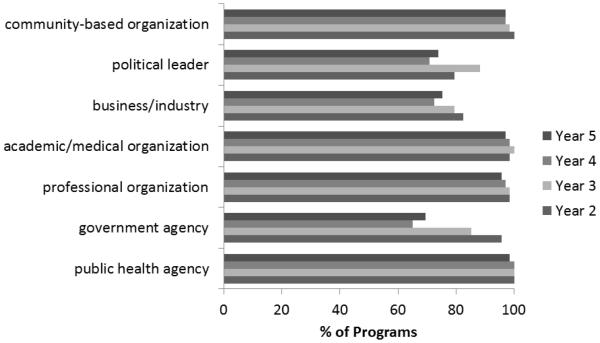
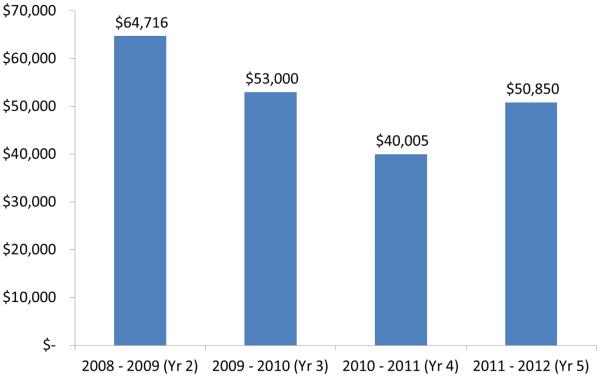
Most programs reported having active coalitions that represent diverse organizational sectors. Nearly all programs routinely assess the burden of cancer. In-kind resources to implement activities peaked at $64,716 in the second year of a five year funding cycle, and declined in subsequent project years. By year 3, over 70% of programs reported having an evaluation plan. While programs reported that nearly two-thirds of their interventions were evidence-based, some programs implemented non-evidence-based interventions. A majority of programs successfully used at least one community- or organization-level change strategy. However, many programs did not incorporate objectives linked to health outcomes as they reported progress in implementing interventions. Conclusions: While NCCCP programs were strong at building and maintaining infrastructure, some programs may need additional technical assistance to increase the adoption of evidence-based interventions, develop solid and responsive evaluation plans, and better link efforts to population-based measures that demonstrate impact toward reducing the burden of cancer. -
Subjects:
-
Keywords:
-
Source:J Public Health Manag Pract. 21(5):449-458
-
Pubmed ID:25136936
-
Pubmed Central ID:PMC4374017
-
Document Type:
-
Funding:
-
Volume:21
-
Issue:5
-
Download URL:
-
File Type:
 [PDF - 427.73 KB]
 -
Collection(s):
-
Main Document Checksum:urn:sha256:fba5a9f7afe1c517100a6008087f77f7f549d86a8f2be4249ccb819feae27344
Supporting Files


File Language:
English
 Was this page helpful?
 Found an issue?

CDC STACKS serves as an archival repository of CDC-published products including
scientific findings, journal articles, guidelines, recommendations, or other public health information authored or
co-authored by CDC or funded partners.
As a repository, CDC STACKS retains documents in their original published format to ensure public access to scientific information.
As a repository, CDC STACKS retains documents in their original published format to ensure public access to scientific information.
You May Also Like
COLLECTION
CDC Public Access