



Clinical evolution of beta cell function in youth with diabetes: the SEARCH for Diabetes in Youth study
Supporting Files

-
12 2012 ; 12-2012
-
Available in CDC Stacks on 2015-07-06T00:00:00Z
File Language:
English
Details
-
Alternative Title:Diabetologia
-
Personal Author:Dabelea, D. ; Mayer-Davis, E. J. ; Andrews, J. S. ; Dolan, L. M. ; Pihoker, C. ; Hamman, R. F. ; Greenbaum, C. ; Marcovina, S. ; Fujimoto, W. ; Linder, B. ; Imperatore, G. ; D’Agostino, R.
-
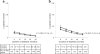
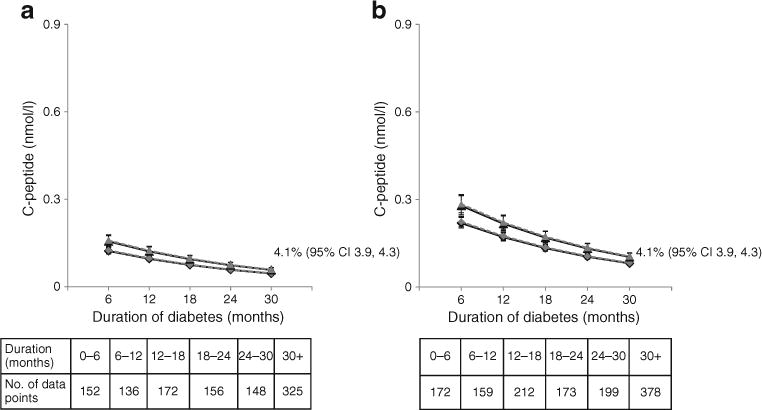
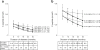
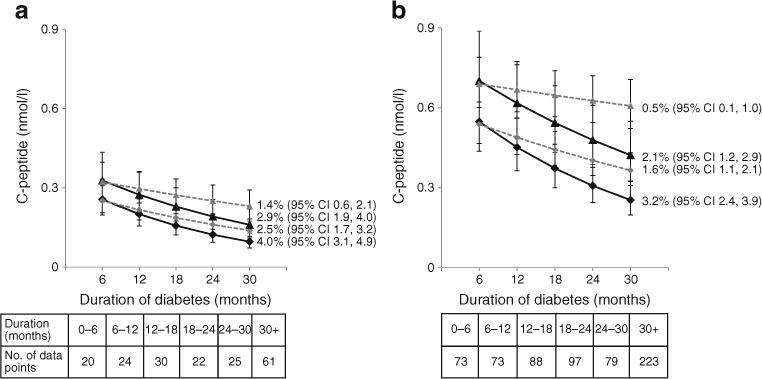
Description:Aims/hypothesis ; Few studies have explored the epidemiology of beta cell loss in youth with diabetes. This report describes the evolution and major determinants of beta cell function, assessed by fasting C-peptide (FCP), in the SEARCH for Diabetes in Youth study. ; Methods ; Participants were 1,277 youth with diabetes (948 positive for diabetes autoantibodies DAs and 329 negative for DAs), diagnosed when aged <20 years, who were followed from a median of 8 months post diagnosis, for approximately 30 months. We modelled the relationship between rate of change in log FCP and determinants of interest using repeated measures general linear models. ; Results ; Among DA-positive youth, there was a progressive decline in beta cell function of 4% per month, independent of demographics (age, sex, race/ethnicity), genetic susceptibility to autoimmunity (HLA risk), HbA1c and BMI z score, or presence of insulin resistance. Among DA-negative youth, there was marked heterogeneity in beta cell loss, reflecting an aetiologically mixed group. This group likely includes youths with undetected autoimmunity (whose decline is similar to that of DA-positive youth) and youth with non-autoimmune, insulin-resistant diabetes, with limited decline (~0.7% per month). ; Conclusions/interpretation ; SEARCH provides unique estimates of beta cell function decline in a large sample of youth with diabetes, indicating that autoimmunity is the major contributor. These data contribute to a better understanding of clinical evolution of beta cell function in youth with diabetes, provide strong support for the aetiological classification of diabetes type and may inform tertiary prevention efforts targeted at high-risk groups.
-
Keywords:
- Beta cell function
- Decline
- Determinants
- Epidemiology
- Type 1 diabetes
- Type 2 diabetes
- Youth
- Adolescent
- Age of Onset
- Autoantibodies
- Biomarkers
- Body Mass Index
- C-Peptide
- Child
- Diabetes Mellitus, Type 1
- Diabetes Mellitus, Type 2
- Disease Progression
- Fasting
- Female
- Glycated Hemoglobin
- Humans
- Insulin Resistance
- Insulin-Secreting Cells
- Male
- Predictive Value of Tests
- Risk Factors
- United States
-
Source:Diabetologia. 2012; 55(12):3359-3368
-
Pubmed ID:22990715
-
Pubmed Central ID:PMC4492685
-
Document Type:
-
Funding:P30 DK057516/DK/NIDDK NIH HHSUnited States/ ; U01 DP000245/DP/NCCDPHP CDC HHSUnited States/ ; M01 RR000069/RR/NCRR NIH HHSUnited States/ ; U18DP002708-01/DP/NCCDPHP CDC HHSUnited States/ ; U18 DP002714/DP/NCCDPHP CDC HHSUnited States/ ; U01 DP000248/DP/NCCDPHP CDC HHSUnited States/ ; U01 DP000244/DP/NCCDPHP CDC HHSUnited States/ ; U18DP002710-01/DP/NCCDPHP CDC HHSUnited States/ ; U01 DP000250/DP/NCCDPHP CDC HHSUnited States/ ; HIR 10-001/HX/HSRD VAUnited States/ ; 1U18DP002709/DP/NCCDPHP CDC HHSUnited States/ ; M01RR00037/RR/NCRR NIH HHSUnited States/ ; U01 DP000247/DP/NCCDPHP CDC HHSUnited States/ ; U18 DP003256/DP/NCCDPHP CDC HHSUnited States/ ; U18 DP002710/DP/NCCDPHP CDC HHSUnited States/ ; U18DP002714/DP/NCCDPHP CDC HHSUnited States/ ; 1UL1RR026314-01)./RR/NCRR NIH HHSUnited States/ ; NIH P30 DK57516/DK/NIDDK NIH HHSUnited States/ ; M01 RR000037/RR/NCRR NIH HHSUnited States/ ; U18DP000247-06A1/DP/NCCDPHP CDC HHSUnited States/ ; UL1 RR029882/RR/NCRR NIH HHSUnited States/ ; M01 RR00069/RR/NCRR NIH HHSUnited States/ ; U18 DP002709/DP/NCCDPHP CDC HHSUnited States/ ; U01 DP000246/DP/NCCDPHP CDC HHSUnited States/ ; U01 DP000254/DP/NCCDPHP CDC HHSUnited States/ ; UL1 RR026314/RR/NCRR NIH HHSUnited States/ ; U18 DP002708/DP/NCCDPHP CDC HHSUnited States/ ; UL1RR029882/RR/NCRR NIH HHSUnited States/
-
Volume:55
-
Issue:12
-
Download URL:
-
File Type:
 [PDF - 254.00 KB]
 -
Collection(s):
-
Main Document Checksum:urn:sha256:985e68381d979d837f620d1cae92e24b40f02e8b02ed044d3c4c5ffa2ad5c9d7
Supporting Files


File Language:
English
 Was this page helpful?
 Found an issue?

CDC STACKS serves as an archival repository of CDC-published products including
scientific findings, journal articles, guidelines, recommendations, or other public health information authored or
co-authored by CDC or funded partners.
As a repository, CDC STACKS retains documents in their original published format to ensure public access to scientific information.
As a repository, CDC STACKS retains documents in their original published format to ensure public access to scientific information.
You May Also Like
COLLECTION
CDC Public Access