


Left Truncation, Susceptibility, and Bias in Occupational Cohort Studies
Supporting Files

-
7 2011
File Language:
English
Details
-
Alternative Title:Epidemiology
-
Personal Author:
-
Description:Background
Left truncation occurs when subjects who otherwise meet entry criteria do not remain observable for a later start of follow-up. We investigated left truncation in occupational studies due to inclusion of workers hired before the start of follow-up in a simulation study.
Methods
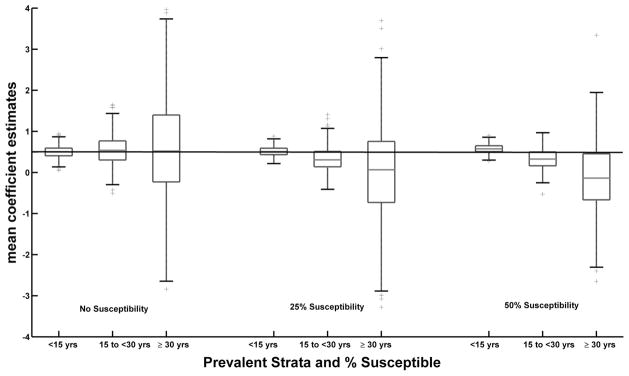
Using Monte Carlo methods, we simulated null and positive associations between exposure (work duration) and mortality for 500 datasets of 5000 subjects, assuming the absence and presence of heterogeneity in susceptibility to disease and to the effect of exposure. We examined incident hires (followed since hire) and left-truncated prevalent hires (those hired before baseline and remained employed at baseline). We estimated the association ( β^1∗) as the mean slope using Cox proportional hazards with a linear term for exposure, under scenarios with and without susceptibility.
Results
With homogeneous susceptibility, there were no differences between incident and prevalent hires. Introducing only disease susceptibility did not change results. However, with heterogeneous susceptibility to the effect of exposure, downward bias was observed among prevalent hires under both the true null and positive exposure-response scenarios. The bias increased with time between hire and baseline (null: β^1∗=0.05[SD=0.08],β^1∗=-0.08[SD=0.24],β^1∗=-0.18[SD=0.98] if hired <15, 15 to <30, and ≥30 years before baseline, respectively), coincident with a decreasing percentage of susceptible subjects.
-
Subjects:
-
Source:Epidemiology. 2011; 22(4):599-606
-
Pubmed ID:21543985
-
Pubmed Central ID:PMC4153398
-
Document Type:
-
Funding:
-
Volume:22
-
Issue:4
-
Collection(s):
-
Main Document Checksum:urn:sha256:8b4a7aa8afe91c0f1f40b89581429b10bf2aae258645fdfb60d8b3a1f13cf521
-
Download URL:
-
File Type:
 [PDF
- 329.96 KB
]
[PDF
- 329.96 KB
]
Supporting Files


File Language:
English
ON THIS PAGE


CDC STACKS serves as an archival repository of CDC-published products including
scientific findings,
journal articles, guidelines, recommendations, or other public health information authored or
co-authored by CDC or funded partners.
As a repository, CDC STACKS retains documents in their original published format to ensure public access to scientific information.
As a repository, CDC STACKS retains documents in their original published format to ensure public access to scientific information.
You May Also Like
COLLECTION
CDC Public Access